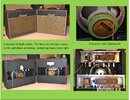
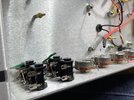
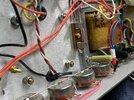
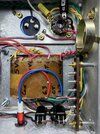
New amp build finally started. JTM45 with KT66.

I have another Greg Germino amp here this morning for a retube. Seems like the hot weather - and all the businesses being able to host outdoor events - is kinda tough on these tubesters...sitting in direct sunlight without a fan and all.

Ok, so I have been following this build, and others, and I am really tempted to try my hand at a 45 watt build.

It's a bit unsettling because I know my tendency to go down the rabbit hole on these projects, which is a huge distraction to my goal of 3-4 hours of practice everyday before the sun comes up.

If I do build a kit, I do know for certain that I want to add an FX loop so I can run the amp near wide open and control volume in the loop.

How feasible is this in a 45 watt British kit???
 
I know that people have put effects loops in older Marshall’s. Don‘t know how, but it can be done.

I can‘t recommend any kits. For the price of a kit and being limited to the components included, I found it not very much more expensive to source everything individually. That also opened up another can of worms as most layouts and kit instructions do not accurately match the schematics.

My build is requiring much more head scratching and thinking things through, than if I just bought a Mojo or MetroAmp kit. But that is the route I wanted to go, so I could better understand what is going on inside my amps.
 
Last edited:
If I do build a kit, I do know for certain that I want to add an FX loop so I can run the amp near wide open and control volume in the loop.

How feasible is this in a 45 watt British kit???
Very feasible... No need to worry. Build the core of a properly working amp first. Then come back and add the fx loop.

My build is requiring much more head scratching and thinking things through, than if I just bought a Mojo or MetroAmp kit.
Unfortunately MetroAmps stopped offering amp kits about 10 years ago. But fortunately Valvestorm.com was created in response to no more MetroAmp kits.

Also, having an experienced vendor like Valvestorm, Mojotone, Weber, Stewmac, Allen Amps, Ceriatone, and now V2 Amps... will greatly reduce the massive headaches that will be associated with sourcing the parts yourself. Especially if you're a newbie.

Mojo makes a great kit with good drawings and step by step.
AFAIK, yes they do, even though I don't have personal experience with Mojo's amp kits. Stewmac got into the amp kit business just a very few years ago, but their instructions seem to be top notched too. The old MetroAmp instructions are well done and still available for download too.
 
Look at this!!!

 
Look at this!!!

Interesting but... If I'm not mistaken, the built-in fx loop in this A-B box will only place your effects at the front of the amp. A real fx loop bypasses the gain and tone shaping circuit and injects its responding signal right before the phase inverter or power circuit... which is what you want!
 
Ok,

So last night, I plugged into my band mate's Germino Lead 55 full stack and played around with it. (As a side note, he is now using a DSL40C for rehearsal as is #2 guitarist, despite having vintage tube Marshall heads available)

If you like AC/DC tone from the "High Voltage" era, this 4-holer definitely delivers that. However, that tone is not really versatile in a band with an eclectic mix of songs.

I couldn't get any really decent gain structure until it was screaming loud, and even then, it wasn't really dirty at all....just loud.

This volume level simply doesn't work on a small stage and I am not sure that I could attenuate it down enough to blend it in.

If all I needed was a raw, Angus Youn tone, this amp would be the right choice. But high volume doesn't even produce a fraction of the gain I can get from a DSL40C without pushing insane volume levels.

I also couldn't get enough punch from the Lead 55's on board EQ stack to really get the same percussive speaker movement that i am able to get with the DSL40C.

It's a good tone, but its very much AC/DC-ish and totally dependent on high volume levels to attain. The amp is also very unstable at those volume levels, to such an extent that I really had to fight it to keep it from feeding back.

If you watch Gary Moore's Cold Day In Hell Live 1992, you can see him rolling the volume off after playing each passage, in an effort just to control the amp at these high stage volumes.

This experience is making me question whether or not I could really use an 18 or 45 watt kit for my live performances...
 
Can someone explain the key differences between how the early hardwired amps tone structure is created and what changed when the JCM800 was introduced???
 
I think that I’ll stop here tonight. I’m not really happy with the ground rail across the pots, and I’m too knackered from work and lack of sleep to deal with it. I’ll probably pull it tomorrow night, sand the pots some more, and try again.
Your soldering looks damn good. Why aren't you happy with the pots ground rail?

I noticed you went with PEC pots. I'm betting it wasn't very easy to solder onto the back of those stainless steel cases.
 
Your soldering looks damn good. Why aren't you happy with the pots ground rail?

I noticed you went with PEC pots. I'm betting it wasn't very easy to solder onto the back of those stainless steel cases.

It is easy if you have a temp controlled soldering station.
Use a big tip, make sure the metal is clean first.

But for PEC pots
disassemble the pot first, treat the track inside with G100 / D100, reassemble, then solder it in.

The lubrication in those pots goes bad after a certain number of years.
The pot should really have a cleaning hole with a plug to seal it.
But overall, those are the best pots I think. I just need to lube them first with some better stuff than the factory uses.
 
Can someone explain the key differences between how the early hardwired amps tone structure is created and what changed when the JCM800 was introduced???
Early amp is:
gain stage > compression stage V2>tone stack> Phase inverter> power tubes.
Later amp is:
gain stage>gain stage>compression stage V2>tone stack>phase inverter>power tubes.

It's just taking the original design, combining the 2 gain stages of the first tube.
That's what an 800 is, a modified Plexi. There is almost no other difference besides stacking the 2 gain stages together.
In other words, a JTM45 or Plexi can be changed to an 800 rather easily.

Then the master volume was added at the end, but that is very simple also.
In fact an attenuator or Fluxtone speaker would be better than a master volume.....
The master volume always suffers tone-suck when the loudness is lowered.

The JTM45 / Plexi is power tube distortion. Clean preamp.
The 800 is preamp distortion. The extra gain stage makes the preamp distort.

One thing I would do different is use a steel chassis. Aluminum tends to oxidize fast.
 
Back
Top