I Was Once Known As 'El Extremo' - My Not-So-New Motorcycle Saga:

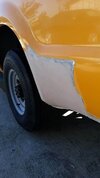
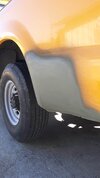
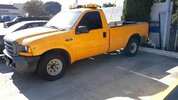
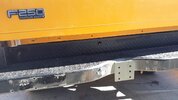
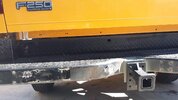
2" wide, yellow/black stripe reflectorized tape will run across the face of the bumper after repainting. Visibility is critical down here. I drove from 1981 until 2016 without a crash.

Between 2016 and now, I've been rear ended twice...
 
Nice body work there Robert !

I grew up learning the art of sheet metal repair from my Dad in his restoration/custom shop. One of the first lessons was how to repair panels without using polyester filler, or "Bondo" as it is called. This process involves hammering the metal smooth with a dolly and then raising the low spots, while reducing the high spots. Low temperature shrinking is one method. You heat the panel until it just starts to turn straw colored (that's a light gold color) then quench the area with a rag dipped in hot water. This will shrink the metal without damaging its structure, pulling high spots down. This technique was used frequently with the older car's from the 1920's-1940's that had very, very thick sheet metal and it has become a lost art.

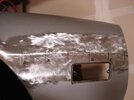
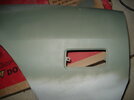
Here is a fender from a 1975 Pontiac Firebird that was flattened right along the body line. I straightened it without any bondo at all.


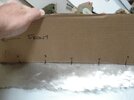
Cardboard templates were made on the good fender, then reversed for the right front gender.
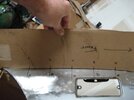
Alignment marks ensure measurements are taken at the correct locations.
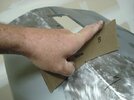
I restored the crown by hammering from the backside with a section of 1/2 galvanized pipe:

RF No Bondo.jpg

Checking to see how the crown is coming back. Note the "low spot" between letters 'B' and 'D.'

Fender Crown.jpg

Getting better...

Body Line Contour Restored RF.jpg

Almost there:

Template B.jpg

Repair is complete and zero 'Bondo' was used:

Sheet Metal Updates 001.jpg

The drawback is this method is very time consuming and can only be done on the older cars using very thick sheet metal panels.
With newer cars, using high strength sheet metals, it's a lot harder to get the panel perfectly straight, because the sheet metal tends to crack
when you hammer it too much.

In those cases, polyester filler (Bondo) is useful and reliable if the surface is properly prepared and the thickness of the filler is held to less than .100" or so.

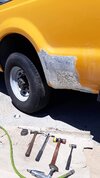
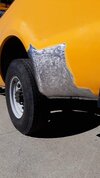
Sometimes, you have to repair a rusted area. Generally, a lot of guys "fix" this with Bondo, which never lasts. I prefer to cut a "jigsaw puzzle piece" from mild steel and spot-weld it into place.
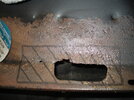
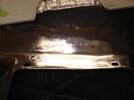
By keeping heat down to a minimum, I can usually perform this repair without using any Bondo, as show below on the rusted out cowling of a Camaro. This is the area at the bottom of the windshield:

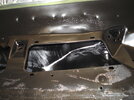
I begin by cutting out the rusted area surgically:

Sheet Metal Updates 004.jpg

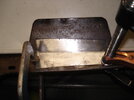
Then, I hand-form a "puzzle piece" to fit precisely into the hole:

& Gas Gauge 002.jpg

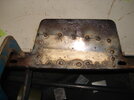
Small spot-welds keep heat to a minimum. Eventually, you will add more spot welds until they all look
like figure '8's so that there is - in effect - a continuous weld:

& Gas Gauge 003.jpg

After polishing, the puzzle piece is invisible and the welded area is water-tight:

& Gas Gauge 005.jpg

Self-etching primer is used to prepare the bare metal for the correct satin black used by the factory.
The finished product doesn't look too bad:

& Gas Gauge 007.jpg

Also, you have to consider that I did this welded patch panel in my garage at home...
 
I have been known to "come out of retirement" a few times over the years... :)

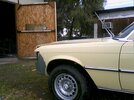
Back in 2006, my Son was involved in a crash in his 1978 Mercedes 300SD. Of course, the insurance company wanted to total the car because of it's age and the fact that it had over 1 million (documented) miles on it. He asked me to help him fix it.

It was hit pretty hard:
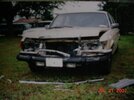
April 21 2006 Collision.jpg

The core support - which mounts the radiator and headlamps - was destroyed and would have to be cut out.
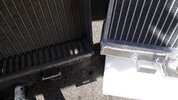
The radiator and A/C condesor were shoved into the engine, shearing off a 19mm solid steel water pump shaft:
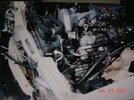
Core Support.jpg

The aluminum hood was turned into a taco. Aluminum panels are the hardest to work. You need special plastic and wooden tools
to be able to reshape the aluminum without cracking it. I used a combination of wooden and plastic tools, plus added metterial to the
hood with low temperature aluminum brazing rod and oxy-acy torch with a super fine tip.

The hood looked nice when it was finally finished. It's shown here after being painted on top a trash can in Mom's pasture:
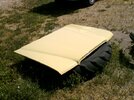
Hood Repaired.jpg

Since I was doing this at Mom & Pop's Ranch, so I used the very best in dark-ages equipment. A come-along
was attached to a china-berry tree I planted when I was 8 years old. This allowed me to pull out some of
the damage to the inner fender skirts, before cutting out the entire core support:
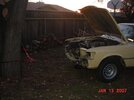
Shade Tree.jpg

At this point, the hood aligns well with the fenders and the damage has been pulled out in the opposite direction
of the impact - This is a crucial step. You CANNOT pound a raise area down - It MUST be pulled out.
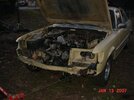
Pulling Damage.jpg

Believe it or not, MBZ of Fresno had a brand new core support on the shelf for $480.00. It was spot welded in place
and painted to match. headlamps were found at Pik-N-Pull Wreckers in Fresno, along with a good used radiator, fan,
A/C condesnor, oil cooler and other parts:
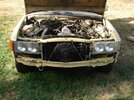
Core Support Installed.jpg

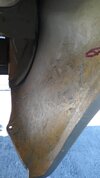
The bumper pushed in the leading edge of the left front fender below the left headlight:
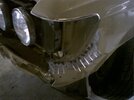
Spot Welded Pins.jpg

Pins were spot-welded on to allow the area to be pulled out with a special puller:

Pulling Damaged Fender.jpg

Ready for paint:

Fender Repaired.jpg

The weekends-only work schedule, (I was working as a police officer full-time) and the many trips to the wrecking
yard to find the obsolete parts, meant the project would take a full two years to complete.

The car looked really good when it was finished. I was able to match the paint and everything but the core support
was just used, 'junkyard' parts that we restored, cleaned, and painted.
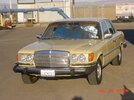

First Run July 20, 2009.jpg
 
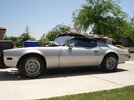
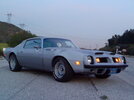
Here's my old Firebird, whose front fender I repaired in the first set of images above:

Formula LS View.jpg

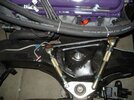
I built my own, fully adjustable upper control arms. Cadium plating courtesy of Commercial Electro Plating
in Fresno, california:

RH Side SHORT Sleeve Rear LONG Sleeve Front.jpg

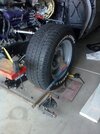
I performed my own precision front end alignments on a 1940's J.H. bender Alignment Machine from Dad's hot rod shop:

JH Bender Toe Bar.jpg

Accurate to 1/2 degree. Most front end alignment specifications are from 1 degree positive to 1 degree negative. BMW and Mercedes have the widest alignment variations.
They cannot ever be aligned properly, because there is insufficient adjustment built into the car. These old cars, however, can be dialed into near perfection.

RF 4 One Half Degree Positive Caster.jpg

This was a very fast car when it was completed. 413 CID Pontiac with a 4 speed: It is now owned by a city council member in Napa, California:

DSC00209.JPG
 
Back
Top