Line Out Mod

ez bake was for your entertainment. But not the actual error in the drawing.

LMAO, ok then.

I thought maybe you found a fatal flaw, and my poor old JTM 45 was being jeopardized!
You see the error?
Not many people see that.

I, of course don't see it, but haven't had a chance to look.

Well, I'm getting back to a few things workwise, thanks gentlemen.

I think my plan at this stage is to use the Weber Mini-Mass schematic, and connect my line out how they have done theirs, unless of course AMS or Ivan direct me otherwise.

I have no stash of electrical parts (so far.....) my plan is to order from Antique Electronics, they are in the same state as me.

So I'll wait a few days and see what the experts have to say, and follow their professional opinions.

Thanks again @Amp Mad Scientist and @ivan H , it really is appreciated.
 
LMAO, ok then.

I thought maybe you found a fatal flaw, and my poor old JTM 45 was being jeopardized!


I, of course don't see it, but haven't had a chance to look.

Well, I'm getting back to a few things workwise, thanks gentlemen.

I think my plan at this stage is to use the Weber Mini-Mass schematic, and connect my line out how they have done theirs, unless of course AMS or Ivan direct me otherwise.

I have no stash of electrical parts (so far.....) my plan is to order from Antique Electronics, they are in the same state as me.

So I'll wait a few days and see what the experts have to say, and follow their professional opinions.

Thanks again @Amp Mad Scientist and @ivan H , it really is appreciated.

It's an error in the drawing only. There's a mistake on the schematic.
The mistake is not installed in the power brake.
 
This is a more preferable arrangement than using a non adjustable voltage divider. With the Weber units that feature a non adjustable line out, people often find that the line out signal is too hot for the input of whatever they are interfacing it with (overdrives it). As such, Weber offers a seperate Line Level Volume Control unit ($36.77) that plugs between the two (between the attenuator's line out & whatever you're interfacing it with's input).
If using a fixed (non adjustable) voltage divider, there is a very simple way to reduce the amplitude of the line out's signal (turn the volume down) & that is to alter the resistor values used, while still keeping the voltage divider's total resistance roughly the same.
Example; the MiniMass uses a 10k resistor & a 4k7 resistor is series for the voltage divider network. We could use a 12k in place of the 10k & a 2k7 in place of the 4k7, thus "turning it down" some.
Cheers
 
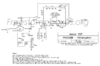
Fun Time Bio Lock-down Quiz: Can anybody spot the mistake in this schematic?

View attachment 45289
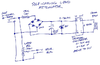
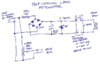
I see that Amp Mad Scientist's quiz has not yet been answered (& I thought I threw a good hint out there), so for comparison purposes & to aid in finding the answer, here's the handrawn schematic of a small, DIY L-pad type attenuator that features the same type circuitry as the incorrectly draw segment, only this one is correctly drawn & doesn't need to be "rectified" (same hint, emphasized).1593206213430843414543736192659.png
Cheers
 
I see that Amp Mad Scientist's quiz has not yet been answered (& I thought I threw a good hint out there), so for comparison purposes & to aid in finding the answer, here's the handrawn schematic of a small, DIY L-pad type attenuator that features the same type circuitry as the incorrectly draw segment, only this one is correctly drawn & doesn't need to be "rectified" (same hint, emphasized).View attachment 45376
Cheers
Rectifier is grounded properly on this schematic?
 
Rectifier is grounded properly on this schematic?
It's much more than just the rectifier's grounding. In the incorrectly drawn schematic, the connections to the rectifier need to be swapped around, ie, the AC source connections need to be where the fan's DC power supply are & vice versa (though correct polarity needs to be ensured with the fans DC supply, positive taken off the diode cathodes & negative off the diode anodes).
We have to think how a diode "works" to understand the error. A diode will only let current flow in one direction.
Applying an AC voltage to the anode of a diode, only the positive half cycles flow in the cathode.
Alternately, applying an AC voltage to the cathode of a diode, only the negative half cycles flow in the anode.
So to use a bridge rectifier, each side or half of the AC supply needs to be connected to the rectifier where both an anode & cathode are joined together.
The DC "negative" is then taken off the rectifier where two anodes meet together, while the DC "positive" is taken off the rectifier where two cathodes meet together.
I hope I've explained this in a way that is understandable. Cheers
 
I see that Amp Mad Scientist's quiz has not yet been answered (& I thought I threw a good hint out there), so for comparison purposes & to aid in finding the answer, here's the handrawn schematic of a small, DIY L-pad type attenuator that features the same type circuitry as the incorrectly draw segment, only this one is correctly drawn & doesn't need to be "rectified" (same hint, emphasized).View attachment 45376
Cheers

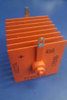
No once-through water cooling?
1593230819813.png

Selenium anyone?

1593230965757.png
 
Thank you so much my friend, it really is appreciated.

Also thanks for your gift of knowledge and the gift of time, I would like to make it quite clear how grateful I am to have a resource such as yourself.

I'm looking at ordering the parts tonight, should have them by Monday or Tuesday, will start and then hit you up after I think I have it together.

If you ever find yourself in Arizona, I would love to buy you a nice dinner and a couple of drinks! You have a standing invitation with me!

Peace
Thanks again
Steve.
 
I see that Amp Mad Scientist's quiz has not yet been answered (& I thought I threw a good hint out there), so for comparison purposes & to aid in finding the answer, here's the handrawn schematic of a small, DIY L-pad type attenuator that features the same type circuitry as the incorrectly draw segment, only this one is correctly drawn & doesn't need to be "rectified" (same hint, emphasized).View attachment 45376
Cheers
Mr. Ivan,

Thank you for your time and attention, you really have no idea how much your lessons mean to me.

I will be ordering my parts tonight, the build will be what our buddy @Mad Amp Scientist has suggested. Later next week I will post what I have ready for you and AMS to approve.

Like I told AMS, you have a standing invitation for dinner and drinks if you find yourself in Arizona!

Just want to make perfectly clear how I do not take your time and experience for granted, taking your valuable time for me is very much appreciated!

Thanks again

Peace
Steve
 
Mr. Ivan,

Thank you for your time and attention, you really have no idea how much your lessons mean to me.

I will be ordering my parts tonight, the build will be what our buddy @Mad Amp Scientist has suggested. Later next week I will post what I have ready for you and AMS to approve.

Like I told AMS, you have a standing invitation for dinner and drinks if you find yourself in Arizona!

Just want to make perfectly clear how I do not take your time and experience for granted, taking your valuable time for me is very much appreciated!

Thanks again

Peace
Steve

It's not me, I copied it off the Weber attenuator.

1593233617563.png
 
Yes
the rectifier on the Marshall schematic is drawn wrong.

The rectifier on this schematic is drawn correctly.
And so, we are privileged to have Mr. Ivan drawing the schematics.

View attachment 45425
I didn't draw this one up. I was going to just re-draw the Marshall power brake's rectifier & cooling fan supply, but this (taken off the net) saved me having to. But thanks for the kind words.
Cheers
 
I didn't draw this one up. I was going to just re-draw the Marshall power brake's rectifier & cooling fan supply, but this (taken off the net) saved me having to. But thanks for the kind words.
Cheers

Now what about some of those cool direct box transformers, to derive a line out signal from a speaker level signal?
I thought somebody mentioned those a little while ago...
 
Back
Top