NAD

Sprague was purchased by Vishay Canada.
But they still make a lot of old style caps.
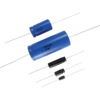
As you can see, the outside foil is clearly marked on every decoupling capacitor.

ARS
Not used in any Marshall Laney Hiwatt as far as I have seen. Unless somebody installed them.
Really cheap capacitors from China. No specification sheet. Like, the cheapest parts from China ever made.
Sold by an electronics supply "ARS" in California.
I bought some and tried them, they suck. Worse than "Illinois Capacitor," which is made in China too.

We used to buy a lot of parts from ARS in the 70s-80s. They used to sell tubes and other parts.

Looking into it, the Vishay Sprague Atom capacitors were at first manufactured in Indonesia, but Vishay later moved the manufacture of all "leaded" components to China (where the greatest bulk of Vishay components are manufactured). Vishay also own Cornell Dublier & all Cornell Dublier components, including the CD electrolytics are manufactured in China. Vishay own numerous manufacturing plants (passives, semiconductors etc etc), all over mainland China & Hong Kong. Vishay is an American corporation (global headquarters Malvern PA), not Canadian.

The ARS capacitors were stock equipment in the Marshall SPL JH (Jimi Hendrix) & also I believe the HW (hardwired) series amps, to name a couple.
Watford Valves in the UK are a supplier of ARS capacitors (& Vishay Sprague Atom). Their site list Marshall, Laney & Hiwatt as using these ARS capacitors in (some of) their amps. Further, they claim the ARS capacitors were made to replicate the UK made LCR capacitors that UK amp manufactures had used (before LCR went out of production), but with better specifications & a longer service life of 3,000 hours.
Given that Marshall's designers & tech staff had the opportunity to use any electrolytic filter capacitors available when producing their "top of the line" JH & HW models, the fact that they specified the ARS capacitors be used would seem to indicate they thought them the most suitable.
Now I may be wrong, but I'm guessing those Marshall staffers have just a little more combined knowledge, experience & know-how than you do when it comes to ascertaining whether a component is a quality choice for a this application, or whether it "sucks".
Illinois Capacitor were OEM for Peavey amps. They don't seem to have any problems with premature filter cap failure or any other problem pertaining to them. Cheers
 
Last edited:
Looking into it, the Vishay Sprague Atom capacitors were at first manufactured in Indonesia, but Vishay later moved the manufacture of all "leaded" components to China (where the greatest bulk of Vishay components are manufactured). Vishay also own Cornell Dublier & all Cornell Dublier components, including the CD electrolytics are manufactured in China. Vishay own numerous manufacturing plants (passives, semiconductors etc etc), all over mainland China & Hong Kong. Vishay is an American corporation (global headquarters Malvern PA), not Canadian.

The ARS capacitors were stock equipment in the Marshall SPL JH (Jimi Hendrix) & also I believe the HW (hardwired) series amps, to name a couple.
Watford Valves in the UK are a supplier of ARS capacitors (& Vishay Sprague Atom). Their site list Marshall, Laney & Hiwatt as using these ARS capacitors in (some of) their amps. Further, they claim the ARS capacitors were made to replicate the UK made LCR capacitors that UK amp manufactures had used (before LCR went out of production), but with better specifications & a longer service life of 3,000 hours.
Given that Marshall's designers & tech staff had the opportunity to use any electrolytic filter capacitors available when producing their "top of the line" JH & HW models, the fact that they specified the ARS capacitors be used would seem to indicate they thought them the most suitable.
Now I may be wrong, but I'm guessing those Marshall staffers have just a little more combined knowledge, experience & know-how than you do when it comes to ascertaining whether a component is a quality choice for a this application, or whether it "sucks".
Illinois Capacitor were OEM for Peavey amps. They don't seem to have any problems with premature filter cap failure or any other problem pertaining to them. Cheers

I ordered some ARS caps.
They were really inexpensive, but Fromel was using them, so I decided to give it a try.
Maybe not the same ones you are using?
But they had no data sheet for the "500 volt, 105C" according to ARS. The ones I bought didn't really have an hour rating that I could find.
I guess I didn't like those, subjective.

We see a lot of Illinois Capacitor fails in Fender amps. I think those caps were rated 2000 hour at 85C.
They used those in HRD, Blues Jr. etc.
I change those to F&T whenever I get the chance.
I thought F&T sounded better but that was subjective.
I usually don't use Illinois, for some reason to me they just don't sound that great. Subjective.

So far, the ones that sound the best to me is F&T. That is, out of all the ones we tried so far. (5000 hour at 85C) Subjective.

I asked Laura Martin at Vishay to help explain the history / origins...I was curious to find out.

Orange Drop History & Timeline

In the 1960s, capacitors began to be developed using more modern materials like mylar. During this time, Sprague Electric introduced the 'Orange Drop' capacitor, and it was quickly adopted by many industries due to its robustness and performance.

1960s: The 'Orange Drop' capacitor was developed by Sprague Electric.

1992: Vishay, a leading manufacturer of components used in electronics for industrial and military/space application, acquires 'Orange Drops' from Sprague. SBE Inc (dba SB Electronics) takes over production of Orange Drops as Vishay/Sprague.
2012: Cornell Dubilier Capacitor (CDE) acquires 'Orange Drops' from SBE.
Current: All Orange Drop Caps manufactured today are by Cornell Dubilier Capacitor (CDE).
 
Last edited:
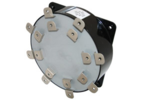
1592320934117.png It's called a "Power Ring" Capacitor. A new thing developed by Vishay SBE.
Supposedly
SBE’s Power Ring film capacitors demonstrate ESR values as low as 0.15 mOhm for a 1000µF – 600V DC Link. This is the industry’s lowest ESR value.

 
Last edited:
Back
Top