
You are using an out of date browser. It may not display this or other websites correctly.
You should upgrade or use an alternative browser.
You should upgrade or use an alternative browser.
NAD
- Thread starter LRT
- Start date

mcblink
Ambassador of Riffs & Spliffs
Heathkit Model WA-P2 Preamplifier (1957)
antiqueradio.org

ivan H
Ambassador of Tubes & Grooves

Great score LRT, & good job finding the pre-amp info Mcblink. Please don't power it up before replacing at least the electrolytic filter capacitors, it would be a shame to have one go off & spew impossible to remove caustic poop all over, plus they go off with a hell of a bang. Cheers

OP

LRT
Well-Known Member

Had no plan to power it up till I had enough info and the part to go through it. I will have questions when I get ready to work it over.Great score LRT, & good job finding the pre-amp info Mcblink. Please don't power it up before replacing at least the electrolytic filter capacitors, it would be a shame to have one go off & spew impossible to remove causticall over, plus they go off with a hell of a bang. Cheers
ivan H
Ambassador of Tubes & Grooves
Questions are good, you can never ask too many in this type situation. CheersHad no plan to power it up till I had enough info and the part to go through it. I will have questions when I get ready to work it over.
OP
LRT
Well-Known Member
Well to start whats a good brand for capacitors?Questions are good, you can never ask too many in this type situation. Cheers
I'd like for it to be as close to original as possible yet have proper operation.
ivan H
Ambassador of Tubes & Grooves
I'm supposing that you mean electrolytic capacitors, in which case;Well to start whats a good brand for capacitors?
I'd like for it to be as close to original as possible yet have proper operation.
(1) Sprague Atom. Mouser stated (around 2009) that the Sprague capacitors were still US made, whether this is still the case I couldn't say.
(2) F&T. A German made type, F&T have been manufacturing capacitors for over 60 yrs.
(3) ARS. I haven't looked into where they're manufactured, but they are used by Marshall, Hiwatt & Laney to name a few. I use these in my Marshall type builds.
I've used all of the above with no problems & all have given good service.
JJ (the tube manufacturer) also make electrolytic capacitors. I've not used them but know others who have.
You'll also need to replace the filter capacitors in the power amp (most important). Hope this helps. Cheers
Edit:
When ordering the electrolytic capacitors you may not find the exact value & voltage. Rule of thumb is to go to the closest (new "standardized") value. Example, old 20uf would be new 22uf, or old 50uf would be new 47uf. With the voltage rating rule of thumb is if the old voltage rating isn't available always go to the next "higher" voltage rating, but common sense must also prevail here. If you have any questions regarding this when ordering don't hesitate to ask, there's several here who will answer.
In the meantime, you could check the value of all the carbon comp type resistors. These are notorious for drifting (& absorbing moisture).
When the filters have been replaced & it's possible to power up you can then check the coupling caps for DC leakage. Cheers
Last edited:


Nice score LRT 

syscokid
Ambassador of War & Peace
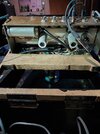
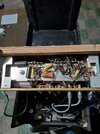
Yes yes… Everything Ivan has posted. If you plan on using this amp, pleze replace and save the old electrolytic caps. I see at least one e-cap in your pic of the main board. Then there's that massive can of multi-E-caps I see in your first pic. A replacement for that is going to severely limit your choices. What's the values on it?Well to start whats a good brand for capacitors?
I'd like for it to be as close to original as possible yet have proper operation.
ivan H
Ambassador of Tubes & Grooves
Good catch Sysco. Looking first at the power amp chassis pic in post #4, I can see a couple of electrolytic caps. A cardboard cylinder type near the power transformer & a metal can type to the left of the tubes. The metal can cap looks like it may be a "snap in" type. (I can't make out if the cardboard cap is the same). Then looking at the pre-amp chassis pic in post #22 we see a sideways mounted metal can cap that again looks like a "snap in" type. (Note there's no mounting bracket clamp around the base).Then there's that massive can of multi-E-caps I see in your first pic. A replacement for that is going to severely limit your choices. What's the values on it?
Snap in type cans are available (ARS, JJ), but as far as I know only single cap cans, & values are somewhat limited.
If you can let us know whether they are multi-cap cans or not & what values they are?? Cheers


Amp Mad Scientist
Ambassador of Heresy
Mono Hi Fi, Late 50s- early 60s, Heathkit audio amp.
6SN7 phase inverter tubes.
Probably 6L6 / 5881 output tubes.
"Roll-off" Turnover, refers to the equalization curve of the phono preamp.
I know this may sound weird.
But music used to come on vinyl disks. The vibrations of the music were scratched into the vinyl. (cave-man like scratches)
This was called a "phonograph."
The phonograph required EQ to facilitate playback.
But people sat around and argued over which EQ should be used. Hence, multiple EQ selections depending on the recording.
At the end of the argument, "RIAA" Equalization took over the world.
But only for a while, then 8 track tapes were invented.
Last edited:
Amp Mad Scientist
Ambassador of Heresy
I'm supposing that you mean electrolytic capacitors, in which case;
(1) Sprague Atom. Mouser stated (around 2009) that the Sprague capacitors were still US made, whether this is still the case I couldn't say.
(2) F&T. A German made type, F&T have been manufacturing capacitors for over 60 yrs.
(3) ARS. I haven't looked into where they're manufactured, but they are used by Marshall, Hiwatt & Laney to name a few. I use these in my Marshall type builds.
I've used all of the above with no problems & all have given good service.
JJ (the tube manufacturer) also make electrolytic capacitors. I've not used them but know others who have.
You'll also need to replace the filter capacitors in the power amp (most important). Hope this helps. Cheers
Edit:
When ordering the electrolytic capacitors you may not find the exact value & voltage. Rule of thumb is to go to the closest (new "standardized") value. Example, old 20uf would be new 22uf, or old 50uf would be new 47uf. With the voltage rating rule of thumb is if the old voltage rating isn't available always go to the next "higher" voltage rating, but common sense must also prevail here. If you have any questions regarding this when ordering don't hesitate to ask, there's several here who will answer.
In the meantime, you could check the value of all the carbon comp type resistors. These are notorious for drifting (& absorbing moisture).
When the filters have been replaced & it's possible to power up you can then check the coupling caps for DC leakage. Cheers
Sprague was purchased by Vishay Canada.
But they still make a lot of old style caps.
As you can see, the outside foil is clearly marked on every decoupling capacitor.
ARS
Not used in any Marshall Laney Hiwatt as far as I have seen. Unless somebody installed them.
Really cheap capacitors from China. No specification sheet. Like, the cheapest parts from China ever made.
Sold by an electronics supply "ARS" in California.
I bought some and tried them, they suck. Worse than "Illinois Capacitor," which is made in China too.
We used to buy a lot of parts from ARS in the 70s-80s. They used to sell tubes and other parts.
ARS Electronics Since 1947 - Home Page - Electron Tubes - Amp Tubes - RF Heating Tubes - Broadcast Transmitter Tubes
ARS Electronics Wholesale Electron Tube Distributor Since 1947, replacement new transmitter tubes and rebuilt transmitter tubes , replacement industrial microwave and magnetron tubes, tubes for radio frequency (rf) heating including rf plastic heating, rf vinyl sealing, rf welder also audio...
www.arselectronics.com
Last edited:
Amp Mad Scientist
Ambassador of Heresy
Well to start whats a good brand for capacitors?
I'd like for it to be as close to original as possible yet have proper operation.
You will not find close to original.
You will need to substitute and adapt newer style caps.
You don't need original style caps to get proper operation.
Last edited: