You are using an out of date browser. It may not display this or other websites correctly.
You should upgrade or use an alternative browser.
You should upgrade or use an alternative browser.
Marshall Style 1987 Build, Which Choke?
- Thread starter Cadorman
- Start date
OP

Cadorman
Ambassador of the Catocaster

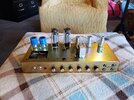
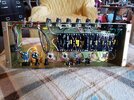
I'm so effing close I can't stand it. The output transformer should be on the way. Hopefully I can swing the power tranny in a couple of weeks. I just need to wire those in and add the resistors to the power tube sockets and I should be done. Can't wait to try it out.

syscokid
Ambassador of War & Peace
That double sucks!!No, I ordered it from Triode. The part number is 40-18025. No one has it in stock.
syscokid
Ambassador of War & Peace
How about this one from AES?No one has it in stock.
Transformer - Marshall Replacement, Output, 50 W | Antique Electronic Supply
Great for upgrading later issue Marshall™ amps. Good replacement for JMP and JCM 800s.
The EIA code matches up with Magnetic Components!!!!

ninjaking67
Ambassador of Good Will

This is looking great!
I am really looking forward to seeing and hearing it finished.
I am really looking forward to seeing and hearing it finished.


OP
Cadorman
Ambassador of the Catocaster
Now I won't be able to sleep tonight.SOLDERING!!!!!!!!!!!!!!!!!!!!!!!!!!!!!!!!!!!!!!!!!!!!!!!!!
View attachment 42817

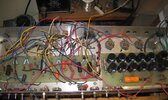
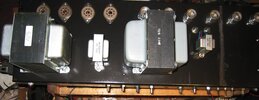
syscokid
Ambassador of War & Peace
I'll have my spaghetti with the Momma's Marinara Sauce, please....


ivan H
Ambassador of Tubes & Grooves

I know what it's like wanting to get the build happening, but I gotta agree with Mr Plexi67 here. By wiring the board in already you've possibly made a few things harder to accomplish. My approach is usually to first install the valve sockets & wire the heaters. Next, transformers & choke fitted. The PT primary is wired first, followed by the PT's high voltage secondary/rectifier/HT fuse/main filter circuit. You'll still be able to do this easily & neatly, the next step might be harder to properly accomplish. This would be the OT primary & secondary wiring. These need to be seperated (primary & secondary), twisted & properly routed for best output stage performance. This could prove to be difficult to do well with the board already in place.
A couple of tips:
The input jack wiring needs the green wires shortened & tidied up. This is a very sensitive area of the amp & it's easy to introduce instability & noise. You want the input wiring to look like this
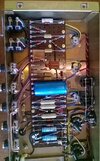
Marshall (& many other manufacturers of the time) didn't choose the best layout for the input wiring in the first place, don't make it worse than it needs to be.
NFB loop wiring. I see you've chosen to take the negative feedback off the speaker jack socket (red wire,,, should be purple if following Marshall colour code). This again is a very sensitive area of the amp & instability/parasitic oscillation can easily be introduced by poor lead dress. If you look at the pic above you'll see I've twisted the purple NFB lead (taken off 8 ohm impedance tap) with the OT secondary leads & it connects neatly to the board almost right above where the OT secondary leads pass under the board. It doesn't "have" to be done like this, but you "do" want the wire to be relatively short with no excess length looping around. Don't shorten it "too" much though, you may need to move it around some to prevent instability when the volume & presence controls are turned up high.
Following good lead dress practices make for a quiet & healthy amp. Shoot for something like this (my JTM50 build) when completed
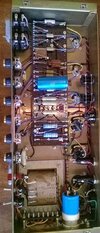
Use zip ties in place of the lacing. Hope this is of help. Cheers
A couple of tips:
The input jack wiring needs the green wires shortened & tidied up. This is a very sensitive area of the amp & it's easy to introduce instability & noise. You want the input wiring to look like this
Marshall (& many other manufacturers of the time) didn't choose the best layout for the input wiring in the first place, don't make it worse than it needs to be.
NFB loop wiring. I see you've chosen to take the negative feedback off the speaker jack socket (red wire,,, should be purple if following Marshall colour code). This again is a very sensitive area of the amp & instability/parasitic oscillation can easily be introduced by poor lead dress. If you look at the pic above you'll see I've twisted the purple NFB lead (taken off 8 ohm impedance tap) with the OT secondary leads & it connects neatly to the board almost right above where the OT secondary leads pass under the board. It doesn't "have" to be done like this, but you "do" want the wire to be relatively short with no excess length looping around. Don't shorten it "too" much though, you may need to move it around some to prevent instability when the volume & presence controls are turned up high.
Following good lead dress practices make for a quiet & healthy amp. Shoot for something like this (my JTM50 build) when completed
Use zip ties in place of the lacing. Hope this is of help. Cheers
Last edited:
OP
Cadorman
Ambassador of the Catocaster
Just an FYI the aerospace wire doesn't play nicely. Unless you tie it up (which I haven't done yet) it goes where it wants. The jacket is nearly impervious to a soldering iron, but it is extremely stiff.I know what it's like wanting to get the build happening, but I gotta agree with Mr Plexi67 here. By wiring the board in already you've possibly made a few things harder to accomplish. My approach is usually to first install the valve sockets & wire the heaters. Next, transformers & choke fitted. The PT primary is wired first, followed by the PT's high voltage secondary/rectifier/HT fuse/main filter circuit. You'll still be able to do this easily & neatly, the next step might be harder to properly accomplish. This would be the OT primary & secondary wiring. These need to be seperated (primary & secondary), twisted & properly routed for best output stage performance. This could prove to be difficult to do well with the board already in place.
A couple of tips:
The input jack wiring needs the green wires shortened & tidied up. This is a very sensitive area of the amp & it's easy to introduce instability & noise. You want the input wiring to look like this
View attachment 42944
Marshall (& many other manufacturers of the time) didn't choose the best layout for the input wiring in the first place, don't make it worse than it needs to be.
NFB loop wiring. I see you've chosen to take the negative feedback off the speaker jack socket (red wire,,, should be purple if following Marshall colour code). This again is a very sensitive area of the amp & instability/parasitic oscillation can easily be introduced by poor lead dress. If you look at the pic above you'll see I've twisted the purple NFB lead (taken off 8 ohm impedance tap) with the OT secondary leads & it connects neatly to the board almost right above where the OT secondary leads pass under the board. It doesn't "have" to be done like this, but you "do" want the wire to be relatively short with no excess length looping around. Don't shorten it "too" much though, you may need to move it around some to prevent instability when the volume & presence controls are turned up high.
Following good lead dress practices make for a quiet & healthy amp. Shoot for something like this (my JTM50 build) when completed
View attachment 42955
Use zip ties in place of the lacing. Hope this is of help. Cheers
I examined my future moves before installing the board and decided I could handle the transformers after the fact.
Purple wire was on backorder.
I wired the NFB to the speaker jack because that's what the Metro diagram shows. Is there a better way? I can move it.
ivan H
Ambassador of Tubes & Grooves
I like the pre-tinned 600V rated 22AWG Topcoat wire (Valvestorm stocks it), though I also have the same in the non-tinned variety. I have used the cloth covered (both stranded & solid) copper wire, but it is harder to do a neat job with (I imagine much like the wire you've used). Simply shorten the input wires as much as possible & the NFB wire as much as is practical.Just an FYI the aerospace wire doesn't play nicely. Unless you tie it up (which I haven't done yet) it goes where it wants. The jacket is nearly impervious to a soldering iron, but it is extremely stiff.
I examined my future moves before installing the board and decided I could handle the transformers after the fact.
Purple wire was on backorder.
I wired the NFB to the speaker jack because that's what the Metro diagram shows. Is there a better way? I can move it.
Regarding the NFB, Marshall did it both off the speaker output jack socket & off the impedance selector. By taking it off the speaker jack socket, the amount of feedback taken is dependent on the impedance of the cab used (impedance selected at selector switch). If your using a 16 ohm cab the amp is taking a lot of negative feedback. With an 8 ohm cab it's taking a good bit less & with a 4 ohm cab even less.
By wiring the NFB to the impedance selector switch you get to choose which tap, & thus how much negative feedback the amp takes, constantly, regardless of where the impedance selector is set (& what impedance cab is used).
The amount of negative feedback taken can be a personal preference thing as it affects, (among other things like damping, power stage gain etc, etc) how dirty the power stage gets & how it "feels". For a 50 Watter, if the V2a cathode is bypassed (0.68uf capacitor), the feedback is taken off the 8 ohm tap at the impedance selector & a 47k series resistor is used (the resistor that the feedback lead is connected to on the board).
If the V2a cathode is not bypassed, normally the 8 ohm tap along with a 100k series resistor, though many like to use the 4 ohm tap/100k resistor like is done in 100 Watters (more dirt, looser feel). Hope this helps. Cheers
Edit:
As you have the V2a cathode bypassed with the 0.68uf capacitor, the 8ohm tap (at selector switch) & 47k series resistor would normally be used.
Personally, I would recommend not using a metal oxide type as the 47k NFB series resistor, rather a carbon film or even a carbon comp type. A 1/2 watt resistor is fine. Cheers
Last edited:

Amp Mad Scientist
Ambassador of Heresy
Just an FYI the aerospace wire doesn't play nicely. Unless you tie it up (which I haven't done yet) it goes where it wants. The jacket is nearly impervious to a soldering iron, but it is extremely stiff.
I examined my future moves before installing the board and decided I could handle the transformers after the fact.
Purple wire was on backorder.
I wired the NFB to the speaker jack because that's what the Metro diagram shows. Is there a better way? I can move it.
Purple wire is necessary for sustain. It's my favorite color wire.
I can not ever understand why purple was so unfairly replaced by violet?
I just disconnect the NFB permanently and go from there. The NFB spoils what I try to achieve.
syscokid
Ambassador of War & Peace
You forgot to mention that purple wire reduces shrillness much more than violet wire in an overly bright amp...Purple wire is necessary for sustain. It's my favorite color wire.
I can not ever understand why purple was so unfairly replaced by violet?