OP


The one at the end of the board by the presence pot.
Wouldn't read at anything under my 20M scale. Im reading .210 on the 20M scale...

The one at the end of the board by the presence pot.

That must be 210k which would be correct.Wouldn't read at anything under my 20M scale. Im reading .210 on the 20M scale...
That's a 12AU7. It will hold up just fine in the amp, but when Cap'n Kirk wants warp 10 Scotty is only gonna be able to give him 3.
Make sure you set the bias after swapping the power tubes around.
V1 and V2 are supplying the gain and tone controls. V3 is the inverter. Really not sure how it affects the overall sound structure.
I put the old Russian El34 tubes in that had 464VDC and the amp sounded fuller and cleaner, if that makes any sense????
This is when you have to let go of the OCD. Most amps only have 1 bias pot. You already have your plate voltage of 464 volts, so you will want to set the bias for 33-39ish ma depending on how hot you want to go. I would shoot for 36 and recheck the plate voltage. I use a VHT bias meter, so not exactly sure which pins you need to probe and does the amp have 1 ohm resistors on the power tube groungs?I can't figure out how to measure the bias, let alone change it.
My DSL40C'S have 2 pots. This has only one.
How do i work with only one bias pot???
Where do i measure Mv???

Those are 2 or 3 watt carbon comp voltage dropping resistors. Both are grey-red-red-silver banded: 8.2k with 10% tolerance each.And while you are at it what is the resistance on those 2 chocolate brown resistors just right of the bias pot?
Those are 2 or 3 watt carbon comp voltage dropping resistors. Both are grey-red-red-silver banded: 8.2k with 10% tolerance each.
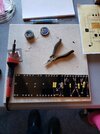
So there's 3 possible combinations with those resistor values: 16.4k... 18.2k... and 20k. It depends on much voltage you want to drop from the main B+ voltage to the PI circuit. At least it will be easy to swap out those resistors and tune to your liking. You may or may not notice a difference.View attachment 39331
I just started populating my JMP50 board yesterday, so this is a rather convenient opportunity to see what the pros are doing. I'm finding schematics with 2 8.2k, 2 10k or one of each. No consistency it seems. Thanks for your resistor marking knowledge!
Cool. I'm going 16.4k for now.So there's 3 possible combinations with those resistor values: 16.4k... 18.2k... and 20k. It depends on much voltage you want to drop from the main B+ voltage to the PI circuit. At least it will be easy to swap out those resistors and tune to your liking. You may or may not notice a difference.
This is when you have to let go of the OCD. Most amps only have 1 bias pot. You already have your plate voltage of 464 volts, so you will want to set the bias for 33-39ish ma depending on how hot you want to go. I would shoot for 36 and recheck the plate voltage. I use a VHT bias meter, so not exactly sure which pins you need to probe and does the amp have 1 ohm resistors on the power tube groungs?
Send AMS a message. I'm sure he can tell you which pins to probe. I'm pretty sure you will need a 1 ohm/1 watt resistor as well if they aren't already installed on the power tube ground. As far as only having 1 pot, you read both tubes and split the difference.Ya, i am not sure how to bias this one...