You are using an out of date browser. It may not display this or other websites correctly.
You should upgrade or use an alternative browser.
You should upgrade or use an alternative browser.
Marshall 2203 Negative Feedback Tap
- Thread starter Cadorman
- Start date
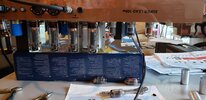

ivan H
Ambassador of Tubes & Grooves

A quick question, are you using "lead free" solder? I won't use it, only the old 60/40 (tin/lead) rosin cored. I find the lead free stuff doesn't "take" well, requiring the use of a non acid flux to help it take properly. Looking at your V1 pic, we can see that pins 6 & 7, possibly 5 (heater) & also possibly 9 (heater CT, I can't see it properly) have not taken well. If pin 9 hasn't taken properly the heaters won't light up. If pin 9 has & pin 5 hasn't, only half the heater will light up. I've got into the practice of pre tinning all valve socket pins before fitting the sockets to the chassis. We don't know how long they've been sitting in a parts bin collecting grime & oxidising. Can make a good solder job hard to do unless pre tinned. When it "takes" the solder to flows onto the pin & flattens, no blobbing which shows it hasn't taken properly.View attachment 37774
Okay. Here is V1. I have 6.1 volts across pins 4 and 9. The tube won't light. Already swapped out a couple. Sysco, Ivan H do you see anything? It looks right to me and V2 and V3 are okay.
Sysco beat me to the other two points. Best to heatshrink the end of shielded cable to keep the braid from possible unwanted contact. If the excess wire off pin 4 is contacting the sockets mounting nut the heater won't light.
I've also experienced one tube of a new set (new production) exhibit such a phenomenon. Appeared to bias up fine, run a signal through the amp & one tube ran away, red plating. Shut amp down, all "metered" fine. A new quad in & all good. After enquiring as to the suppliers testing procedures I no longer use that supplier.
Try first removing solder from suspect V1 pins then reflow. A good, fine pointed pair a of side cutters is a must. Hopefully it'll be up & running properly soon. Cheers
Last edited:
OP

Cadorman
Ambassador of the Catocaster

I only allow the best Kester 60/40 poison in the house.A quick question, are you using "lead free" solder? I won't use it, only the old 60/40 (tin/lead) rosin cored. I find the lead free stuff doesn't "take" well, requiring the use of a non acid flux to help it take properly. Looking at your V1 pic, we can see that pins 6 & 7, possibly 5 (heater) & also possibly 9 (heater CT, I can't see it properly) have not taken well. If pin 9 hasn't taken properly the heaters won't light up. If pin 9 has & pin 5 hasn't, only half the heater will light up. I've got into the practice of pre tinning all valve socket pins before fitting the sockets to the chassis. We don't know how long they've been sitting in a parts bin collecting grime & oxidising. Can make a good solder job hard to do unless pre tinned. When it "takes" the solder to flows onto the pin & flattens, no blobbing which shows it hasn't taken properly.
Sysco beat me to the other two points. Best to heatshrink the end of shielded cable to keep the braid from possible unwanted contact. If the excess wire off pin 4 is contacting the sockets mounting nut the heater won't light.
I've also experienced one tube of a new set (new production) exhibit such a phenomenon. Appeared to bias up fine, run a signal through the amp & one tube run away, red plating. Shut amp down, all "metered" fine. A new quad in & all good. After enquiring as to the suppliers testing procedures I no longer use that supplier.
Try first removing solder from suspect V1 pins then reflow. A good, fine pointed pair a of side cutters is a must. Hopefully it'll be up & running properly soon. Cheers
I actually got the correct voltage on the top side of socket for pin 4 and 9. I will check the others.
ivan H
Ambassador of Tubes & Grooves
Ok, Kester is the good stuff. By "top side" of the socket you mean the pin contacts on the valve side of the socket? If you have meter probes that will allow this it's best to check them this way. It may be that the sockets just need a bit of contact cleaning. CheersI only allow the best Kester 60/40 poison in the house.
I actually got the correct voltage on the top side of socket for pin 4 and 9. I will check the others.
OP
Cadorman
Ambassador of the Catocaster
I KNEW IT WAS GOING TO BE STUPID!
Somehow when I installed the power tubes into my VHT meter I got one tube in wrong. Hence the red plate. This also took out the HT fuse. For some reason I still had continuity across the fuse, but there must have been some resistance there. My eyes aren't very good anymore and I didn't notice the melted fuse until I got it under a magnifier today. Replaced the fuse and presto the amp now works. Biasing up right now. Got 471.4 volts to all 4 power tubes. Yea.
Somehow when I installed the power tubes into my VHT meter I got one tube in wrong. Hence the red plate. This also took out the HT fuse. For some reason I still had continuity across the fuse, but there must have been some resistance there. My eyes aren't very good anymore and I didn't notice the melted fuse until I got it under a magnifier today. Replaced the fuse and presto the amp now works. Biasing up right now. Got 471.4 volts to all 4 power tubes. Yea.
OP
Cadorman
Ambassador of the Catocaster
After setting the bias with a set of EH EL34s I ended up at 466.4 volts on all 4 power valves. I am happy with that. Now I have to figure out how to make it sound decent. I've never had the experience of playing a bone stock 800 before and it pretty much sounds like a wet blanket over the cab/ amp from 1950.
OP
Cadorman
Ambassador of the Catocaster
The low input jack still isn't working and I don't have a lot of gain. Would this indicate that V1b is not operating, but still passing the signal through?Glad you've got it up & running without needing to tear into circuitry. Hopefully you get the "wet blanket" sound sorted as easily. Cheers

67plexi
Ambassador of Amps
OP
Cadorman
Ambassador of the Catocaster
A simple yes or no would be helpful. I'm not sure why you enjoy being an ass.
67plexi
Ambassador of Amps
can you look at a photo and say my amp is wired just like that on the input jack.
OK whats the ohm reading from the tip of the input jack to pin 2 and 7 on V-1 should be 68K
In the photo V-1 a is wired coax to 68K V-1 b is wired to input 68K to volume control then to coax
OK whats the ohm reading from the tip of the input jack to pin 2 and 7 on V-1 should be 68K
In the photo V-1 a is wired coax to 68K V-1 b is wired to input 68K to volume control then to coax

syscokid
Ambassador of War & Peace
Let's revisit the pics from posts #30 & #36...
First pic:
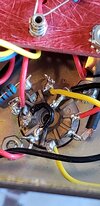
Second pic:
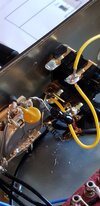
First pic: Did you confirm that the frayed single strand of shielding wire is not making contact with the wire of the hot lead or pin lug?
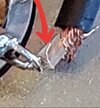
Second pic of yours: I'm having a hard time following the connections of the input jacks. They could be correct, but I would start all over again. With those Cliff-style jacks I would rather have their lugs facing the opposite way. Prewire the set of input jacks as much as possible by temporarily installing them on the outside of the chassis where you'll have more room to work with. It should look like this, but on the front of the chassis:
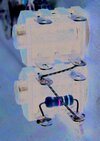
Also, prep and connect a flying lead for the ground wire at the jack. Do the same thing with the shielded coax cable that connects the jack to the 68k resistor that connects to pin 2 of V1. After the jacks are prewired, reinstall them in the proper position and connect the flying leads.
Even better yet, download the excellent METROAMP 100 WATT MASTER VOLUME STEP-BY-STEP INSTRUCTIONS manual in a pdf. Go straight to the lower part of page 26, and all the way through page 29. You should enjoy what you see there! The whole manual is awesome...
Here's a link to the 15mb pdf file:
First pic:
Second pic:
First pic: Did you confirm that the frayed single strand of shielding wire is not making contact with the wire of the hot lead or pin lug?
Second pic of yours: I'm having a hard time following the connections of the input jacks. They could be correct, but I would start all over again. With those Cliff-style jacks I would rather have their lugs facing the opposite way. Prewire the set of input jacks as much as possible by temporarily installing them on the outside of the chassis where you'll have more room to work with. It should look like this, but on the front of the chassis:
Also, prep and connect a flying lead for the ground wire at the jack. Do the same thing with the shielded coax cable that connects the jack to the 68k resistor that connects to pin 2 of V1. After the jacks are prewired, reinstall them in the proper position and connect the flying leads.
Even better yet, download the excellent METROAMP 100 WATT MASTER VOLUME STEP-BY-STEP INSTRUCTIONS manual in a pdf. Go straight to the lower part of page 26, and all the way through page 29. You should enjoy what you see there! The whole manual is awesome...
Here's a link to the 15mb pdf file:
ivan H
Ambassador of Tubes & Grooves
Here is a layout that shows how the inputs should be wired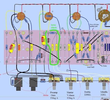
Note that the layout ii's a "horizontal" inputs rather than a "vertical" inputs like yours. The wiring is the same, just connect the 470k/470pf combination from the volume pot to the "low" input as in the Metroamp pic that plexi67 linked. That 470k/470pf combo really should be heatshrink insulated.
Follow Sysco's advice, both on the orientation of the Cliff input sockets & on first "pre-wiring" the sockets with them mounted "external" to the chassis. It makes wiring/soldering them much easier. When you mount the sockets externally, have the solder lugs facing the volume pot, that way when you mount them properly the solder lugs will be correctly facing away from the volume pot. Get this sorted, then if the "wet blanket ect" remains we'll do a simple "pop test" using your multimeter to find where the signal is dropping out. Cheers
Note that the layout ii's a "horizontal" inputs rather than a "vertical" inputs like yours. The wiring is the same, just connect the 470k/470pf combination from the volume pot to the "low" input as in the Metroamp pic that plexi67 linked. That 470k/470pf combo really should be heatshrink insulated.
Follow Sysco's advice, both on the orientation of the Cliff input sockets & on first "pre-wiring" the sockets with them mounted "external" to the chassis. It makes wiring/soldering them much easier. When you mount the sockets externally, have the solder lugs facing the volume pot, that way when you mount them properly the solder lugs will be correctly facing away from the volume pot. Get this sorted, then if the "wet blanket ect" remains we'll do a simple "pop test" using your multimeter to find where the signal is dropping out. Cheers
syscokid
Ambassador of War & Peace
Please explain this "pop test" you speak of...… do a simple "pop test" using your multimeter to find where the signal is dropping out.

ivan H
Ambassador of Tubes & Grooves
Sure, it's very simple, though the amp must have a speaker or cab hooked to the output & be powered up & running, so due care must be taken. Then, with the multimeter switched to a suitably large DC range, attach the black meter lead to the amp chassis, just like you would to read DC voltages. Set the amps volume & if applicable, master volume up some, though no need to crank them.Please explain this "pop test" you speak of...
Now, if you touch the red lead's probe to one of the power tube plate pins (pin 3), you will hear a "pop" or "buzz" through the speaker. If you touch the probe to a power tube grid pin (pin 5) you will hear a very loud "pop" through the speaker. This will happen with circuit components that are in the signal chain too, if you touch the probe to them.
So it is possible to simply chase the signal chain back through the circuit, from the power tubes, through the PI, then the cathode follower etc, listening to the "pops" as you touch the probe to valve pins to find where the signal is dropping out, where no pop, or only a very low volume pop will be heard. Some pops will be louder than others due to the nature of the circuit, but it's usually fairly easy to ascertain which stage is faulty using this simple method. You can see why it is referred to as a "pop test". Cheers
Last edited:

syscokid
Ambassador of War & Peace
Nice info and tip...Sure, it's very simple, though the amp must have a speaker or cab hooked to the output & be powered up & running, so due care must be taken. Then, with the multimeter switched to a suitably large DC range, attach the black meter lead to the amp chassis, just like you would to read DC voltages. Set the amps volume & if applicable, master volume up some, though no need to crank them.
Now, if you touch the red lead's probe to one of the power tube plate pins (pin 3), you will hear a "pop" or "buzz" through the speaker. If you touch the probe to a power tube grid pin (pin 5) you will hear a very loud "pop" through the speaker. This will happen with circuit components that are in the signal chain too, if you touch the probe to them.
So it is possible to simply chase the signal chain back through the circuit, from the power tubes, through the PI, then the cathode follower etc, listening to the "pops" as you touch the probe to valve pins to find where the signal is dropping out, where no pop, or only a very low volume pop will be heard. Some pops will be louder than others due to the nature of the circuit, but it's usually fairly easy to ascertain which stage is faulty using this simple method. You can see why it is referred to as a "pop test". Cheers
syscokid
Ambassador of War & Peace
I need to get a couple of these shirts. One for me, one for you!UGH -- soldering