
You are using an out of date browser. It may not display this or other websites correctly.
You should upgrade or use an alternative browser.
You should upgrade or use an alternative browser.
Marshall 2203 Negative Feedback Tap
- Thread starter Cadorman
- Start date

OP

Cadorman
Ambassador of the Catocaster

I am taking a break today and just going to play and maybe record if I come up with anything before I start trying to diagnose the 2203. I have a feeling it is something stupid that I missed/messed up.
This was not a kit and I have been working with both the Valvestorm and Triode Electronics layouts as I liked parts of both of them. Might have been a bit of a stupid idea, so I have to go back and trace my way through both layouts to see where I effed up.
I will let you guys know what I find after my brain cools down.
This was not a kit and I have been working with both the Valvestorm and Triode Electronics layouts as I liked parts of both of them. Might have been a bit of a stupid idea, so I have to go back and trace my way through both layouts to see where I effed up.
I will let you guys know what I find after my brain cools down.

Hahahahaha! Nope! No rest for you!Alright, I can't leave well enough alone.

67plexi
Ambassador of Amps
I'm sorry lead dress is everything this is a good example
I truly wish that I could be of some help in this.

syscokid
Ambassador of War & Peace
Been there many times...I have a feeling it is something stupid that I missed/messed up.

syscokid
Ambassador of War & Peace
Another TTR member that happens to live and breathe through old school Marshalls is IvanH...Don, Sysco, your positive presence is enormous help as it is.

OP
Cadorman
Ambassador of the Catocaster
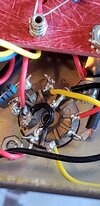
Okay. Here is V1. I have 6.1 volts across pins 4 and 9. The tube won't light. Already swapped out a couple. Sysco, Ivan H do you see anything? It looks right to me and V2 and V3 are okay.
syscokid
Ambassador of War & Peace
Pin 4/5 should be 3.15 AC and pin 9 should be 3.15 AC in a perfect world. Are you getting 6.1 (vdc or vac?) combining pins 4 and 9?Okay. Here is V1. I have 6.1 volts across pins 4 and 9. The tube won't light.
Are you sure that at pin 2 that the ground shielding of the cable is not making any contact with the pin or the wire itself? Looks like there's a sneaky fray of wire awfully close to the danger zone!

Amp Mad Scientist
Ambassador of Heresy
I wouldn't know what to expect out of a 100 watter, but I have a 2204/JCM800 50w on EL34's and a 2204 on 6505's. They both live and destroy in the 4 ohm tap with the stock 100k NFB resistor. 8 ohms is "meh"... 16 oms is a Debbie Downer!
Yup 16 ohms will give the most NFB and the amp will be deadened to Buddy Holly performance specs.
4 ohms will work better for sure if you like to crunch.
But there is value to experimenting with more/less NFB. It should have been adjustable but need some high power L pad pot to handle it.
Amp Mad Scientist
Ambassador of Heresy
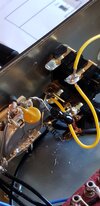
You are correct. I have 3.1 ish volts AC on each of those pins to ground. 6.1 is together. That heater wire is over a 1/4 inch from the mounting nut. That zoomed picture plays tricks with depth.
The filament still isn't lighting up?
I think what I see is that the solder didn't flow on the pins of the tube socket.
It seems like the solder temp is too low.
The pin on the socket and wire is dissipating too much of the heat for the solder to flow between the wire and the solder pin.
Also the iron may be too low power to do this job.
So what you need to do is probably get a higher power soldering iron, (soldering station)
make sure the tip of the iron is clean and tinned.
Re-solder the connections and make sure the solder is flowing.
Cause I think if the filament wires are hooked to the right pins (meter says they are I hope) then it's just cold solder connections.
The pin on the socket must be clean / UN-oxidized.
The tip of the iron must be clean, UN-oxidized and tinned.
The iron must have enough power.
Wire must be clean shiny metal not oxidized.
If all 4 do not happen solder connection may be defect / solder will not flow.
Power cannot reach the tube when the connection is cold.
Last edited:
OP
Cadorman
Ambassador of the Catocaster
Pin 4/5 should be 3.15 AC and pin 9 should be 3.15 AC in a perfect world. Are you getting 6.1 (vdc or vac?) combining pins 4 and 9?
Are you sure that at pin 2 that the ground shielding of the cable is not making any contact with the pin or the wire itself? Looks like there's a sneaky fray of wire awfully close to the danger zone!
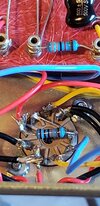
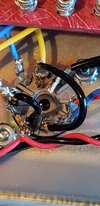
An extremely weak glow I can only see through the bottom of the socket. I can also hold the tube in my fingers. It is cooler than the other 2, but none are lighting up like they should.The filament still isn't lighting up?

BFT Gibson
Ambassador of Originality
apologize for my lack of knowledge ahead of time...your last sentence...is that whyi might like a jtm45...the tube rec & my jtm50..always choose the tube rec over SS.I didn't see this thread yesterday, sorry, but I'll try to provide a bit of insight into Marshall use of NFB during the years to help you make a choice.
The first amps used 27k/16 ohm tap, which is a lot of NFB. This results in a tight, clean power amp.
As the circuit evolved the amps became (1) brighter & (2) more distortion oriented. One of the circuit changes was the use of a 0.68uf V2a cathode bypass capacitor. This boosts the frequencies above about 720hz, making for a brighter, gainier pre amp. The common negative feedback arrangement with the 820r/0.68uf V2a combination is 47k/8 ohm tap, though some amps have the feedback taken off the output jack making it variable depending on what impedance cab/s were used.
When the metal panel amps came about (mid '69-ish), the aforementioned mentioned V2a cathode arrangement was phased out & to compensate the NFB series resistor value was first increased from 47k to 100k on the 8 ohm tap, later changed to the 4 ohm tap. Decreasing the amount of NFB taken (increasing series resistor value &/or lower impedance tap) results in more "hair" & looser feel in the power amp.
My own personal preferences are;- if using the V2a 0.68uf bypass cap, 47k/8 ohm tap. If not, 100k on either 8 or 4 ohm tap depending on how I want the power amp to act.
2203's first came with 100k/8 ohm tap. IIRC, the change to 100k/4 ohm tap coincided with the change from EL34's to 6550's in the US. Now, which tap to use is just personal preference. Hope this helps. Cheers
Edit: You can use an even larger value feedback series resistor for an even more distorted & looser power amp section, though 200k seems to be the limit where it gets too messy. Cheers
Since we are referenceing a SS rec...what is the dif & any if a tube rec is involved in that "sag" in the equation some of us revere as we get older?