Univibes

Catmandue

Well-Known Member
Country flag
I have a Moen Shaky Jimi. It sounds pretty good. I want to get one of the new Dunlop Psych 69 series Jimi Hendrix Univibe. I like the tone I heard on the demo. I'm sure I could dial it in better than the guy in the demo did. I like the tone of a Univibe. They have a number of cool one out.
 
I have a Moen Shaky Jimi. It sounds pretty good. I want to get one of the new Dunlop Psych 69 series Jimi Hendrix Univibe. I like the tone I heard on the demo. I'm sure I could dial it in better than the guy in the demo did. I like the tone of a Univibe. They have a number of cool one out.
Do you find yourself using single coils more than humbuckers with it?
Also, pre or post distortion?
 
Do you find yourself using single coils more than humbuckers with it?
Also, pre or post distortion?
Humbuckers I like using 490s on the SG Special as well as Single wounds on my Strat Special. I like using OD pre Jimi. BB Pros sound excellent with the chambered Les Paul Standard. With SCN pups a very cool and chime like tone can be dialed in. For a cheap pedal the Shaky Jimi sounds pretty bitchen. I like the way the new Dunlop sounds. I bet it rules with single coils I strongly suspect.
 
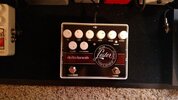
Have you ever tried one of these?View attachment 32758
The Lester G is a Leslie pedal, not a Univibe. Sounds mighty good on the demos though. I miss having a rotary tone on my pedalboards.

As for signal path, I've always believed Leslie sounds best after the drive and vibe sounds better before. This is how it was done on the classic recordings: the Leslie was an actual speaker cabinet so it was always after the amp, while vibe pedals were used between guitar and amp. Drive softens the swooshiness of the vibe pedal and gives that classic tone.

My benchmark reference tones have always been Badge for rotary tone and Bridge Of Sighs for vibe sound.

Of course, in the old days they would've been using vibe after drives if they could, since the original Univibe was intended to simulate the rotary tone. But because of its limitations at the time, it evolved into something new and different that's now a classic tone of its own.

Odd semi-funny story - I once watched the YouTube demo for a Leslie pedal; somebody must've told the guy to use the part from Badge. He obviously didn't know the song because he had no idea that the Leslie kicked in for the bridge, and he learned the intro part to use as his Leslie demo. Don't remember which pedal it was; I've done my best to block out the memory...

Another bit of trivia - the song Badge actually got its name when Clapton and Harrison were working on the tune; Ringo looked across the table at their notes, and reading upside down asked, "What's this 'Badge' part?" The notes actually read 'Bridge' but Eric decided then & there to call the tune Badge.

When it comes to vibe pedals, I like the Danelectro CoolCat Vibe; it's an actual photocell vibe like the originals and uber-expensive modern ones. Most of today's vibe pedals are digital. But they're getting pretty good. And they might also be more robust than something with a lightbulb inside. Plus they don't draw as much power - the Dano eats batteries very fast and really needs remote power to be practical. But it's the genuine iconic tone and you can find them used for well under $100 if you look around for awhile.
 
The Lester G is a Leslie pedal, not a Univibe. Sounds mighty good on the demos though. I miss having a rotary tone on my pedalboards.

As for signal path, I've always believed Leslie sounds best after the drive and vibe sounds better before. This is how it was done on the classic recordings: the Leslie was an actual speaker cabinet so it was always after the amp, while vibe pedals were used between guitar and amp. Drive softens the swooshiness of the vibe pedal and gives that classic tone.

My benchmark reference tones have always been Badge for rotary tone and Bridge Of Sighs for vibe sound.

Of course, in the old days they would've been using vibe after drives if they could, since the original Univibe was intended to simulate the rotary tone. But because of its limitations at the time, it evolved into something new and different that's now a classic tone of its own.

Odd semi-funny story - I once watched the YouTube demo for a Leslie pedal; somebody must've told the guy to use the part from Badge. He obviously didn't know the song because he had no idea that the Leslie kicked in for the bridge, and he learned the intro part to use as his Leslie demo. Don't remember which pedal it was; I've done my best to block out the memory...

Another bit of trivia - the song Badge actually got its name when Clapton and Harrison were working on the tune; Ringo looked across the table at their notes, and reading upside down asked, "What's this 'Badge' part?" The notes actually read 'Bridge' but Eric decided then & there to call the tune Badge.

When it comes to vibe pedals, I like the Danelectro CoolCat Vibe; it's an actual photocell vibe like the originals and uber-expensive modern ones. Most of today's vibe pedals are digital. But they're getting pretty good. And they might also be more robust than something with a lightbulb inside. Plus they don't draw as much power - the Dano eats batteries very fast and really needs remote power to be practical. But it's the genuine iconic tone and you can find them used for well under $100 if you look around for awhile.
Cool background story, thanks for the share.
 
I have a Moen Shaky Jimi. It sounds pretty good. I want to get one of the new Dunlop Psych 69 series Jimi Hendrix Univibe. I like the tone I heard on the demo. I'm sure I could dial it in better than the guy in the demo did. I like the tone of a Univibe. They have a number of cool one out.

Here's another new one...
 
Back
Top