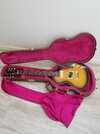
What Makes a Les Paul Sound So Unique???

This is a much better sound clip demonstrating the tone quality of a concrete block ...


You got me curious so I checked it out. Lashbrook makes the piezo pickup this guy is using, not the guitar. They do make guitars too, and they look very nice, but they don't peddle concrete blocks.

Anyway, not particularly impressed with the tone, and despite the novelty of playing concrete this dude should get himself some lumber, but now that I know it's a piezo system it all makes sense.
 
You got me curious so I checked it out. Lashbrook makes the piezo pickup this guy is using, not the guitar. They do make guitars too, and they look very nice, but they don't peddle concrete blocks.

Anyway, not particularly impressed with the tone, and despite the novelty of playing concrete this dude should get himself some lumber, but now that I know it's a piezo system it all makes sense.

Absolutely agree!!!

That tone isnt worthy of a letter home to Mom.
 
I think that the mahogany body guitars resonate really well, and have a warm mellow sound to them. They are very ballsy sounding, and even Fender did a short run of set neck mahogany Strats because of that warmth. Adding a maple cap, and using a much thicker slab of mahogany is what gives the Les Paul it's sound. If you get the right pieces of wood together, it has a very pronounced sound unplugged, and an over the top snarl when plugged in. I'm sure it was by accident that McCarty and his team hit on the combination of mahogany neck and body,, maple cap, and rosewood or ebony fingerboard, although many of those combinations were being used in acoustic or "Electric Spanish" guitars of that era.

It's a great sound. My SGs are the "old pair of jeans" guitars to me, but my Les Pauls have that "snottyness" I can't quite get out of my other guitars.
 
This is a much better sound clip demonstrating the tone quality of a concrete block ...

Oh come on---
NO its not going to sound like a 5000.00 les paul or a 10,000.00 Martin---

BUt he is a good player the sound is functional for the genere and style -- I hear no BOOs or see any fruit being thrown --

it fits the vibe its a fun song I bet some folks are dancing in the audience-- I tapped my toe--

kinda like this -- no its not Bach on a cLassical guitar---

but its fun-- it works and folks like it---

I dont think any one is abdicating a cinder block sounds as good as a Stradivarius-- but IT DOES MAKE sound-- to SOME a pleasing sound
 
I liked the Norseman's tone test, and believe that this is really the
best way to make these judgements. Keep everything else the same.

So there actually seems to be a difference, in spite of the FACT that
wood is not magnetic. I heard it all right, and thought the mahogany board-guitar
has the best tone.
I'm sure it's the composition of the buzz saws
used to cut the logs into planks... Poulan saw blades vs Stihl saw blades
and like that. European steel vs Japanese steel ya know... Gotta have
some tonal effect. Samantha Fish plays a guitar made of an Oil can, to great effect.
Oil can guitar.jpg
And they didn't test any Ash wood, or Alder... I'd be curious about
Walnut, Cherry, Hickory, Birch, even Osage Orange...Eastern White Pine,
Southern Yellow Pine, Western Lodgepole pine... we all know Basswood
makes good basses... but how about re-purposed California redwood?
What about the tonal difference between Norway Maple, Swamp Maple
and Sugar Maple.

Me, I like diversity, and I like guitars with unique tone. I'm sort of retired now,
but in the past, audiences that came to see my colleagues and me came to expect
diversity of tones from us, and not consistency
. I believe it makes the show more
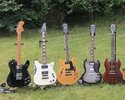
interesting. It certainly does when we put a rack of guitars on display behind us,
and they can sit there anticipating the playing of each one.
five electrics@100 sm.jpg
So the tone wood argument has only intellectual interest for me. I bought four of
the above unique guitars because I liked the concept and wanted to add that to
my repertoire. Not giving up any of my previously developed tones, but adding
something else to the banquet
. I bought the SG on the right because its unamplified tone rang bells in my head and in my heart at the same time... and
I had to listen. It still does.

I guess I don't own a Les Paul or a Strat, partly because everybody else does.
So why should I? Each of the above guitars (except Luna, the brown SG) has
a unique combination of wood and hardware, and each has a remarkable tone
all its own... which is what attracted me.

The Fender, I never saw anybody play one in the '70s, but when I heard about
the re-issue, I immediately wanted one. Alder body, string through bridge, Fender's
own version of the hum bucker, Strat neck, one piece maple... ALL of these have
some tonal effect, and the ensemble package is dynamite IMHO.

The Epi Wilshire... I did see guys like MC-5 and Johnny Winter play this model
and then forgot about it until the re-issue, and then I wanted one instantly.
The body is made of whatever... (Tsingtao wood merchants' closeouts probably)
Epi guitars are built to a price point, which means no high quality wood,
but I can testify that the Wilshire has a lovely clear tone with excellent highs, mids and lows, and lots of sustain. It weighs about seven pounds and balances perfectly.
I upgraded the hardware and really enjoyed playing it until reluctantly selling it this year. Very very sixties, including the neck profile.

The Epi ES-339: Another amazo combination... Solid maple center block, hollow upper and lower bout, plywood top, sides and back, Mahogany neck with scarf joint
at the headstock, rosewood FB, Ken Rose P-90 p'ups, high quality wiring... All of these features have an effect, great or small. It's an endless chain of speculation to
try and figure what does what. I just love the tone and the feel of this one, and am
not sure I really care why. Not sure if Gibson designers came up with this, but I think they did.

The Silverburst SG special is another unique instrument. Mahogany body, maple neck, mini hum buckers, Nashville bridge, Corian nut, baked maple fretboard...
Go figure. It's got a beautiful tone, plenty of presence in all the frequencies,
sustains as long as I need it to and it makes me very happy to play.
Why does it sound unique? All of the above IMHO. I left this one mostly stock:
Gibson traditional wiring (no PCB), Nashville bridge, 2012 mini hums, stock nut
but I made an ebony pick guard for it, which
adds depth and presence to the tone for sure... as well as increasing sustain.
*grins


And then there's Luna, my "conventional" SG which blows them all away
as the Queen ought to, among her handmaids. She rang like a bell right at
the music store, and won my heart without trying. I've described her mods
and her tone enough times, she gives me a very normal electric guitar sound
but just oozing Gibson goodness and elegance, in spite of being a humble
faded special. She can take her place onstage or in studio alongside other
much more expensive instruments, and hold her own or surpass them.

It's owning my Luna which shortens my patience for the poor schmoes who
come aboard a guitar forum, finding fault with their brand new __________________
guitar... OMG there's a dimple in the finish... OMG there's some glue near one of the joints, OMG I put a magnifier on the varnish and found a scratch... I just feel sorry
for someone who has to look at his guitar with a magnifier, and then is bummed out
when he found some trouble. *shrugs

And I read posts where guys find fault with their pickups... one guy will say that
his 498T is shrill, and another will say that it's muddy. I've read a lot of those kinds
of posts, and I still don't really get it. None of the above guitars is or was ever muddy, none was ever shrill. The tone controls seem to work properly, and my
EQ pedal does too.
The stock Epiphone pickups on the Wilshire sounded
a little harsh to my ear, but the replacements don't.

That wasn't a tone wood issue...
 
I'm sure it was by accident that McCarty and his team hit on the combination of mahogany neck and body,, maple cap, and rosewood or ebony fingerboard, although many of those combinations were being used in acoustic or "Electric Spanish" guitars of that era.

Actually, it was not by accident. According to this interview of Ted McCarty in 1992, he mentions how the Gibson engineers experimented with several different woods and combinations before settling on the final product.

The salient information is several paragraphs into the article.

 
Actually, it was not by accident. According to this interview of Ted McCarty in 1992, he mentions how the Gibson engineers experimented with several different woods and combinations before settling on the final product.

The salient information is several paragraphs into the article.


That is exactly the article I was referring to earlier!
 
So there actually seems to be a difference, in spite of the FACT that
wood is not magnetic. I heard it all right,

You may put your mind at ease!

There Is no “in spite of”...anything.

You may have actually heard something!

The fact that “wood is not magnetic” has no bearing, one way or the other, on whether or not wood could affect the tone of an electric guitar.

It is true...the pickups cannot directly detect anything about the wood. All they detect is the string’s vibration.

However, if there is some means whereby the materials and construction of the guitar could affect how the strings vibrate, this would carry through to what the pickups are “picking up”.

This is the heart of the tonewood discussion: Can the materials and construction affect how the strings vibrate?

I’m still waffling on the point. But, if you heard something different, just accept it and enjoy it!
 
You may put your mind at ease!

There Is no “in spite of”...anything.

You may have actually heard something!

The fact that “wood is not magnetic” has no bearing, one way or the other, on whether or not wood could affect the tone of an electric guitar.

It is true...the pickups cannot directly detect anything about the wood. All they detect is the string’s vibration.

However, if there is some means whereby the materials and construction of the guitar could affect how the strings vibrate, this would carry through to what the pickups are “picking up”.

This is the heart of the tonewood discussion: Can the materials and construction affect how the strings vibrate?

I’m still waffling on the point. But, if you heard something different, just accept it and enjoy it!

I am so glad I'm not tripping right now!
 
Back
Top