What Makes a Les Paul Sound So Unique???

Inspector #20

Ambassador of Tone
Fallen Star
Country flag
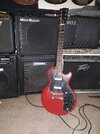
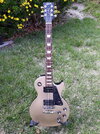
I have three Les Paul's - a 2016 Gibson, a hand-built replica we did in 2016, and a Chinese copy. All have the same setup and electronics and all are indistinguishable from each other on a recording, but they sound so different from any other 24.75" guitar.

If wood try has no bearing on tone, then what is it????
20190323_152400.jpg


20190626_084447.jpg
 
Last edited:
Hummm looking at the pictures I see different pickup's for starts.
Different control knobs also. Tone plastic has a HUGE impact.
OH and one only has 5 strings, they all have different tuners.
Bridge and tailpieces are all different also.
 
Hummm looking at the pictures I see different pickup's for starts.
Different control knobs also. Tone plastic has a HUGE impact.
OH and one only has 5 strings, they all have different tuners.
Bridge and tailpieces are all different also.

The photo above was taken during the build of the 1959 Replica.

Of greatest interest, nobody can tell these three Les Paul's apart on a recording. The gold-top has Gibson 498T/496R and the other two have the Epiphone equivalent of HB8N/HB6N.
 
I don't buy into the wood not mattering. At least the mass or thickness must have some impact. I can easily distinguish the differences between my SG, FV and LP's which all have different body thickness. Bridges, tail pieces and tuners are the same on all of them except my classic and I can't distinguish a sound difference from the different tuners on it.

Now why do Gibson's sound different than other guitars? I think it is more due to the violin style design with the angled neck and raised strings, not to mention the lack of a coil spring vibrato.
 
I don't buy into the wood not mattering. At least the mass or thickness must have some impact. I can easily distinguish the differences between my SG, FV and LP's which all have different body thickness. Bridges, tail pieces and tuners are the same on all of them except my classic and I can't distinguish a sound difference from the different tuners on it.

Now why do Gibson's sound different than other guitars? I think it is more due to the violin style design with the angled neck and raised strings, not to mention the lack of a coil spring vibrato.

Wood makes a difference. McCarty himself opined many times about the subject and is on record regarding the choice to use the mahogany/maple sandwich. And the differences between mahogany-necked and maple-necked Les Pauls are immediately apparent when you play them side-by-side.

I agree with you as well on the overall design of the Les Paul. The neck being set so far into the body certainly has an effect on the tone. Whatever it is, nothing sounds like a Les Paul, not even a PRS 245.
 
Wood makes a difference. McCarty himself opined many times about the subject and is on record regarding the choice to use the mahogany/maple sandwich. And the differences between mahogany-necked and maple-necked Les Pauls are immediately apparent when you play them side-by-side.

I agree with you as well on the overall design of the Les Paul. The neck being set so far into the body certainly has an effect on the tone. Whatever it is, nothing sounds like a Les Paul, not even a PRS 245.

Even my hand-built LPC Replica follows the Gibson blueprints...
 
Naturally, we know the scale length is probably the biggest factor.

One major difference between a Stratocaster and the Les Paul is their scale length. The Les Paul is 24.75 inches versus the Stratocaster’s longer 25.5 inches. This has an impact on both sound and playability.

A longer scale length results in more space between the frets and greater string tension making it a little more challenging to play. The Stratocaster’s longer scale also results in a brighter, more chiming sound whereas the LP’s shorter scale is to an extent responsible for its rounder, warmer sound. String tension is lower on the shorter scale too.
 
Does wood matter???

John Good, of Drum Workshop, has done a lot over the years, in terms of wood thickness and density, and it's direct effect on the actual resonant frequency. John demonstrates this all the time. It's pretty much universal and can be described like this...

As the thickness and/or density of a given piece of wood increases, the resonant frequency, pitch, or note produced is higher, takes longer to reach it's peak volume and decays slower... Conversely, as the thickness and/or density of a given piece of wood decreases, the resonant frequency, pitch, or note produced is lower, reaches it's peak volume quicker and decays quicker...

Hmmm....mahogany is extensively used in Les Paul construction...
 
The real question concerning the effect of materials and construction on tone in an electric guitar is not asking whether or not the materials and construction will cause the guitar, itself, to vibrate and resonate differently.

This is self-evident. Whenever you play an electric guitar unplugged and hear how it resonates (sounds) different from another, you are demonstrating this to yourself.

That is not the question.

The question has to do with how those variances could impact the string’s vibration. The pickups “pick up” the string‘s vibration. For any wood or construction method to affect tone, they have to affect how the strings vibrate.

It doesn’t matter that “wood is not magnetic.”

If the wood and construction can have an effect on how the strings vibrate, there will be some difference (though whether it is detectable by human ears is another matter). The mechanism for how that effect may occur is the real question.

I can certainly conceive of a mechanism whereby this is possible.
 
Back
Top