


I wanted to post an update to this thread with some information and things that I learned. I have since picked up a second DSL40C, also a 2016 build, that I have added as my #2 amplifier for live work.
I have not done any of the tone cap/clipped resistor mods that some have suggested. I play these amps at very high stage volumes - usually 12 noon to 1pm on the knob - and under those conditions, I do not think the mods- like 'C19' - are needed. So, my comments that follow are centered around a totally stock amplifier.
Speaker:
IMHO, at least 90% of my dissatisfaction with my DSL's was the stock speaker. Initially, I was using custom made, 50 watt WGS Reaper 55Hz models. They work nicely, despite needing a lot of break in time. I recently switched to the Electro-Harmonix 12VR75. Not only is this speaker noticeably louder - dial position for given dial position - (it's a 98 db rating) it's break in time is greatly reduced. This is the speaker I am running now. Great chug and response.
Pre-Amp Tubes:
I tried at least 8 documented tube combinations. I found two that give me what I want:
ECC823/ECC83S/ECC83MG/5751 was a great combination and was easy to make up from tubes on hand. It also worked good with both a 12AU7 and 12AT7 in the V1 slot, but the ECC823 in V1 had a better gain response at lower knob settings.
I still use the 12AU7 in V1 for some amps that I set up for others when a very mild gain structure is desired.
However, I found a combination that sounded even better IMHO, and was even easier to create:
7025WA/JJ5751/7025WA/JJ5751
This is now my 'default' tube loadout. I use it on both amps. It has a very warm and organic gain structure and allows dramatically increased range of motion on the gain knob.
Tube Screamer:
The addition of a TS-9 as a clean boost tightened up the low end. Combined with the reduced preamp gain of the tube combination, the TS-9 allowed greater levels of gain with increased clarity. Both amps sound good without it, but they become multi-dimensional when it is in play. It's a nigh and day difference.
The Pedals:
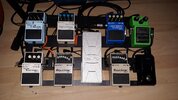
I use these to color my tone. Only two pedals are not in use 100% of the time.
Left EQ: It is used only as a boost for solos
DD-3: Used for solos only.
The amp volume is set to around 2pm and the volume is controlled by the Boss FV30L in the board's center.
Primary Signal Paths Is: Korg Tuner >>> TS-9 >>> GE -7 #1 >>> CS-3 >>> NS-2 >>> Front of DSL40C
Secondary Path Is: FV30L to FX Loop Send - FV30L >>> DD-3 >>> GE-7 #2 >>> CE-5 >>> to FX Loop Return
All other pedals are very subtle, making very little change when switched on individually, but together, they add a very unique element to my overall tone.
I tried the X pattern and every other order one can imagine, but this was the arrangement that gave me what I was hearing in my head. Te board is quiet under all conditions, even in the studio.
So, for me, the DSL40C has become my mainstay amplifiers.
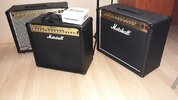
Here's a shot my two DSL40c's. In the middle is my owned-since-new, 1999 G50 Marshall SS, which serves as my lightweight practice amp.
Finding my tone was a very difficult and time consuming venture and it involved a lot of research and bringing some old vintage pedals back into action.
I happened to read an article on line very late one night where max Norman commented on the fact that Lynch ran a chorus 24-7 as pillar of his tone. Since I had a vintage 1980's Arion SCH-1, I tried some experiments - and the results were just awful. It was a mystery to me how anyone could run chorus and get it to sound good. Then, I ran across a photo of Lynch's 2018 rig and there was a CE-5 on the board. I posted some questions in here and got favorable reviews by actual users, so I set out to get one. I ended up trading an old 1980's Arion Metal Master pedal for a brand new CE-5 still in the factory packaging. This is the only Boss effect that has not been modded by Modest Mike. It is 100% stock.
The chorus was - by itself - a very subtle thing. It added some color and has a two band EQ, which allows me to again EQ the sound to some extent, but it's effect was not fully realized until I switched on the entire board at once.
The interplay of the delay and reverb is fantastic. It is never switched off except on songs like "Symphony Of Destruction." The effect is subtle. The rhythms sound fuller and deeper and there is a definitive slap-back when a note is abruptly choked off, but the effect is on all the time with absolute clarity. Although the settings on the DD-3 do not allow for precise user-programming of the delay effect, I found that 800ms, with a single repeat and a second 'ghosting fade' was the perfect blend from a tonal perspective. If more delay is needed, increase the pick attack. Very simple.
When the board is switched on, there is no noise. Each effect comes online silently and without loud hissing. What little noise the chain makes is completely quelled by the NS-2. The amp is extremely responsive to pick attack and the tone can be almost clean if picked lightly. The behavior of this rig at such high performance volumes is just so incredible. It's well behaved, doesn't squeal or feedback and really sounds good - as in the mixture and sonic texture of the tone is very broad and engaging to the listener. There are no feedback issues even on a tight stage at over 12 noon volume settings on 40 watt (full power) mode. None. Zero.
The speaker movement during F# palm mutes is something you really have to hear in person. You can feel the speaker movement in the room. It's incredibly dramatic.
I hope something in this post will help you in your own personal DSL40C tonal quest....
I have not done any of the tone cap/clipped resistor mods that some have suggested. I play these amps at very high stage volumes - usually 12 noon to 1pm on the knob - and under those conditions, I do not think the mods- like 'C19' - are needed. So, my comments that follow are centered around a totally stock amplifier.
Speaker:
IMHO, at least 90% of my dissatisfaction with my DSL's was the stock speaker. Initially, I was using custom made, 50 watt WGS Reaper 55Hz models. They work nicely, despite needing a lot of break in time. I recently switched to the Electro-Harmonix 12VR75. Not only is this speaker noticeably louder - dial position for given dial position - (it's a 98 db rating) it's break in time is greatly reduced. This is the speaker I am running now. Great chug and response.
Pre-Amp Tubes:
I tried at least 8 documented tube combinations. I found two that give me what I want:
ECC823/ECC83S/ECC83MG/5751 was a great combination and was easy to make up from tubes on hand. It also worked good with both a 12AU7 and 12AT7 in the V1 slot, but the ECC823 in V1 had a better gain response at lower knob settings.
I still use the 12AU7 in V1 for some amps that I set up for others when a very mild gain structure is desired.
However, I found a combination that sounded even better IMHO, and was even easier to create:
7025WA/JJ5751/7025WA/JJ5751
This is now my 'default' tube loadout. I use it on both amps. It has a very warm and organic gain structure and allows dramatically increased range of motion on the gain knob.
Tube Screamer:
The addition of a TS-9 as a clean boost tightened up the low end. Combined with the reduced preamp gain of the tube combination, the TS-9 allowed greater levels of gain with increased clarity. Both amps sound good without it, but they become multi-dimensional when it is in play. It's a nigh and day difference.
The Pedals:
I use these to color my tone. Only two pedals are not in use 100% of the time.
Left EQ: It is used only as a boost for solos
DD-3: Used for solos only.
The amp volume is set to around 2pm and the volume is controlled by the Boss FV30L in the board's center.
Primary Signal Paths Is: Korg Tuner >>> TS-9 >>> GE -7 #1 >>> CS-3 >>> NS-2 >>> Front of DSL40C
Secondary Path Is: FV30L to FX Loop Send - FV30L >>> DD-3 >>> GE-7 #2 >>> CE-5 >>> to FX Loop Return
All other pedals are very subtle, making very little change when switched on individually, but together, they add a very unique element to my overall tone.
I tried the X pattern and every other order one can imagine, but this was the arrangement that gave me what I was hearing in my head. Te board is quiet under all conditions, even in the studio.
So, for me, the DSL40C has become my mainstay amplifiers.
Here's a shot my two DSL40c's. In the middle is my owned-since-new, 1999 G50 Marshall SS, which serves as my lightweight practice amp.
Finding my tone was a very difficult and time consuming venture and it involved a lot of research and bringing some old vintage pedals back into action.
I happened to read an article on line very late one night where max Norman commented on the fact that Lynch ran a chorus 24-7 as pillar of his tone. Since I had a vintage 1980's Arion SCH-1, I tried some experiments - and the results were just awful. It was a mystery to me how anyone could run chorus and get it to sound good. Then, I ran across a photo of Lynch's 2018 rig and there was a CE-5 on the board. I posted some questions in here and got favorable reviews by actual users, so I set out to get one. I ended up trading an old 1980's Arion Metal Master pedal for a brand new CE-5 still in the factory packaging. This is the only Boss effect that has not been modded by Modest Mike. It is 100% stock.
The chorus was - by itself - a very subtle thing. It added some color and has a two band EQ, which allows me to again EQ the sound to some extent, but it's effect was not fully realized until I switched on the entire board at once.
The interplay of the delay and reverb is fantastic. It is never switched off except on songs like "Symphony Of Destruction." The effect is subtle. The rhythms sound fuller and deeper and there is a definitive slap-back when a note is abruptly choked off, but the effect is on all the time with absolute clarity. Although the settings on the DD-3 do not allow for precise user-programming of the delay effect, I found that 800ms, with a single repeat and a second 'ghosting fade' was the perfect blend from a tonal perspective. If more delay is needed, increase the pick attack. Very simple.
When the board is switched on, there is no noise. Each effect comes online silently and without loud hissing. What little noise the chain makes is completely quelled by the NS-2. The amp is extremely responsive to pick attack and the tone can be almost clean if picked lightly. The behavior of this rig at such high performance volumes is just so incredible. It's well behaved, doesn't squeal or feedback and really sounds good - as in the mixture and sonic texture of the tone is very broad and engaging to the listener. There are no feedback issues even on a tight stage at over 12 noon volume settings on 40 watt (full power) mode. None. Zero.
The speaker movement during F# palm mutes is something you really have to hear in person. You can feel the speaker movement in the room. It's incredibly dramatic.
I hope something in this post will help you in your own personal DSL40C tonal quest....
Last edited:


