Caring for ebony fingerboards

The other important thing about ebony is, it isn't enough just to keep your ebony clean and oiled - you need to keep it humidified.

Ebony shrinks more than rosewood or maple when it loses too much moisture and you can wind up with sprouted frets or worse.
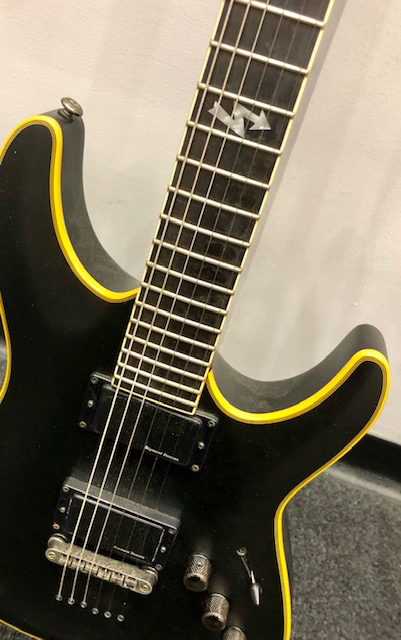
This is what I was worried about buying it on the basis of photos. They did send me a couple of more photos but nothing close up enough to tell what the fretboard is like, except that I can see that it needs a clean and a new set of strings.

This guitar is coming from Queensland though so hopefully it hasn't dried out much. Even Brisbane at the least humid time of year was more than this Adelaide boy could cope with. When it gets here I will clean it, oil it, and look after it. The only issues I had last time I bought a guitar this age from Queensland was rusty strings, which you can see from the photo is also the case with this one. The first thing that will happen is me taking the strings off, then cleaning the whole guitar and treating the fretboard, followed by a set of D'Addario EXL117 11-56 strings and tuning to C standard, then I will wait for the neck to settle before adjusting the truss rod etc.

sKK9HqU.jpg
 
Last edited:
There is a danger in over-oiling your board too. Hydrated is different than saturated, which can cause warping and separation

I guess I've been fortunate that I've never had a problem??? I've oiled that 1987 Squire at every string change since it was new and after every performance too....my Les Paul's get oiled the same way....
 
+1 on Fret Doctor. I bought a small bottle about five years ago, and
used it on all (but one) of my collection of guitars, rosewood, ebony, baked maple,
they all seem to absorb the Bore Oil and take its sealing qualities into the grain.
Once a year seems to be enough. I apply it sparingly with a Q-tip.

Another fine alternative is Music Nomad's F1, an excellent fretboard product.
I use lemon oil very sparingly, mostly to clean a fretboard of grime and dead punk skin
before the real treatment with Fret Doctor.

Lemon Oil works for me as a cleaner, but I don't think it does much else.
It does no harm, unless you work excessive quantities of it down into the fret slots
where it can soften the wood.
On an old lacquered guitar with checking in the finish, excessive lemon oil can get worked
down into the tiny cracks and make them bigger. Not recommended.

By the way, in the Army they issue G.I. Bore Cleaner for weapons maintenance,
and that stuff is designed to dissolve powder residue and dislodge brass fouling from
military rifle barrels. Bore Oil is a much more peaceable compound... *grins
It's intended to sink into the bare wood of musical instruments, and protect the wood from
moisture, spit, grease from human skin, and airborne pollution such as smoke, greasy steam
from kitchens near the stage, condensation, girl perfume, and spilled beer.
The scent of G.I. Bore Cleaner can send even an old man right back into the barracks,
or the brig.

I don't use anything on my MIM Fender Tele, because its maple neck with integral fingerboard
seems well sealed with Polyurethane and never gets dirty, never has any issues, wipe it
down with a bandana after playing and forget it. Typical Fender tough.

A polyurethane finished maple neck seems impervious to just about anything.
You can oil it all you want, and then wipe all that oil off. It doesn't do anything.
You can spray it with polish, and wipe the polish off and the neck is unchanged.
Furniture products like Pledge are terrible choices for guitars, because of the silicones
in them. But a polyurethane finish won't be damaged by something as bad as Pledge.
Wipe anything off it, and it remains unchanged. Polyurethane seems like an excellent
and practical guitar finish IMHO.

You can spray it with fast fingers, and then rub all that off on your fingers, then wipe
your fingers off on your pants. *grins. The neck will remain the same. That's my experience
but I've only owned my MIM Tele for about ten years. I've seen Fender telecasters with the
Lacquer varnish worn right off, and the dirt and grime and finger skin rubbed right into
the grain of the bared maple. Those look dreadful to my eyes... yuck. But I don't think the
Polyurethane is as easy to damage as the traditional lacquer.
 
Last edited:
I don't distinguish between ebony, rosewood, and richlite. I have all three. I rarely oil them, once a year at best. You can tell when they need it by how dry they feel and look. I find too much oil is almost as bad as no oil. The wood gets too soft. I have a small bottle that came in a Gibson guitar maintenance kit. No idea what is is but a few drops on a clean rag is more than enough for a whole fret board. Oil it, wait five minutes or so, then wipe off any excess.I never use anything except a clean dry rag on my maple neck strat.
 
This guitar is coming from Queensland though so hopefully it hasn't dried out much. Even Brisbane at the least humid time of year was more than this Adelaide boy could cope with. When it gets here I will clean it, oil it, and look after it. The only issues I had last time I bought a guitar this age from Queensland was rusty strings, which you can see from the photo is also the case with this one. The first thing that will happen is me taking the strings off, then cleaning the whole guitar and treating the fretboard, followed by a set of D'Addario EXL117 11-56 strings and tuning to C standard, then I will wait for the neck to settle before adjusting the truss rod etc.

sKK9HqU.jpg
Up until a year & half ago I lived on the (very humid) Sunshine Coast, Queensland. Then I moved to the New England area of New South Wales, right around Xmass time (the hottest, dryest time). Within about 3 months of moving, the truss on all my guitars needed tweaking. Another 3 months (ish) later they all needed another tweak. My Jackson (my only ebony 'board), with its graphite reinforced neck required less adjustment than the other guitars, but still needed tweaking twice. During this period especially, I made sure the 'boards were well hydrated to avoid cracking as the wood dried. They all seemed settled after about 6 or 7 months. I'm imagining that Adelaide is even drier than where I'm am. Cheers
 
Up until a year & half ago I lived on the (very humid) Sunshine Coast, Queensland. Then I moved to the New England area of New South Wales, right around Xmass time (the hottest, dryest time). Within about 3 months of moving, the truss on all my guitars needed tweaking. Another 3 months (ish) later they all needed another tweak. My Jackson (my only ebony 'board), with its graphite reinforced neck required less adjustment than the other guitars, but still needed tweaking twice. During this period especially, I made sure the 'boards were well hydrated to avoid cracking as the wood dried. They all seemed settled after about 6 or 7 months. I'm imagining that Adelaide is even drier than where I'm am. Cheers

I don't know if Armidale is more or less dry than Adelaide. If it is in the rain shadow of the Great Dividing Range then it is probably very dry, especially given that it is in the mountains. I found Canberra to be oppressively dry when I lived there, even coming from Adelaide. 35C felt like 45C. Galahs were always panting in the trees outside my window. Winter was terribly dry and cold as well. Rain was very welcome. Adelaide gets very hot so it can get as dry in summer, but it is not as dry all year around. But airborne humidity certainly much lower than Brisbane, Sydney, or even Melbourne.

This guitar is coming from a pawn shop in Lawnton, which is in the Moreton Bay area, south of the Sunshine Coast. I don't know where the previous owner was based but it has been in this pawn shop long enough for them to drop the price by $300 (from $999 to $699).
 
Back
Top