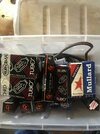
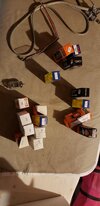
Ok,
If you are shooting for a very classic rock kind of tone, like early AC/DC for example, it's hard to beat a 12AU7 in the V2 position with a standard ECC83 (12AX7) in the V1 spot.
If you want a little less gain and more volume, put a JJ5751 in V1 with a standard 12AX7 in V2.
V3 is the cathode follower position, and the tube used here needs to be tough. Spiral filament 12AX7 tubes have problems in cathode follower circuits due to the fact that most cathode follower circuits in guitar amplifiers exceed the maximum cathode to heater rating of 100 volts. It's also said that you should avoid long-plate tubes in this position in the DSL's because it can cause unwanted feedback.
I tend to stick with a JJECC83s or JJECC83MG here exclusively with good results. However, the TAD7025WA has also worked very well in this position.
Of all the tube combinations I have experimented with, the best tube in V4 continues to be the 5751 or the ECC81 (12AT7)
Now, I am in the habit of using what I have on hand before buying more tunes. That being said, here are some noted substitutions:
The TAD7025WA can be used in any position as you would use a standard 12AX7/ECC83. It is a quiet tube and is rugged.
I often use the JJ ECC803 Long-Plate (because I got quite a few of them) in place of a standard ECC83/12AX7, except in the V3 cathose follower position.
The JJ 12AT7 (ECC81) is a lower gain variant of the 12AX7 and it can be used in place of a 12AX7 - NOTE that I mentioned "JJ 12AT7" specifically - because it is a short-plate tune. The TAD, Electro-Harmonix, Genelex and Mullard 12AT7's are long-plate versions and they don't seem to work that well in the V3 of the DSL's,
Thus far, I am very pleased with the JJ ECC823 in V1, a JJ ECC803 in V2, a JJ ECC83MG in V3 and a JJ 5751 in V4.
Overall, that combination has the most natural, organic gain structure, with rich sustain, absent of fizziness and the cleanest overdriven chug of any combination I have tested....