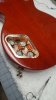
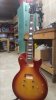
Tone Man Wire Harness:

I have been upgrading the wiring on my guitars and friends guitars for years. The wire is changed from loose strand junk to solid coated copper wire with less resistance. That makes the caps and pot deliver the amps, voltage and to the specs you choose. I replace the pots with CTS pots and caps are what ever I have. I used a paper clip on one of my guitars. I can't remember what one, I didn't have any pots, so the paper clip works fine. True thing gentlemen, no one can tell what cap is in any guitar. Someone says they can tell, I need them for invasive, painful medical experiments. Put a 500 or 550 k in place of a 250k pot can cut your head off with treble, if they are good single coil pickups.
Pay attention to the important stuff like pickups and getting your true tone out them.

No, low resistance wire does nothing - there are virtually no amps to deliver. The input impedance of your amp is going to be 500k. Assuming your guitar delivers about 0.1 volt of signal, the current is 0.0000002 amps. A wire thinner than a hair will carry that happily. And the guitar in question is a Lester, so it will already have 500k pots.
 
I always thought copper tape was for p90, and single coil pickups. I didn't really consider that mine aren't covered...learn something everyday.
Thank you everyone. I'll give this a try, and report my findings.
 
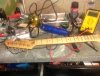
IMG_4026.JPG A clean work bench is a sign of undetected insanity and to much free time. My bench is an on going natural event. Stuff get lost even when I am in a coma. A prayer to Saint Anthony and bong it's there. I ask no questions just like the lady that cuts my hair. She can't see but we all leave with both ears! She is beautiful but she stopped smoking and ballooned up. She started again and now she can get a free mustache any day that ends in a " Y " on my work bench even.
 
No thanks. A bench like that is a really good way of scratching your customers' guitars. That is if they don't just walk out when they see it.
 
Those videos give a guy a time to do fancy playing. With iPad speakers or ear buds it is very hard to tell the difference. Take the guitar a part and lets take a look.
 
No thanks. A bench like that is a really good way of scratching your customers' guitars. That is if they don't just walk out when they see it.
I just work on my stuff and friends guitars. Of course it cleared off. I started to do this so show the neighborhood kids how change strings. This little program snow balled to all repair work, mods and even a few guitar builds. There are 9 kids that have no father, I teach them how to use tools and other stuff. This has been going on for 12 years, in that time I have never asked for one penny.
I am a MD and one of my kids was accepted to the medical school I teach in. We all had fun growing up together. I have little free time but I did try to be there for these kid. Now I am starting a college fund so any of them can go to college, I will cover the experience. I have scratches a guitar or two on the back though. No one sees it.
 
I have some copper tape arriving today. Going to spend some time this weekend lining my cavity.

But, im curious about my zebra 57, and my humming situation. I went with the zebra because I wanted a different look than my other guitars and also wanted the classic look that the 2017 les paul displays.

So, If I were to put covers on my pickups, would it 1) change the tone of my guitar? 2) would it eliminate the humming?

Im not currently planning on doing it, but I am curious of the changes, if any. As for the 57 , it is my first time using them, and I love the sound they're giving me. Fantastic.
 
I have some copper tape arriving today. Going to spend some time this weekend lining my cavity.

But, im curious about my zebra 57, and my humming situation. I went with the zebra because I wanted a different look than my other guitars and also wanted the classic look that the 2017 les paul displays.

So, If I were to put covers on my pickups, would it 1) change the tone of my guitar? 2) would it eliminate the humming?

Im not currently planning on doing it, but I am curious of the changes, if any. As for the 57 , it is my first time using them, and I love the sound they're giving me. Fantastic.

A ground problem will create a constant "buzz" or "hum" that never changes, regardless of how you move the guitar around.

Interference, from an outside source, such as RF or EMI, will change as you move the guitar around the room.

Shielding tape must have continuity to ground to be effective.
 
Oh, heck yea!
I now have a quiet guitar!

Thanks everyone...especially DonP and RobertH, for all the help.

It took a few hours, I did the wire routs as well. Overkill, I know. But....why not seeing I got the guitar apart for the third time in a week.

So, when I was done with the tape, put the guitar together, plugged her in....No Fu#@*%g sound. I almost threw it out the window. I thought better of that, put it down and relaxed for the rest of the night.

This morning I tried several things with no results....I knew it had to be the jack. I removed any tape near the jack, and shazam, SOUND! Only sweet notes, without the hum hum hum humming!

Tomorrow, my pick guard arrives, the final piece to the puzzle. Almost, there....

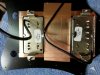
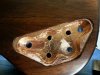
20170204_174602.jpg 20170204_145219.jpg
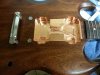
20170204_142706.jpg
 
I have been upgrading the wiring on my guitars and friends guitars for years. The wire is changed from loose strand junk to solid coated copper wire with less resistance. That makes the caps and pot deliver the amps, voltage and to the specs you choose. I replace the pots with CTS pots and caps are what ever I have. I used a paper clip on one of my guitars. I can't remember what one, I didn't have any pots, so the paper clip works fine. True thing gentlemen, no one can tell what cap is in any guitar. Someone says they can tell, I need them for invasive, painful medical experiments. Put a 500 or 550 k in place of a 250k pot can cut your head off with treble, if they are good single coil pickups.
Pay attention to the important stuff like pickups and getting your true tone out them.

I cannot listen to a guitar and tell you what tone capacitor is in it, but I can tell you that I recently changed my way of thinking regarding tone capacitors. I discovered a local luthier guy who made a breakout box, loaded with different capacitors, with a switch that enables you to switch between them while playing. I experimented with this contraption for a while and discovered that, to my ear, the PIO tone capacitors (specifically the Russian K40Y's) had more clarity, more sweetness and no hint of "muddiness" when rolling off the tone control.

I also experimented with tone cap values. I found that I liked the tone of a .033uf in the bridge and a .015uf in the neck. That was the combination I had Tone Man build for me...
 
Oh, heck yea!
I now have a quiet guitar!

Thanks everyone...especially DonP and RobertH, for all the help.

It took a few hours, I did the wire routs as well. Overkill, I know. But....why not seeing I got the guitar apart for the third time in a week.

So, when I was done with the tape, put the guitar together, plugged her in....No Fu#@*%g sound. I almost threw it out the window. I thought better of that, put it down and relaxed for the rest of the night.

This morning I tried several things with no results....I knew it had to be the jack. I removed any tape near the jack, and shazam, SOUND! Only sweet notes, without the hum hum hum humming!

Tomorrow, my pick guard arrives, the final piece to the puzzle. Almost, there....


GREAT work!!!

Like you, I also did my wire routs, 360 degrees around. I used a tiny 1/4" deep socket and pushed it through the routs to pack the tape into place. I left a large overlap at the entry/exit to each cavity. Overkill is the new normal!!!! LOL!!!!

What are the specs on those pickups you have there????
 
I cannot listen to a guitar and tell you what tone capacitor is in it, but I can tell you that I recently changed my way of thinking regarding tone capacitors. I discovered a local luthier guy who made a breakout box, loaded with different capacitors, with a switch that enables you to switch between them while playing. I experimented with this contraption for a while and discovered that, to my ear, the PIO tone capacitors (specifically the Russian K40Y's) had more clarity, more sweetness and no hint of "muddiness" when rolling off the tone control.

I do have to ask, because I am skeptical about this...

Is the luthier absolutely certain, through directly measuring the capacitors, of what their actual capacitance values are, or is he relying on their ratings? For example, if he is testing a capacitor rated for .022 mfd, did he measure that capacitor to be sure that, due to manufacturing tolerances, that it actually isn't some level higher or lower than .022 mfd?

Also, when you were switching through the capacitors, did you know what you were using before you tried it, or was it a blind test?
 
I also experimented with tone cap values. I found that I liked the tone of a .033uf in the bridge and a .015uf in the neck. That was the combination I had Tone Man build for me...

That does make sense and you're not alone. I was just looking at the current ES-335's today. I see they are using .015 uF caps in the neck. They're still using .022 uF in the bridge, though.
 
I do have to ask, because I am skeptical about this...

Is the luthier absolutely certain, through directly measuring the capacitors, of what their actual capacitance values are, or is he relying on their ratings? For example, if he is testing a capacitor rated for .022 mfd, did he measure that capacitor to be sure that, due to manufacturing tolerances, that it actually isn't some level higher or lower than .022 mfd?

Also, when you were switching through the capacitors, did you know what you were using before you tried it, or was it a blind test?

It's 100% certain that Robert didn't hear any differences due to capacitor type and construction. They were absolutely down to differences in value due to tolerance. A 20% cap can be 50% off and still meet the tolerance criteria.
 
Back
Top