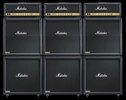
MY one and only ORANGE Super Bass JMP 100 Mk 2

Nice probe Sysco. Does it read plate current directly or use current sensing resistors?
I'm not sure. Reading Plate Voltage is pretty straightforward: Voltage is measured between cathode and plate. According to Compu-Bias manual, the wattage dissipation is measured as total dissipation through the cathode: Cathode current = Plate current + Screen current. This is followed with statement: "using the recommended Plate dissipation will afford a safety factor as some of the power is actually being dissipated in the Screen."

I don't make use of 1 ohm current sensing resistors inserted between the cathode & ground. Aside from them practically never being exactly 1 ohm,
But if the resistors have a 1% tolerances wouldn't that be close enough?

I prefer to use the "voltage drop across OT primary half divided by (DC) resistance of OT primary half" method of calculating plate current & do the same to calculate each tubes screen current.
I need to educate myself on this. But how much different could the bias readings measure between the few methods discussed here?
 
Hi sysco. To calculate (quiescent, or "no signal") screen current, first measure & note the resistance value of each screen grid resistor. Then, with the amp properly warmed up & stabilised (off standby for 10 minutes), read & note the (DC) voltage drop across each screen grid resistor. Now divide the voltage drop across each screen grid resistor by the resistance of each corresponding resistor to get current draw.
This is the same method used to calculate plate current flowing in each half of the OT primary. It is very accurate.
How much bias readings differ between methods mentioned really depends on tube type & power amp design. To give an example, in a typical Marshall (which has a low resistance filter choke) equipped with EL34's, it is not uncommon to see 8mA (or 9mA) screen current per tube at idle.
So you can see how much it can throw the bias current readings "off". Cheers

Edit; The Marstran site (in the "technical info" section) has a very good instruction for this method of biasing. It does show example figures for a duet of power tubes, to use for a quad you need to double the figures. Cheers
 
Last edited:
Ivan, I may be off or you may have addressed this but I need to ask.
Somewhere along the diagnosing of my 100 Watter, I was advised to take readings with the Power tubes out. I am thinking I recollect it was when taking the reading of the screen grid resistors.

Can you walk my through the logic here. I believe I told the fella who suggested it that I had taken the resistor readings, but with tubes in. I think it was maybe Ampmadscientist or another Marshall amp forum member. Does it make a difference in taking this reading or any other important one if the tubes are installed or out?
 
Does it make a difference in taking this reading or any other important one if the tubes are installed or out?
The measured DC voltages should drop a bit when the tubes are installed. I'm guessing that measuring voltages with no tubes installed is like a safety precaution. It you spot a voltage reading that is way off spec, then you shouldn't install the tubes until you correct the problem... :hmmm:
 
Thanks, eclectic. It came to me with a few warts, but I have acquired some key maintenance parts it will need. With the most major issue resolved with a new set of tubes, I am psyched to get the new filter caps installed, to get a few resistors and coupling back to spec and wire up the new Ohms selector. Other than that, my initial tests point to things being within spec.
 
My favorite part on the Eden was the Eden amps have good reputations, and it only cost me $35.
If all goes well on this little bass head or it doesn't, It will still be a $35 cheap enough electronics school type lesson.

Win/ Win situation as I see it.
 
Ivan, I may be off or you may have addressed this but I need to ask.
Somewhere along the diagnosing of my 100 Watter, I was advised to take readings with the Power tubes out. I am thinking I recollect it was when taking the reading of the screen grid resistors.

Can you walk my through the logic here. I believe I told the fella who suggested it that I had taken the resistor readings, but with tubes in. I think it was maybe Ampmadscientist or another Marshall amp forum member. Does it make a difference in taking this reading or any other important one if the tubes are installed or out?
Yes, the first DC voltage testing should be done with no power tubes installed.
We have the pre-amp tubes fitted so that there is current flowing in the pre-amp, lowering the pre-amp HT nodes enough that the pre-amp filter caps voltage rating & coupling cap DC withstand rating isnt exceeded by a completely un-loaded HT rail.
We leave the power tubes out for a few reasons;
1) So that we can make sure that the negative bias voltage is present at pin 5 (control grid pins) of all power tube sockets. This is of critical importance & should be the first DC voltage checked.
2) So we can make sure that the negative bias voltage is set to the maximum setting (largest available negative voltage) before the power tubes are fitted.
3) So that we don't risk damaging/ruining the power tubes (due to no bias voltage being present, or the bias voltage not being set high enough) while doing voltage checks.

Be aware that with no power tubes fitted, DC voltages can be 10 to 15% higher than what they normally would be (with the power tubes fitted & properly biased). Cheers
 
Last edited:
Back
Top