

syscokid
Ambassador of War & Peace

Why would anybody do this? Answer: The heater AC voltage is too high for best tube life. Optimal voltage for heating up our tube's filaments is 3.15 vac per side, or 6.3 vac total. What is a safe operating range? Answer: 6.3 volts +/- 10% or 5.7 to 6.9v. Just so happens that one of my amps is putting out 6.8 vac. Not dangerous, but borderline high, and probably will reduce tube life. Now, would be a great opportunity to apply this mod that I just learned from the robrobinette.com website.
I needed to drop a total of a half of a volt with a couple of resistors. Calculating the proper value of the resistors involves knowing the current draw of each tube and how much voltage needs to be dropped. The results are .06 ohms per resistor with a 5 watt rating per resistor. The only source I found for these resistors was at Mouser.com. About $1.50 each.
I also wanted to install a tag strip board to secure the two new resistors. I bought a single piece strip with 8 lugs. 2 of the lugs are connected to a ground and mounting lug. I cut it in half, and grounded off the lugs that I wont be using:
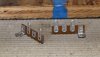
Modified strips installed. Voltage dropping resistors installed. Heater wiring reconnected:

Just a broader look at this mod:
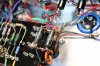
The final results: The heater voltage has been reduced to 6.28 vac, or 3.14 per side... Perfect... . No extra noise, too. In fact I think it's a tad bit quieter!
I needed to drop a total of a half of a volt with a couple of resistors. Calculating the proper value of the resistors involves knowing the current draw of each tube and how much voltage needs to be dropped. The results are .06 ohms per resistor with a 5 watt rating per resistor. The only source I found for these resistors was at Mouser.com. About $1.50 each.
I also wanted to install a tag strip board to secure the two new resistors. I bought a single piece strip with 8 lugs. 2 of the lugs are connected to a ground and mounting lug. I cut it in half, and grounded off the lugs that I wont be using:
Modified strips installed. Voltage dropping resistors installed. Heater wiring reconnected:
Just a broader look at this mod:
The final results: The heater voltage has been reduced to 6.28 vac, or 3.14 per side... Perfect...
. No extra noise, too. In fact I think it's a tad bit quieter!

 It was 120 to 121vac! I've seen our household above 123vac many times.


 ... Must have been a good night's sleep:

