ivan H
Ambassador of Tubes & Grooves

Hi everyone. As, aside from PM's with our buddy Chilli I haven't been here for a couple of weeks I though I'd best show what has been taking up my spare time. 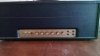
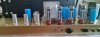 This build was a long time in the making, firstly as I wanted to use as many "period correct" NOS components as possible & secondly as during construction I had a few interuptions (family visits over Easter, waiting on NOS pre amp tubes & other components to arrive etc). The amp is build to early '69 specs, the very last evolution of the Plexi, just before the change to brushed aluminium metal panel amps.
The headcab, chassis, electrolytic filter capacitors (ARS 50uf/50uf/500v dual cans), CTS potentiometers & all hardware were sourced through Valvestorm.
Transformers are from Merren Audio, a little more costly than Marstran or Heyboer (who I usually use), but I went with Merren after being advised (by a very knowledgeable UK builder) that his C1998 output transformer had the edge over the others. I am happy with his manufacturing services but not really impressed with the transformers being shipped "single boxed". A few dents in the end bells can be seen as a result. I chose not to try removing them as sheet metal stretches when dented & I didn't want to make things worse.
The filter choke is a 3 Henry job from Classic Tone. Measured DC resistance is 117 ohms.
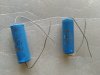
All resistors (Iskra & Piher) & coupling caps (Philips Mullard mustards & RS dogbones) are period correct NOS items.
The tag board is not "period correct", rather an FR4 fibreglass item that I turreted up myself. I could have used phenolic material but have heard of people experiencing "leakage" with some currently available phenolic boards & didn't want to risk it. I think this stuff looks reasonable.
So, a couple of pic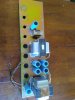
Above is early into the build. Note the period correct McMurdo octal valve sockets.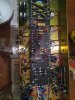
Above, all valve heater wiring done, output transformer wired in. I apologize for no pic without the board in. The twisted output transformer primary & secondary leads are kept well seperated (unseen) under the board , crossing each other near V5 & V6. The board is all wired to the valve sockets, input jack sockets & control potentiometers. Before fitting the potentiometers they were opened up & had their values carefully "doctored" to the following values;
Volume 1 & 2 pots, 1.3 Meg.
Treble pot, 330k.
Middle pot, 29k.
Bass pot, 1.1 Meg.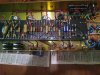
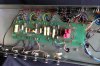
Above; Almost complete. The rectifier, screen filter balance resistors & PT HT secondary center tap are not yet properly wired, in order that the filter caps can be properly formed/conditioned by "current limiting" them (100k resistor).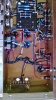
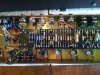
Above; Power transformer wiring. Small tag board is the AC voltage selector. The power transformer has dual high voltage secondary taps. Note the large 3 pole, double throw standby switch that allows switching between a B+ of 506V & 466V (center position "standby").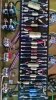 Above, the completed board. Note the red "dogbone" bright cap on volume 1. I did try a Lemco 4,700pf ceramic disk cap, as is usually seen in this position however it was quite hissy so I used the 5000pf RS dogbone which is much quieter.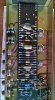
As these chassis allow for 4 pre amp tubes (1st one has cover fitted), I used a full length tag board, in case I decide to add something like a (switchable) Caswell #39 mod circuit. If not the extra length can either stay as is or be cut off.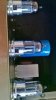
Pre amp tubes are all NOS. V1 is an RTC branded Mullard Blackburn 163 series ECC83. V2 is a Brimar CV4004 (box plate) 12AX7 & V3 is another RTC branded Mullard 163 series ECC83.
Power tubes are (at the moment) new production Svetlana EL34's, however I do have a quad of NOS/NIB Mullard xf2 (single halo) EL34's on the way. These are biased at 65% of maximum plate dissipation.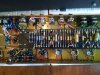
Note the two paralleled resistors (total value 6k8) wired on the back of the standby switch (left of the two white wires). These maintain correct bias of the power tubes whether switched to 506V B+ or 466V B+.
In 506V mode the bias voltage is -46.7V. In 466V mode the bias voltage is -42.2V.
After doing all AC voltage checks, forming/conditioning the filter caps & properly biasing the power tubes I took it to our rehearsal space for play tests. So far I have put an hour on it last Wednesday night & another hour on it on Thursday night. As I was worried about blowing greenbacks in my 1960ATV cab I used a buddy's creamback loaded cab. With no signal applied the amp is very quiet, with just a small amount of hiss on the bright channel, which is normal. Now I know that there is only a 3db volume difference between a 50 Watter & a 100 Watter, but man, this thing is LOUD. Plugged into the bright channel high input, with the volume almost to 4 (unused normal volume at 5) it is noticeably louder than my 50 watters "cranked".
So how does it sound? Well, very good. I've only used the bright channel high input (almost to 4 on the volume), but at that setting it has a (remarkably) cleaner tone than my 50 Watter set similarly, with noticeably higher headroom & quite better touch response. Excellent response to picking dynamics. I didn't want to push it straight off, but at that volume setting it's starting to get a powerful light crunch tone happening that cleaned up really well with the guitars volume control. Not quite as bright as my 50 Watter but has great upper mid clarity. With my SG (T top type bridge pup) I was enjoying close to an early Angus/ACDC tone (a little higher volume setting would nail it). Im looking forward to further exploring this amp, it's controls & capabilities. I know that as more hours are put on it all components will settle in & the tone will open up more. Really looking forward to seeing what it will do when pushed, too. Cheers
This build was a long time in the making, firstly as I wanted to use as many "period correct" NOS components as possible & secondly as during construction I had a few interuptions (family visits over Easter, waiting on NOS pre amp tubes & other components to arrive etc). The amp is build to early '69 specs, the very last evolution of the Plexi, just before the change to brushed aluminium metal panel amps.The headcab, chassis, electrolytic filter capacitors (ARS 50uf/50uf/500v dual cans), CTS potentiometers & all hardware were sourced through Valvestorm.
Transformers are from Merren Audio, a little more costly than Marstran or Heyboer (who I usually use), but I went with Merren after being advised (by a very knowledgeable UK builder) that his C1998 output transformer had the edge over the others. I am happy with his manufacturing services but not really impressed with the transformers being shipped "single boxed". A few dents in the end bells can be seen as a result. I chose not to try removing them as sheet metal stretches when dented & I didn't want to make things worse.
The filter choke is a 3 Henry job from Classic Tone. Measured DC resistance is 117 ohms.
All resistors (Iskra & Piher) & coupling caps (Philips Mullard mustards & RS dogbones) are period correct NOS items.
The tag board is not "period correct", rather an FR4 fibreglass item that I turreted up myself. I could have used phenolic material but have heard of people experiencing "leakage" with some currently available phenolic boards & didn't want to risk it. I think this stuff looks reasonable.
So, a couple of pic
Above is early into the build. Note the period correct McMurdo octal valve sockets.
Above, all valve heater wiring done, output transformer wired in. I apologize for no pic without the board in. The twisted output transformer primary & secondary leads are kept well seperated (unseen) under the board , crossing each other near V5 & V6. The board is all wired to the valve sockets, input jack sockets & control potentiometers. Before fitting the potentiometers they were opened up & had their values carefully "doctored" to the following values;
Volume 1 & 2 pots, 1.3 Meg.
Treble pot, 330k.
Middle pot, 29k.
Bass pot, 1.1 Meg.
Above; Almost complete. The rectifier, screen filter balance resistors & PT HT secondary center tap are not yet properly wired, in order that the filter caps can be properly formed/conditioned by "current limiting" them (100k resistor).
Above; Power transformer wiring. Small tag board is the AC voltage selector. The power transformer has dual high voltage secondary taps. Note the large 3 pole, double throw standby switch that allows switching between a B+ of 506V & 466V (center position "standby").
Above, the completed board. Note the red "dogbone" bright cap on volume 1. I did try a Lemco 4,700pf ceramic disk cap, as is usually seen in this position however it was quite hissy so I used the 5000pf RS dogbone which is much quieter.As these chassis allow for 4 pre amp tubes (1st one has cover fitted), I used a full length tag board, in case I decide to add something like a (switchable) Caswell #39 mod circuit. If not the extra length can either stay as is or be cut off.
Pre amp tubes are all NOS. V1 is an RTC branded Mullard Blackburn 163 series ECC83. V2 is a Brimar CV4004 (box plate) 12AX7 & V3 is another RTC branded Mullard 163 series ECC83.
Power tubes are (at the moment) new production Svetlana EL34's, however I do have a quad of NOS/NIB Mullard xf2 (single halo) EL34's on the way. These are biased at 65% of maximum plate dissipation.
Note the two paralleled resistors (total value 6k8) wired on the back of the standby switch (left of the two white wires). These maintain correct bias of the power tubes whether switched to 506V B+ or 466V B+.
In 506V mode the bias voltage is -46.7V. In 466V mode the bias voltage is -42.2V.
After doing all AC voltage checks, forming/conditioning the filter caps & properly biasing the power tubes I took it to our rehearsal space for play tests. So far I have put an hour on it last Wednesday night & another hour on it on Thursday night. As I was worried about blowing greenbacks in my 1960ATV cab I used a buddy's creamback loaded cab. With no signal applied the amp is very quiet, with just a small amount of hiss on the bright channel, which is normal. Now I know that there is only a 3db volume difference between a 50 Watter & a 100 Watter, but man, this thing is LOUD. Plugged into the bright channel high input, with the volume almost to 4 (unused normal volume at 5) it is noticeably louder than my 50 watters "cranked".
So how does it sound? Well, very good. I've only used the bright channel high input (almost to 4 on the volume), but at that setting it has a (remarkably) cleaner tone than my 50 Watter set similarly, with noticeably higher headroom & quite better touch response. Excellent response to picking dynamics. I didn't want to push it straight off, but at that volume setting it's starting to get a powerful light crunch tone happening that cleaned up really well with the guitars volume control. Not quite as bright as my 50 Watter but has great upper mid clarity. With my SG (T top type bridge pup) I was enjoying close to an early Angus/ACDC tone (a little higher volume setting would nail it). Im looking forward to further exploring this amp, it's controls & capabilities. I know that as more hours are put on it all components will settle in & the tone will open up more. Really looking forward to seeing what it will do when pushed, too. Cheers
Last edited: