Invaluable info for educational rescources to learn for Electronics

Another invaluable guy I found who will aid me in my particular amp the 1978 Superlead/Superbass I acquired. I posted this video elsewhere, but possibly some may have missed this there.

 
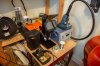
Here's my soldering and rework stuff, all together on a board so I can take it where I need it. The soldering iron is my one real extravagance - a Metcal. The micorscope is an Andonstar and the hot air gun is Hunko. I got that reel of solder about 55 years ago, and it's going somewhere in my will.

soldering-station.jpg
 
Here's my soldering and rework stuff, all together on a board so I can take it where I need it. The soldering iron is my one real extravagance - a Metcal. The micorscope is an Andonstar and the hot air gun is Hunko. I got that reel of solder about 55 years ago, and it's going somewhere in my will.

View attachment 24635

Don, I can see how nice it is to operate at that station, and was going to mention your microscope since you mentioned it in previous threads for high quality viewing of solder joints etc. I have seen demo's of hot air guns, and have considered acquiring one, once I get a few more bucks allocated.
 
Another way I have researched is whenever I find a topic, component, design component in amps etc, I often have to google for the explanation and then pore over explanations. Then if I need clarification I often ask our more experienced members here to help me understand.

Here is another fella I like to learn from.


Last edited:
Cat III is OK. There is actually quite a lot of margin built into that, and you aren't likely to come across anything that should bother it.
 
Don, I kind of gathered, since you reviewed my specs before and didn't seem overly concerned.

I still am hoping to come by a few Fluke meters to have as additional tools in my arsenal. One can never be less able if they have a good tool for the job. I really liked having 2 identical Kleins where we can see readings simultaneously like in doing testing of those 2 caps and plate dissipations and setting bias
 
Last edited:
Buying Used gear, Mouse eaten wires, Bad Tubes, Unscrupulous sellers.

Here are some other lessons I've learned buying gear on the used market. My Laney head was finicky in the high stage input jack of the amp.
It would play but I had to fiddle with the cord plug end to get good signal. Thought it was simply a need new jack scenario. But when the amp would run awhile, then make some funny sounds, or the strength of sound fluctuated up and down in volume, I decided to look under the hood.
Turns out mice had chewed some wires and possibly a coupling cap.

And if some of you don't know, I got my latest amp and despite it playing nicely at the seller's house, the first time I plugged it in at home, it blew fuses and made flashes inside V7 of the 6550 tubes as soon as I'd take it off standby. The culprit was a tube so bad, it caused the Amplirex 1000 AT tube tester to shut down into self protect mode when the guy testing the tubes for me started to run the testing. Turns out 3 of the 6550's tested bad and at least V3 of the 12 ax7's also tested bad.

Unscrupulous sellers: even though some tube sellers claimed their preamp tubes I bought off ebay tested good, The Amplirex tester my new tube guy used gave at least 1/2 of them a failing grade specs wise. So, if anyone does have some type issue on their amps, have the tubes tested and then proceed accordingly.

You are a sharp cookie. I would have most patience with it long before fixing it.
 
Cat III is OK. There is actually quite a lot of margin built into that, and you aren't likely to come across anything that should bother it.
This is good to know.

Do you, or anyone else, know how to verify a digital multi meter's accuracy?
 
This is good to know.

Do you, or anyone else, know how to verify a digital multi meter's accuracy?

Don't even think about it. Digital multimeters - even the cheapest - are accurate to a small fraction of a percent. Where the cheapest show their limitations is inAC measurements, where they may be accurate only up to a few kHz.
 
Don't even think about it. Digital multimeters - even the cheapest - are accurate to a small fraction of a percent. Where the cheapest show their limitations is inAC measurements, where they may be accurate only up to a few kHz.
This is also good to know. Muchas gracias Señor DonP... :cheers:
 
A good resource in individual articles regarding tube circuits is the Merlin Blencowe Valve Wizard pages.
How to design valve guitar amplifiers
I got this book over 10 years ago. Last time I looked at it was 9 1/2 years ago. It's way over my head, and I'm too impatient. I should try again though... :hmmm:

Nice thread.
A good resource in individual articles regarding tube circuits is the Merlin Blencowe Valve Wizard pages.
How to design valve guitar amplifiers

dont forget Rob Robinette's tube amp pages - TONS of good stuff here.

How Amps Work
All kinds of good stuff! The name just rolls right off the tongue...:dood:
 
Back
Top