Staggered string hole pattern on Tele

RVA

Ambassador
Mates,

I have the below string hole pattern on my SX Tele. It is making it difficult to match toa replacement bridge. The only reason I could think of for this is to assist intonation, which is not necessary with adjustable saddles. This does not seem to be common as and most teles I found have straight hole patterns. Any idea why this is done?
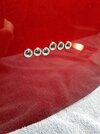
20190127_181551.jpg
 
I owned a couple SX tele's that had that too. I think both the SX tele's I had ended up going to a bass player who's band gigged regularly. The guitar player was playing the one sx tele live regulary - I guess he loved it and kept trying to get if from the bass player.
 
Not a clue RVA. With adjustable saddles theres no need for such a thing as you say. Even with the old 3 barrel brass string saddles its not nessasary to have that.
 
No idea why; mine is like that as well.
I never considered it a problem as I kept the stock bridge with but upgraded the block type saddles.
 
Mates,

I have the below string hole pattern on my SX Tele. It is making it difficult to match toa replacement bridge. The only reason I could think of for this is to assist intonation, which is not necessary with adjustable saddles. This does not seem to be common as and most teles I found have straight hole patterns. Any idea why this is done?

View attachment 21693

My opinion?

It's just for looks. You'll see string hole patterns in a variety of shapes on various guitars: Z-pattern, V-pattern, Straight, etc....

Not every design feature on a guitar has, or even needs to have, a functional purpose.

It fine to do some things just for the visual interest.
 
My opinion?

It's just for looks. You'll see string hole patterns in a variety of shapes on various guitars: Z-pattern, V-pattern, Straight, etc....

Not every design feature on a guitar has, or even needs to have, a functional purpose.

It fine to do some things just for the visual interest.
The issue is that it precludes a replacement bridge.

Okay..I looked up a picture of an SX Tele. I think I spoke too soon in my previous post.

I think I see what they’re doing. What they are trying to do is match the string-through pattern to the geometry of the saddles that generally results when properly intonated. This will allow the string to rise straight up and over saddles.

It could have been designed differently, such as how in a Strat the holes are aligned in a straight line in the string block, yet still pass over staggered saddles. Though, in the Strat the string breaks forward at an angled toward the saddle, as the string exits the bridge plate. The slots in a Strat saddle look to be a little longer than what the slots appear to be in the SX.

I think in the SX they were just trying to position the string-through holes a little more closely to where the saddle would be, minimizing the forward bend of the string as it exits the plate.
 
Last edited:
Mates,

I have the below string hole pattern on my SX Tele. It is making it difficult to match toa replacement bridge. The only reason I could think of for this is to assist intonation, which is not necessary with adjustable saddles. This does not seem to be common as and most teles I found have straight hole patterns. Any idea why this is done?

View attachment 21693

Never understand why they do that. It will not alter intonation.
 
  • Like
Reactions: RVA
From reading the links it was just a bad idea requested by a lot of people...


Never understand why they do that. It will not alter intonation.

Now that I’ve taken a closer look at the staggered hole spacing, compared to non-staggered spacing, I’m thinking it makes some sense. But, the reason I think it makes some sense has nothing to do with iimproving intonation.

As I described earlier (using a Strat bridge as an example, though the same situation exists with a Tele bridge), where the string exits the bridge plate, it makes a bend against the edge of the bridge plate toward the saddle. Then, it makes a shallower bend over the saddle, which is more gradually rounded than the comparatively sharper edge of the bridge plate.

What the SX string hole geometry appears to do is to try to position the exit point of the string closer to the likely position of the intonated saddle, minimizing how sharply the string bends against the edge of the bridge plate.

One benefit I can see is that it may lessen string breakage where the string bends against the edge of the bridge plate.
 
Last edited:
  • Like
Reactions: RVA
Back
Top