Gibson Static Electricity:

Inspector #20

Ambassador of Tone
Fallen Star
Country flag
Found this on the web and thought it contained helpful information:

Sorry for the delay here, but I have an update. I received a new "still in box" Traditional last Thursday. I didn't get to really play it until Saturday, and it also creates "static" noise through the amp when I brush my hand across the back -exactly like the first one. It's louder near the plastic cover (covers the pots) where the wiring enters the body. My wife ran her hand across the back and we could barely hear any static noise at all. It was hardly noticeable. (Maybe it's me. I have a friend coming over on Wednesday and I'llsee what happens when he plays it.)

So I called Gibson this morning and they told me that they use an electrostatic charge on the guitars while they are painting them. (This is comon in a number of industries, and I've seen it in several automotive applications.) They told me it would likely go away in a few weeks. Their tech also talked about dry weather and carpeting which can cause the noise. The retailer recommended that I play it for a few weeks and then see if it settles in okay. If not, they will get me still another one. But this one is really nice! I'll post some pics when I can - likely this weekend.

I have another question: the guitar was set up quite nicely from the factory. Intonation was near perfect (save for the B string) and string height was just to my liking. However, I do hear a very, very slight string buzz on all strings from the 11th up to the 6th fret only when the guitar is not plugged in. When I'm using an amp, the buzz is negligible. In fact, I can't hear it at all. It looks like the 15th fret might be a bit high - using a straight edge, it "see-saws" over the 15th fret. Is this common? Or is it a condition with which I should have much concern?

Assuming the noise abates, I'm thinking that I'll play it for maybe three or four months and then take to a local tech for a set up. That's what I've done with my acoustics over the years. Does that make sense?

Thanks for your input and counsel.
 
Last edited:
More on the subject - posted here from a different guitar forum:

I recently posted that I had a ton of static coming through my BRAND NEW Gibson SG. We decided collectively that it was a problem with the shielding in the electronics. Well, BINGO!!!! Gibson is no longer shielding the electronics in all of their guitars. This includes (but is not limited to) seemingly higher end Les Pauls and SGs.

Given the fact that Guitar Center did not know about this, they fixed mine free of charge. It would have cost me $80 to have it done (not a big deal but I had just dropped $1300 on it!!).

It works fine now and plays great! I'm really happy with the guitar now that it works the way it should. I would advise looking into this though before picking up a newer Gibson electric. To test it out, plug it in and turn up a bit. Rub your hand over the plate on the back of the guitar behind the pots. Also, rub it against your shirt and pants. You'll most likely hear some crackling. If you still want the guitar, point it out to the sales person and see if they will shield the electronics for you before you buy it. If you are buying online or used from someone, well, I don't know what to tell you.

I don't know why Gibson is letting these out like this! One of the worst ones I plugged in was a $2700 Les Paul. It was a beautiful piece but if you pay this much and get it home only to hear static coming through your playing, well, that's just unacceptable to me!

Anyhow, hope this helps.
 
Last edited:
Another aspect that can reek havoc on electronics are transformers and dimmer switches.
I had my amp plugged in and guitar cord in socket. No guitar at all. Dimmer switch was on in living room below. Turned off switch and amp was as quiet as it was the day before.

Also Robert, I am unclear about your first 2 posts here. Was it actually you who got GC to fix the guitar? Did squealing pickups stop squealing and tone etc approach what you expected when you bought the guitar?

I see your other thread about Tone Man controls. Good stuff and hope you get the SG to a 100% confident to go to guitar really soon.
 
Hey, Chili...

Those first two posts were ones I found on the web and I posted them here because I thought they contained helpful information....
 
Robert, that is what I thought.

Also, my issues I had with my faded were not ones I encountered when it was new. I bought that guitar used and test drove it and heard the issues but bought anyway knowing I could easily fix em cheaply enough.
 
Another aspect that can reek havoc on electronics are transformers and dimmer switches.
I had my amp plugged in and guitar cord in socket. No guitar at all. Dimmer switch was on in living room below. Turned off switch and amp was as quiet as it was the day before.

Also Robert, I am unclear about your first 2 posts here. Was it actually you who got GC to fix the guitar? Did squealing pickups stop squealing and tone etc approach what you expected when you bought the guitar?

I see your other thread about Tone Man controls. Good stuff and hope you get the SG to a 100% confident to go to guitar really soon.


Chili,

On my SG, I decided to fix it myself, rather than surrender it to Gibson warranty and wait 6-8 weeks for them to be able to look at it. The pickups still buzz loudly when touched, squeals at high stage volume and the bridge tone becomes increasingly thinner as you in crease the volume. The guitar also creates an incredible amount of static electricity....

On the positive, its as loud as an acoustic when unplugged, it stays in tune 100% of the time with the Gibson Green keys (totally stock) and I love the feel, so I decided to invest in it.

Ok, on the static electricity issue...I have given this a lot of thought. The body of the guitar is stained and oiled. Both of these treatments actually enable a light electrical charge to pass through the instrument. I believe, that since there are literally hundreds of newer Gibson's on the Web with the same static issue, that there has to be something that can be correlated to all of them.

Gibson claims it is caused because they use electro-statically charged equipment in the finish department. If that is true, the static would eventually dissipate. However, if you study the problems people are having, the static returns, even after anti-static treatments. This leads me to believe the guitar is generating its static.

I think the lack of shielding is only one issue. the back of the PCB has exposed solder joints. One some of the Gibson guitars with boards I have examined recently, the solder joints actually left an imprint in the body cavity. I firmly believe this is the path that transient voltage is being sent into the instrument. So, in order to shield a Gibson with a PCB, you would need to apply black electrical tape to the solder joints on the back of the PCB.

Pickups - Gibson has confirmed to me that the "T Series" (traditional) instruments, and some of the re-issues, are intentionally produced with unspotted pickups for their historical nature. My 2016 T-Series SG was confirmed to have unspotted pickups. Not only did Gibson tell me this, I confirmed it by a physical inspection. I recently saw a set of pickups from a 61 re-issue Gibson SG that were unpotted. It was also confirmed that Gibson now pots all their over-the-counter pickups.

I do not think my PCB is a problem. It is just easier to replace pickups without having to deal with the 5 pin Molex connectors...
 
Robert, that is what I thought.

Also, my issues I had with my faded were not ones I encountered when it was new. I bought that guitar used and test drove it and heard the issues but bought anyway knowing I could easily fix em cheaply enough.

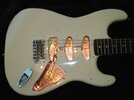
My old 1987 Stratocaster has been used on hundreds of studio recordings. I shielded it many years ago with copper tape from Carvin. It is so quiet that I sometimes have to check the volume knob because I think it has been rolled off...and that's with the gain on a tube Marshall at halfway....

That's my standard for evaluating this Gibson...

Stratoblaster Copper Shielding Tape.jpg
 
Chili,

On my SG, I decided to fix it myself, rather than surrender it to Gibson warranty and wait 6-8 weeks for them to be able to look at it. The pickups still buzz loudly when touched, squeals at high stage volume and the bridge tone becomes increasingly thinner as you in crease the volume. The guitar also creates an incredible amount of static electricity....

On the positive, its as loud as an acoustic when unplugged, it stays in tune 100% of the time with the Gibson Green keys (totally stock) and I love the feel, so I decided to invest in it.

Ok, on the static electricity issue...I have given this a lot of thought. The body of the guitar is stained and oiled. Both of these treatments actually enable a light electrical charge to pass through the instrument. I believe, that since there are literally hundreds of newer Gibson's on the Web with the same static issue, that there has to be something that can be correlated to all of them.

Gibson claims it is caused because they use electro-statically charged equipment in the finish department. If that is true, the static would eventually dissipate. However, if you study the problems people are having, the static returns, even after anti-static treatments. This leads me to believe the guitar is generating its static.

I think the lack of shielding is only one issue. the back of the PCB has exposed solder joints. One some of the Gibson guitars with boards I have examined recently, the solder joints actually left an imprint in the body cavity. I firmly believe this is the path that transient voltage is being sent into the instrument. So, in order to shield a Gibson with a PCB, you would need to apply black electrical tape to the solder joints on the back of the PCB.

Pickups - Gibson has confirmed to me that the "T Series" (traditional) instruments, and some of the re-issues, are intentionally produced with unspotted pickups for their historical nature. My 2016 T-Series SG was confirmed to have unspotted pickups. Not only did Gibson tell me this, I confirmed it by a physical inspection. I recently saw a set of pickups from a 61 re-issue Gibson SG that were unpotted. It was also confirmed that Gibson now pots all their over-the-counter pickups.

I do not think my PCB is a problem. It is just easier to replace pickups without having to deal with the 5 pin Molex connectors...
You know, if the finish on your guitar is transmitting electricity, you could put the multi meter probes on it, and it will have continuity.

But there are lots of other possible sources of noise. The human body also produces a electric field, some people more then others. Your clothes build static charge. Your phone is actually a pretty serious trasmitter, I've heard mine screw with wireless headphones, and older cassette decks and car stereos.

Gibson ships these guitars now without even the most basic shielding, so there's really nothing to prevent any interference of any kind getting into the signal.

Which just seems stupid to me because they used to shield guitars, and there is more electrical noise in the modern home then practically anywhere else at any time in history. So if it was ever needed, Now is the time.
 
Gibson claims it is caused because they use electro-statically charged equipment in the finish department. If that is true, the static would eventually dissipate. However, if you study the problems people are having, the static returns, even after anti-static treatments. This leads me to believe the guitar is generating its static.

They use that equipment to get the finish to adhere faster and better, the static goes away after about 6 months IME. Duration probably has something to do with average ambient temps, humidity, etc. My LP had a very strong charge when new and nothing now after a year. My Firebird is only 4 months old and still has some charge, especially when I touch the pickguard while playing. It too will dissipate in time.
 
I noticed the lack of shielding when I first plugged my new faded SG in.

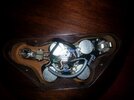
There's no shielding at all, not even antistatic paint in the cavities. just like shown in Chili's picture.

This makes the guitar hum like a strat when I take both hands away from the strings.

I think this is a negative point for Gibson. My Am. Std. Strat came entirely noise-free (except for the 60 cycle hum) and perfectly shielded from the factory.
 
I noticed the lack of shielding when I first plugged my new faded SG in.

There's no shielding at all, not even antistatic paint in the cavities. just like shown in Chili's picture.

This makes the guitar hum like a strat when I take both hands away from the strings.

I think this is a negative point for Gibson. My Am. Std. Strat came entirely noise-free (except for the 60 cycle hum) and perfectly shielded from the factory.

Well-known problem, and the absolutely vital thing is to get some shielding tape onto the cover plate for the controls - grounded of course. That will stop the hum when you take your hands off. Same for the pickup cavity, but not quite so important.
 
I noticed the lack of shielding when I first plugged my new faded SG in.

There's no shielding at all, not even antistatic paint in the cavities. just like shown in Chili's picture.

This makes the guitar hum like a strat when I take both hands away from the strings.

I think this is a negative point for Gibson. My Am. Std. Strat came entirely noise-free (except for the 60 cycle hum) and perfectly shielded from the factory.
Thats how my sg future came as well, nothing in the cavity but finish overspray. the first thing I did to it was swap on the shielded and better quality plastic cover from my old epiphone. That helped but eventually I shielded the whole cavity with aluminum duct reapir tape, and that seems to have eliminated alll the hum from the guitar.
I still have some hum sometimes, but that's because I play very high gain garage rock and metal out a noise gate, and there is some noise from my distortion pedals. At more tasteful gain settings it has been eliminated.
 
Thats how my sg future came as well, nothing in the cavity but finish overspray. the first thing I did to it was swap on the shielded and better quality plastic cover from my old epiphone. That helped but eventually I shielded the whole cavity with aluminum duct reapir tape, and that seems to have eliminated alll the hum from the guitar.
I still have some hum sometimes, but that's because I play very high gain garage rock and metal out a noise gate, and there is some noise from my distortion pedals. At more tasteful gain settings it has been eliminated.

How did you do the grounding?
 
Thats how my sg future came as well, nothing in the cavity but finish overspray. the first thing I did to it was swap on the shielded and better quality plastic cover from my old epiphone. That helped but eventually I shielded the whole cavity with aluminum duct reapir tape, and that seems to have eliminated alll the hum from the guitar.
I still have some hum sometimes, but that's because I play very high gain garage rock and metal out a noise gate, and there is some noise from my distortion pedals. At more tasteful gain settings it has been eliminated.

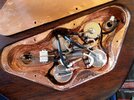
Yes...2016 and zero shielding of any kind.

If I keep the PCB, I have already figured out I can put black tape over the solder points on the back of the PCB and keep it from shorting....I will assume the threaded shaft of a PCB mounted pot is still grounded like a regular pot...???

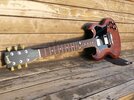
Gibson 2016 SG.jpg
 
You know, if the finish on your guitar is transmitting electricity, you could put the multi meter probes on it, and it will have continuity.

But there are lots of other possible sources of noise. The human body also produces a electric field, some people more then others. Your clothes build static charge. Your phone is actually a pretty serious trasmitter, I've heard mine screw with wireless headphones, and older cassette decks and car stereos.

Gibson ships these guitars now without even the most basic shielding, so there's really nothing to prevent any interference of any kind getting into the signal.

Which just seems stupid to me because they used to shield guitars, and there is more electrical noise in the modern home then practically anywhere else at any time in history. So if it was ever needed, Now is the time.

I have the copper tape on hand...I just need to decide if i want to keep the PCB or go to a vintage style wire setup. I honestly do not think the vintage wiring, orange drop/pio whatever really has any tonal effect you can hear with a human ear, but it does make repairs/modifications easier...
 
I noticed the lack of shielding when I first plugged my new faded SG in.

There's no shielding at all, not even antistatic paint in the cavities. just like shown in Chili's picture.

This makes the guitar hum like a strat when I take both hands away from the strings.

I think this is a negative point for Gibson. My Am. Std. Strat came entirely noise-free (except for the 60 cycle hum) and perfectly shielded from the factory.

Yep....my strange "static cling" issue went away when I shielded my SG....Maybe its because of how thin the wood is???

IMG_20170317_57431.jpg

IMG_20170307_5510.jpg
 
Back
Top