eSGEe
Ferengi Ambassador of Trade

winnerHis stream of consciousness

winnerHis stream of consciousness

His stream of consciousness
BUWAHAHAHAHAH a LOT of rocks in my stream---- a few lose screws and a hairball-- but I am TRYING to cough it up!There's a few rocks in the stream...

It works because the resistor is basically in parallel with the volume pot, so lowers the pots value. A 200k resistor in parallel with a 250k pot comes to roughly 111k. A 200k resistor in parallel with a 500k pot comes to roughly 142k. You can see from this that the effect would be more pronounced with a 500k pot, though still quite noticeable with a 250k pot. Cheers
Edit: It will also change the "taper" of the volume pot. Cheers
code?One over 2 pie r c.


The smaller the resistance value of the volume pot, the easier the highs "leak" to ground through the resistance. This is the reasoning behind using a 250k volume pot for single coil pickups (that naturally have a thinner, brighter sound) & using a 500k volume pot for humbuckers (that naturally have a thicker, darker sound due to their having roughly twice as many turns of wire in their coils). CheersAgree, but you’re talking amplitude, not frequency response. With an AC signal you need a resistor and a cap to affect frequency as a first order filter, being bled to ground (low pass filter) hence frequency response. One over 2 pie r c.
The smaller the resistance value of the volume pot, the easier the highs "leak" to ground through the resistance. This is the reasoning behind using a 250k volume pot for single coil pickups (that naturally have a thinner, brighter sound) & using a 500k volume pot for humbuckers (that naturally have a thicker, darker sound due to their having roughly twice as many turns of wire in their coils). Cheers
Edit: People will often use a 1 meg volume pot to combat a dark sounding pickup for the same reason. Cheers
Agree, but you’re talking amplitude, not frequency response. With an AC signal you need a resistor and a cap to affect frequency as a first order filter, being bled to ground (low pass filter) hence frequency response. One over 2 pie r c.
Sorry, Don....I don't always get it right, but jopefilly Bill's drawing sheds some light...
Ok, forget about the "tone circuit" & "capacitors to ground" etc, we are talking "VOLUME POT VALUE ONLY." Now there is literally soooo much info out there on this subject, if one would only look for it.But, but, in an AC circuit it will also leak the mids and the lows, there no distinction for frequency with just a resistor. A capacitor to ground is required to give the ac electrons a path leak to ground based on frequency which is determined by the charge time on the cap, which is determined by the resistor value and cap value.

But, but, in an AC circuit it will also leak the mids and the lows, there no distinction for frequency with just a resistor. A capacitor to ground is required to give the ac electrons a path leak to ground based on frequency which is determined by the charge time on the cap, which is determined by the resistor value and cap value.
Another way to think of it is that the volume pot resistance forms an LR circuit with the windings of the pickup, which is essentially an inductor.
Regardless, it is undoubtedly true that decreasing the volume pot resistance will result in a darker tone, and vice versa (to a point). I've experienced this first-hand while experimenting with different pot values in the guitars I've modded.
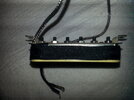
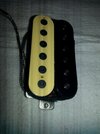
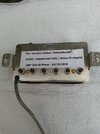
The guidance that pole pieces don’t need to be magnetic, only conductive depends on your definition of terms.
The pole piece does not need to be magnetic, meaning it does not have to be a magnet. It does have to be magnetically conductive.
The pole piece becomes magnetized by the underlying magnet and focuses the magnetic field on the strings.
This requires that the pole piece be a magnetically conductive material (known as being magnetically permeable), such as a ferrous metal, not just an electrically conductive material.
You still have the steel slugs in one coil. However, most SS alloys aren’t magnetically conductive. However, some cold-worked annealed SS alloys do exhibit some attraction to a magnet.
I’m very curious to hear your results.