You are using an out of date browser. It may not display this or other websites correctly.
You should upgrade or use an alternative browser.
You should upgrade or use an alternative browser.
Possible Upcoming Jackson Mods
- Thread starter smitty_p
- Start date
OP


Today I completed the cavity shielding process.
As some may recall, I decided to try shielding paint, instead of copper tape.
After quite a bit of hunting around, I ended up getting this product:
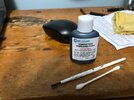
This is a paint sold by a company called, "Cat Music." It is made from fine micron graphite powder suspended in an acrylic binder. I applied it with a small paint brush (shown above). I used a Q-tip to get the paint into the wiring channels. The bottle shown above was enough for three coats. I still have a little left in that bottle. I did buy two bottles, but I only needed the one.
I bought it on eBay, but it actually came from Coulsdon, Surrey in the UK. It's pretty impressive. As mentioned, I applied three coats. After letting the first coat dry for 24 hours the total resistance from the new switch cavity to the end of the output jack cavity was around 120 ohms. After the second coat dried for 24 hours, the resistance was only about 30 ohms. After the third coat dried for about three hours the resistance was about 10 - 12 ohms. The paint seems to get more conductive as it dries, so I'll see what it's like after a full 24 hours. But, even 10 ohms is really quite good. Granted, copper would be under an ohm, but I'm pretty happy with this.
Anyhoo...
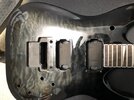
Here's just a pic from the top showing the completed painting in the pickup cavities:
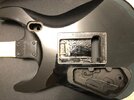
And, a shot from the back:
This shot shows the shielding grounding wire. I used a ring terminal and crimped and soldered it to the wire. After the second coat of paint had dried for 24 hours, I screwed the wire to the body. Then, I applied the third coat over top of the terminal and screw.
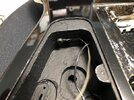
When I get the components in the cavity, I'll cut the wire to length, put some clear heat shrink over it, and solder it to my grounding buss.
Soooo...the next step is to make a template for the controls and begin soldering up the pots and caps.
As some may recall, I decided to try shielding paint, instead of copper tape.
After quite a bit of hunting around, I ended up getting this product:
This is a paint sold by a company called, "Cat Music." It is made from fine micron graphite powder suspended in an acrylic binder. I applied it with a small paint brush (shown above). I used a Q-tip to get the paint into the wiring channels. The bottle shown above was enough for three coats. I still have a little left in that bottle. I did buy two bottles, but I only needed the one.
I bought it on eBay, but it actually came from Coulsdon, Surrey in the UK. It's pretty impressive. As mentioned, I applied three coats. After letting the first coat dry for 24 hours the total resistance from the new switch cavity to the end of the output jack cavity was around 120 ohms. After the second coat dried for 24 hours, the resistance was only about 30 ohms. After the third coat dried for about three hours the resistance was about 10 - 12 ohms. The paint seems to get more conductive as it dries, so I'll see what it's like after a full 24 hours. But, even 10 ohms is really quite good. Granted, copper would be under an ohm, but I'm pretty happy with this.
Anyhoo...
Here's just a pic from the top showing the completed painting in the pickup cavities:
And, a shot from the back:
This shot shows the shielding grounding wire. I used a ring terminal and crimped and soldered it to the wire. After the second coat of paint had dried for 24 hours, I screwed the wire to the body. Then, I applied the third coat over top of the terminal and screw.
When I get the components in the cavity, I'll cut the wire to length, put some clear heat shrink over it, and solder it to my grounding buss.
Soooo...the next step is to make a template for the controls and begin soldering up the pots and caps.
Last edited:

OP
Another quick update.
I decided on a minor course correction. Much earlier in this thread I stated that I'd reuse the control cavity cover. However, I didn't like the look of it with an unused screw hole, since I had routed away one of the anchor points.
So, I got some 2.1 mm thick, plain black pick guard material from Stew-Mac and fashioned a new control cavity cover.
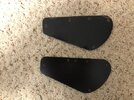
Here's a shot showing the new cover I made and the original cover. The additional hole in the top center of the original cover is the screw hole to the anchor point that I removed. My new cover is the top one.
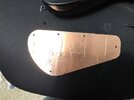
And, here's the back of the cover with copper shielding tape applied;
Here's a shot with the new cover test fitted into place. I'll remove the clear protective film when I'm all done with this project.
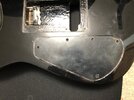
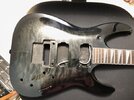
Aaaaaand, as just a little teaser...
I've got the new switch soldered up and installed!
Things will probably start going together pretty quickly now.
I decided on a minor course correction. Much earlier in this thread I stated that I'd reuse the control cavity cover. However, I didn't like the look of it with an unused screw hole, since I had routed away one of the anchor points.
So, I got some 2.1 mm thick, plain black pick guard material from Stew-Mac and fashioned a new control cavity cover.
Here's a shot showing the new cover I made and the original cover. The additional hole in the top center of the original cover is the screw hole to the anchor point that I removed. My new cover is the top one.
And, here's the back of the cover with copper shielding tape applied;
Here's a shot with the new cover test fitted into place. I'll remove the clear protective film when I'm all done with this project.
Aaaaaand, as just a little teaser...
I've got the new switch soldered up and installed!
Things will probably start going together pretty quickly now.

RVA
Ambassador
Nice work! WHat did you use to cut the cover?Another quick update.
I decided on a minor course correction. Much earlier in this thread I stated that I'd reuse the control cavity cover. However, I didn't like the look of it with an unused screw hole, since I had routed away one of the anchor points.
So, I got some 2.1 mm thick, plain black pick guard material from Stew-Mac and fashioned a new control cavity cover.
Here's a shot showing the new cover I made and the original cover. The additional hole in the top center of the original cover is the screw hole to the anchor point that I removed. My new cover is the top one.
View attachment 18894
And, here's the back of the cover with copper shielding tape applied;
View attachment 18895
Here's a shot with the new cover test fitted into place. I'll remove the clear protective film when I'm all done with this project.
View attachment 18896
Aaaaaand, as just a little teaser...
I've got the new switch soldered up and installed!
Things will probably start going together pretty quickly now.
View attachment 18897
OP
Nice work! WHat did you use to cut the cover?
First, I traced the old cover onto the new pick guard material. Then I used a utility knife to score and break the material in roughly the shape of the cover. Of course, I could only cut in straight lines doing this.
After I had the rough shape, I used a rasp to round the corners and get the shape correct. As you can imagine, I compared my progress frequently with the original cover and made multiple test fits.
Finally, I smoothed all the edges with my rubber sanding block and 320 grit sandpaper.
The last fabrication steps were to drill and countersink the holes.

syscokid
Ambassador of War & Peace
Interesting....Then I used a utility knife to score and break the material in roughly the shape of the cover. Of course, I could only cut in straight lines doing this.
How deep did you need to score the material, and did it break cleanly with little effort?
RVA
Ambassador
I was toying with mine last night and quickly realized that I do not have any quick change drill bits. I orderd the one piece type as reviews claim that the bits with a separate shaft come loose and spin in place
OP
Interesting....
How deep did you need to score the material, and did it break cleanly with little effort?
I only had to make about three or four passes with the knife (using a new blade). I suppose I may have gone about 1/4 to 1/3 of the way through. And it snaps very cleanly. The plastic isn’t really that hard. As I was rough forming around the corners I snapped the small pieces off with a pliers, after scoring.
Then I used the rasp to finish forming the corners. The rasp, itself, is not a really coarse one.
I should add, the lower, long side of the cover was a little too wide earlier in the process. I just used a hand plane to shave about 1/16” off it. Using a plane worked well.
Last edited:
syscokid
Ambassador of War & Peace
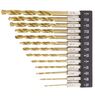
I don't understand what this type of bit looks like...?...bits with a separate shaft...
RVA
Ambassador
1 piece set that I purchasedI don't understand what this type of bit looks like...?
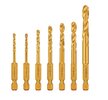
An example of a 2 piece bit
syscokid
Ambassador of War & Peace
Thanks! Never seen those 2-piece bits.1 piece set that I purchased
View attachment 18899
An example of a 2 piece bit
View attachment 18901
OP
1 piece set that I purchased
View attachment 18899
An example of a 2 piece bit
View attachment 18901
I bought the two-piece bits. I don’t recall seeing the one-piece when I got my 90 degree adapter. I only bought two bits, though.
In the future I’ll probably look for those one-piece bits.
RVA
Ambassador
Good thing, but they appear to be more common than the one piece.Thanks! Never seen those 2-piece bits.

Today I completed the cavity shielding process.
As some may recall, I decided to try shielding paint, instead of copper tape.
After quite a bit of hunting around, I ended up getting this product:
View attachment 18881
This is a paint sold by a company called, "Cat Music." It is made from fine micron graphite powder suspended in an acrylic binder. I applied it with a small paint brush (shown above). I used a Q-tip to get the paint into the wiring channels. The bottle shown above was enough for three coats. I still have a little left in that bottle. I did buy two bottles, but I only needed the one.
I bought it on eBay, but it actually came from Coulsdon, Surrey in the UK. It's pretty impressive. As mentioned, I applied three coats. After letting the first coat dry for 24 hours the total resistance from the new switch cavity to the end of the output jack cavity was around 120 ohms. After the second coat dried for 24 hours, the resistance was only about 30 ohms. After the third coat dried for about three hours the resistance was about 10 - 12 ohms. The paint seems to get more conductive as it dries, so I'll see what it's like after a full 24 hours. But, even 10 ohms is really quite good. Granted, copper would be under an ohm, but I'm pretty happy with this.
Anyhoo...
Here's just a pic from the top showing the completed painting in the pickup cavities:
View attachment 18882
And, a shot from the back:
View attachment 18883
This shot shows the shielding grounding wire. I used a ring terminal and crimped and soldered it to the wire. After the second coat of paint had dried for 24 hours, I screwed the wire to the body. Then, I applied the third coat over top of the terminal and screw.
View attachment 18884
When I get the components in the cavity, I'll cut the wire to length, put some clear heat shrink over it, and solder it to my grounding buss.
Soooo...the next step is to make a template for the controls and begin soldering up the pots and caps.
Very nice work. I too use shielding paint - followed by copper tape with conductive adhesive. I also line the channels between th cavities with tape...
OP
Very nice work. I too use shielding paint - followed by copper tape with conductive adhesive. I also line the channels between th cavities with tape...
Why do you use both?
BTW, minor update:
The pickups are back in place!

BlackSG91
Ambassador of Anarchy

Why do you use both?
BTW, minor update:
The pickups are back in place!
Because he loves copper tape as much as you love FLOYDS.

;>)/
OP
Last update for today.
I've got my template built and the controls in place in preparation for wiring things up as much as I can outside the guitar.
Now, some may ask why I've chosen to reuse the import switch (even though I'll just be using it as a coil split switch) and haven't changed it for a CRL switch or an Oak-Grigsby switch.
The answer is simply because the body is too thin for those switches. My Jackson has an arched top and the switch is located toward the edge of the body where it is thinnest. Consequently, there is not enough space to fit a CRL or Oak-Grigsby.
Anyhoo, this is where things are finished up for today.
As I mentioned earlier, the pickups are back in the guitar, so things are about where they'd be if I was just changing pots and caps.
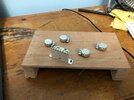
I've got my template built and the controls in place in preparation for wiring things up as much as I can outside the guitar.
Now, some may ask why I've chosen to reuse the import switch (even though I'll just be using it as a coil split switch) and haven't changed it for a CRL switch or an Oak-Grigsby switch.
The answer is simply because the body is too thin for those switches. My Jackson has an arched top and the switch is located toward the edge of the body where it is thinnest. Consequently, there is not enough space to fit a CRL or Oak-Grigsby.
Anyhoo, this is where things are finished up for today.
As I mentioned earlier, the pickups are back in the guitar, so things are about where they'd be if I was just changing pots and caps.
Last edited:
Why do you use both?
BTW, minor update:
The pickups are back in place!
I don't really know, other than I personally feel the tape adheres better to the paint than the bare wood...but pretty much everything i do is excess...
RVA
Ambassador
Thanks! Never seen those 2-piece bits.
I bought the two-piece bits. I don’t recall seeing the one-piece when I got my 90 degree adapter. I only bought two bits, though.
In the future I’ll probably look for those one-piece bits.
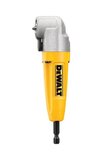
Just as a final word on this topic, I got both versions of the right angle adapter, and I think they are both worth having, especially for $ 20. While this does not provide the flexibility of the other, this version is more steady and easier to use without the need to grasp a handle.
https://www.amazon.com/gp/product/B00C0VSNKQ