The Joy Of Being Out-Of-Phase:

Inspector #20

Ambassador of Tone
Fallen Star
Country flag
So, my youngest Son has asked me to make the old 1987 Squirecaster OOP for him. I currently have an old H-S-S pickguard from around 2001 with a 14kΩ GFS Double Slug and two (prototypes at the time) GFS stacked single coils. Since a stacked single coil is - in effect a humbucker - I am assuming the bridge and middle pickup in position 2 would interact in a similar fashion to how the bridge and neck humbuckers interact in my Gibson SG....

Thoughts????
_Robert Strat Crowley Grave.jpg
 
Ok, I don't have experience with "stacked" humbuckers, but I'll relate my findings regarding phase (& out of phase) in the middle position when putting the Burstbucker 2 in the neck position of my telecaster. The BB2 has "screw pole south" polarity. I tried a few bridge pickups with the BB2. All bridge pickups were wound "top right, top going" which means the winding is "anti clockwise". With a "south up" polarity pickup in the bridge position, the pickups are "in phase" in the middle position. With a "north up" polarity pickup in in the bridge position, the pickups are "out of phase" in the middle position. I'm imagining the same would apply with a "stacked" humbucker/normal humbucker. Hope this helps. Cheers
 
Ok, I don't have experience with "stacked" humbuckers, but I'll relate my findings regarding phase (& out of phase) in the middle position when putting the Burstbucker 2 in the neck position of my telecaster. The BB2 has "screw pole south" polarity. I tried a few bridge pickups with the BB2. All bridge pickups were wound "top right, top going" which means the winding is "anti clockwise". With a "south up" polarity pickup in the bridge position, the pickups are "in phase" in the middle position. With a "north up" polarity pickup in in the bridge position, the pickups are "out of phase" in the middle position. I'm imagining the same would apply with a "stacked" humbucker/normal humbucker. Hope this helps. Cheers

Thanks, Ivan...I think a stacked humbucker will react the same...
 
I should have added that it was quite noticeably OOP. Also, I have the neck humbucker mounted with the screw poles toward the bridge (or, the wrong way 'round) but I don't think that matters. Cheers
 
I had a though this afternoon Robert, that "may" have a bearing on what I first posted. The BB2 came out of my circuit board equipped SG (bridge position), so is a 5 conductor lead type. I have read that these are "reversed wound". When in the middle position the pickups were OOP. Apparently, the reverse wound bridge pickup was done so that when using the pickups "coil tapped" as single coils, they would still be humbucker in the middle position. Apologies for not thinking of this earlier. Cheers
 
No problem. Gibson has been doing 'RW/RP' for quite some time, but it doesn't give you the OOP effect. No volume drop in the middle position. All (4) of my recent brand new Gibson's had the RW/RP feature but no volume drop in the middle position, no tonal changes...

In fact, while you can alter the wiring (on a 4 conductor) to get OOP, the effect is not the same as reversing the magnet's polarity and maintaining the coil's polarity...its much less dramatic when switching only the wiring.
 
I should have added that it was quite noticeably OOP. Also, I have the neck humbucker mounted with the screw poles toward the bridge (or, the wrong way 'round) but I don't think that matters. Cheers

Moving the screw coil changes the location of that coil along the length of the string and will produce a slightly different tone...
 
The magnet 'flip' produces a dramatic and immediately noticeable change.
The BB1 has screw pole north (south end of compassion needle attracts to it). It was noticeable in the middle position of both my SG & LP traditional when used in them. Cheers
 
The BB1 has screw pole north (south end of compassion needle attracts to it). It was noticeable in the middle position of both my SG & LP traditional when used in them. Cheers

I use a ohm meter and place a metal feeler gauge across the poles. A positive jump in DCR indicates correct phasing. A negative drop in DCR indicates reversed polarity...
 
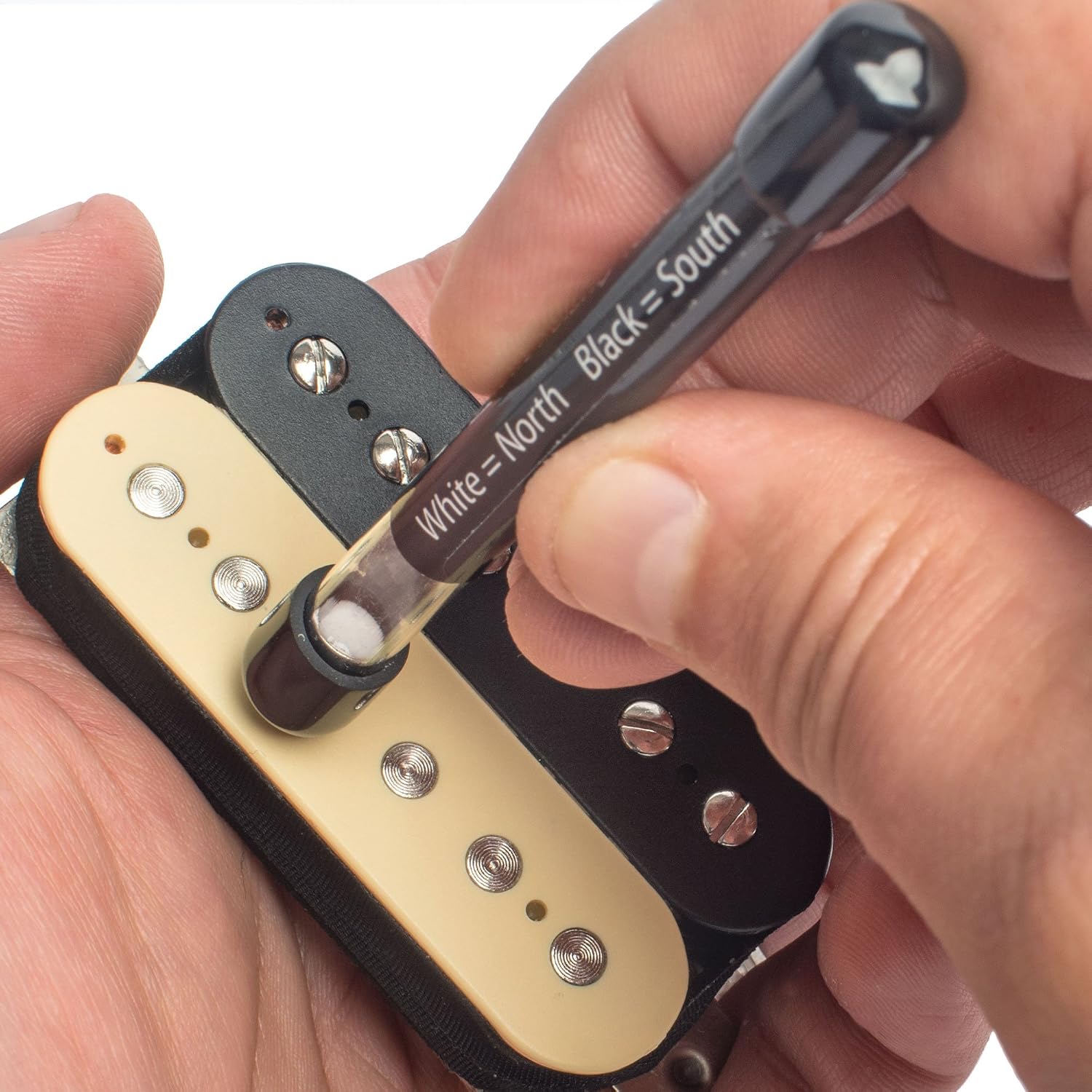
I hear this is a good tool...

81eAk2NlhNL._SL1500_.jpg
 
I use a ohm meter and place a metal feeler gauge across the poles. A positive jump in DCR indicates correct phasing. A negative drop in DCR indicates reversed polarity...
Yes, even an old analogue meter can be used by observing which way the needle kicks, though it's a small kick. Cheers
 
Back
Top