
You are using an out of date browser. It may not display this or other websites correctly.
You should upgrade or use an alternative browser.
You should upgrade or use an alternative browser.
Von Herndon Double Neck:
- Thread starter Inspector #20
- Start date
OP


Maybe try a smaller value tone cap than the 0.033uf you have on the bridge pickup. Cheers
The only thing is, I am running the tone control full-up, so the cap has little, if any influence....

ivan H
Ambassador of Tubes & Grooves

A common misconception. While ever in circuit the tone cap is having an effect. Tell me, why do you have an 0.015uf on the neck pickup? A smaller value cap will move the resonant peak up. CheersThe only thing is, I am running the tone control full-up, so the cap has little, if any influence....
Edit: An 0.033uf cap on a properly positioned bridge humbucker may give you the tone you like, but this time it's not a properly positioned bridge pickup, more kinda getting towards the "middle" position. Just as an 0.015uf on the neck pickup works well for you (& me), so might a smaller value than 0.033uf on the improperly positioned back pickup. Cheers
Last edited:
OP
A common misconception. While ever in circuit the tone cap is having an effect. Tell me, why do you have an 0.015uf on the neck pickup? A smaller value cap will move the resonant peak up. Cheers
My only tone cap consideration is for its behaviour when the pot is rolled back. I have changed from a .047uf to a .015uf and could not detect a difference with the tone control wide open...
OP
If there was a difference - with the tone pot on 10 - I could not detect it...

The only thing is, I am running the tone control full-up, so the cap has little, if any influence....
Not true. The tone cap is ALWAYS in the circuit.
When your tone control is at "0" ONLY the capacitor is in the circuit. When your tone control is at "10" the capacitor AND the full value of the tone pot resistance is in the circuit.
A common misconception.
FINALLY, someone else points this out!!!
Ivan, you're my hero!
Last edited:
OP
Not true. The tone cap is ALWAYS in the circuit.
When your tone control is at "0" ONLY the capacitor is in the circuit. When your tone control is at "10" the capacitor AND the full value of the tone pot resistance is in the circuit.
FINALLY, someone else points this out!!!
Ivan, you're my hero!
I can stipulate to your description, but since I made a significant change - from .047uf to .015uf - with no noticeable difference in tonality - on more than one occasion - I no longer consider it to be a worthwhile modification....I'm only interested in a change with a noticeable change in tonal signature.
In fact, the only significant change I have experienced personally was lifting the tone control ground altogether...
OP
This makes a difference I can hear....
"The “Bright Switch” is a simple mod that adds a little extra Treble to your signal. It does this by removing your Volume Pot and Tone Pot from your signal path, which always “load” your signal. Essentially, it’s like connecting your guitar’s pickups direct to the output jack. It’s a pretty crazy difference – your guitar sounds bigger, brighter, and louder...."
"The “Bright Switch” is a simple mod that adds a little extra Treble to your signal. It does this by removing your Volume Pot and Tone Pot from your signal path, which always “load” your signal. Essentially, it’s like connecting your guitar’s pickups direct to the output jack. It’s a pretty crazy difference – your guitar sounds bigger, brighter, and louder...."
ivan H
Ambassador of Tubes & Grooves
Which is what a "no load" pot does. This proves that the cap is still having an effect with the tone pot right up. Perhaps Smitty_p can explain "tuned circuits" a little, I'm in the car on the way to work & should not be on the phone. CheersIn fact, the only significant change I have experienced personally was lifting the tone control ground altogether...
Perhaps Smitty_p can explain "tuned circuits" a little...
Do I gotta?
I mean, there are, like, formulas and such!
OP
Which is what a "no load" pot does. This proves that the cap is still having an effect with the tone pot right up. Perhaps Smitty_p can explain "tuned circuits" a little, I'm in the car on the way to work & should not be on the phone. Cheers
Do I gotta?
I mean, there are, like, formulas and such!
There's no need...I believe your theory, but after changing to what I would consider a 'big jump" in tone caps, with no detectable difference, I consider the theoretical benefit to be too little to justify the effort....
OP
Question...Is the CTS 1MΩ Audio Taper Split-Shaft Coarse 18 Spline pot even available????
I did find a DiMarzio that meets those specs...#EP1202
I did find a DiMarzio that meets those specs...#EP1202
Last edited:
There's no need...I believe your theory, but after changing to what I would consider a 'big jump" in tone caps, with no detectable difference, I consider the theoretical benefit to be too little to justify the effort....
I would say that a lot of that depends on your usage.
The more you overdrive your signal, the less dynamic range you have due to the resultant compression and saturation. At this point, it is possible that replacing one or two tone components will have lesser audible impact. Remember some of the superstrats from the '80s that had just a volume knob?
At lower gain levels the variances in tone control components become more apparent.
OP
I would say that a lot of that depends on your usage.
The more you overdrive your signal, the less dynamic range you have due to the resultant compression and saturation. At this point, it is possible that replacing one or two tone components will have lesser audible impact. Remember some of the superstrats from the '80s that had just a volume knob?
At lower gain levels the variances in tone control components become more apparent.
I recall the SuperStrats with no tone control. Kramer's were common in tht configuration because EVH had popularized it. I also have no perceptible volume loss when switching to the middle - out-of-phase position - when played through my rig, but I do hear a volume loss when played clean. However, other then testing, I don't play anything clean....
OP
Think about it this way, IF the tone cap was having no effect when the 500k tone pot is wound right up, how the freak would a 1 meg tone pot make a difference,,, but it does. No load tone pots also have an effect. Cheers
The no load tone pot produces an effect I can hear...
Last edited:
OP
I was going through some old emails from Bill Lawrence tonight and found some very cool things. I also found this little tidbit from Hugh Thomas.

There's a lot of talk about tone capacitors. People have theories and ideas about them. A lot of this information is not founded in reality, but rather in marketing and "mojo."
Your tone capacitor does almost nothing until you turn your tone control down. While potentiometers do allow for a tiny, minuscule bit of bleed-through, they are essentially an open gate or a closed gate when turned all the way in one direction.
Think of it like this:
Sound comes out of the pickup. It meets with the volume control. The volume is a gate that limits how much sound can get through. When it's turned all the way up, the gate is wide open. The guitar is loud. You hear everything that pickup has to offer.
The tone control is like a side gate. When it's turned all the way up, it is closed. Everything goes out the main gate - through the volume control. As you turn down the tone, it opens the side gate. It allows sound to hit the tone capacitor.
The tone capacitor only allows high frequencies (treble) to pass through. The treble that gets through is then sent to ground. It's gone. You don't hear this sound. What you hear is what didn't go to ground.
People have an idea that their tone cap will have a huge effect on the overall tone of the guitar with everything turned up. That is just not true. If you don't turn your tone controls down while playing, you can't really hear what your tone cap is doing. That's because it's just sitting there doing nearly nothing. Now, as mentioned above, there is a tiny bit of bleed through. We say the difference between having the tone control there and not is like turning your tone up from 10 to 11. It's really more like turning it up from 10 to 10.2 or something. It's almost undetectable. The bulk of your tone, with the exception of a tiny bit of high frequencies, is all getting through. You're not "hearing the cap."
The human mind seems to have more effect on what tone you perceive than anything. You just spent $100 on two caps for your Les Paul. You fire it up, and you're convinced it sounds better. Why wouldn't it? You spent a bunch of money. You should get something for your money.
Next time, spend $5 or $10 on Orange Drops or similar caps. Get the same sound at a fraction of the price. Go buy a bunch of beer with the money you saved.
And...you don't even want to read Bill's opinions of vintage pickups and wiring. It would have many of you hopping mad...
There's a lot of talk about tone capacitors. People have theories and ideas about them. A lot of this information is not founded in reality, but rather in marketing and "mojo."
Your tone capacitor does almost nothing until you turn your tone control down. While potentiometers do allow for a tiny, minuscule bit of bleed-through, they are essentially an open gate or a closed gate when turned all the way in one direction.
Think of it like this:
Sound comes out of the pickup. It meets with the volume control. The volume is a gate that limits how much sound can get through. When it's turned all the way up, the gate is wide open. The guitar is loud. You hear everything that pickup has to offer.
The tone control is like a side gate. When it's turned all the way up, it is closed. Everything goes out the main gate - through the volume control. As you turn down the tone, it opens the side gate. It allows sound to hit the tone capacitor.
The tone capacitor only allows high frequencies (treble) to pass through. The treble that gets through is then sent to ground. It's gone. You don't hear this sound. What you hear is what didn't go to ground.
People have an idea that their tone cap will have a huge effect on the overall tone of the guitar with everything turned up. That is just not true. If you don't turn your tone controls down while playing, you can't really hear what your tone cap is doing. That's because it's just sitting there doing nearly nothing. Now, as mentioned above, there is a tiny bit of bleed through. We say the difference between having the tone control there and not is like turning your tone up from 10 to 11. It's really more like turning it up from 10 to 10.2 or something. It's almost undetectable. The bulk of your tone, with the exception of a tiny bit of high frequencies, is all getting through. You're not "hearing the cap."
The human mind seems to have more effect on what tone you perceive than anything. You just spent $100 on two caps for your Les Paul. You fire it up, and you're convinced it sounds better. Why wouldn't it? You spent a bunch of money. You should get something for your money.
Next time, spend $5 or $10 on Orange Drops or similar caps. Get the same sound at a fraction of the price. Go buy a bunch of beer with the money you saved.
And...you don't even want to read Bill's opinions of vintage pickups and wiring. It would have many of you hopping mad...
Last edited:
OP
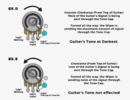
And Lindy Fralin's response:
So, getting back to what I was saying, IMHO, I would not change a tone capacitor 'expecting' a change if I spent most of my time with the tone controls wide open....which is pretty much how I play...
So, getting back to what I was saying, IMHO, I would not change a tone capacitor 'expecting' a change if I spent most of my time with the tone controls wide open....which is pretty much how I play...
Last edited:
ivan H
Ambassador of Tubes & Grooves
In "guitar World" there may be a lot of misinformation founded in mojo & marketing, but the world of electronic is a different story altogether where its all calculable facts, not marketing & mojo. Referring to a volume & tone pot as "gates" is a bit of a misrepresentation, kinda inferring they do the same thing electronically, which they do not. A volume control pot is acting as a "variable voltage divider" while a tone control pot is acting as a "variable resistance". Quite different things electronically. A tone control pot can be "fully open" (zero resistance) & allow the tone cap to dump straight to ground, but it is never ever "fully closed", except in the case of a "no load" tone pot. The frequencies that pass through the tone capacitor are dependent on the size, or value of the cap. The smaller the value, the narrower the band of high frequencies that pass through it. As the value get larger, so does the band of frequencies passing through it widen, allowing lower frequencies to pass through it. There's no "marketing or mojo involved. CheersI was going through some old emails from Bill Lawrence tonight and found some very cool things. I also found this little tidbit from Hugh Thomas.
There's a lot of talk about tone capacitors. People have theories and ideas about them. A lot of this information is not founded in reality, but rather in marketing and "mojo."
Your tone capacitor does almost nothing until you turn your tone control down. While potentiometers do allow for a tiny, minuscule bit of bleed-through, they are essentially an open gate or a closed gate when turned all the way in one direction.
Think of it like this:
Sound comes out of the pickup. It meets with the volume control. The volume is a gate that limits how much sound can get through. When it's turned all the way up, the gate is wide open. The guitar is loud. You hear everything that pickup has to offer.
The tone control is like a side gate. When it's turned all the way up, it is closed. Everything goes out the main gate - through the volume control. As you turn down the tone, it opens the side gate. It allows sound to hit the tone capacitor.
The tone capacitor only allows high frequencies (treble) to pass through. The treble that gets through is then sent to ground. It's gone. You don't hear this sound. What you hear is what didn't go to ground.
People have an idea that their tone cap will have a huge effect on the overall tone of the guitar with everything turned up. That is just not true. If you don't turn your tone controls down while playing, you can't really hear what your tone cap is doing. That's because it's just sitting there doing nearly nothing. Now, as mentioned above, there is a tiny bit of bleed through. We say the difference between having the tone control there and not is like turning your tone up from 10 to 11. It's really more like turning it up from 10 to 10.2 or something. It's almost undetectable. The bulk of your tone, with the exception of a tiny bit of high frequencies, is all getting through. You're not "hearing the cap."
The human mind seems to have more effect on what tone you perceive than anything. You just spent $100 on two caps for your Les Paul. You fire it up, and you're convinced it sounds better. Why wouldn't it? You spent a bunch of money. You should get something for your money.
Next time, spend $5 or $10 on Orange Drops or similar caps. Get the same sound at a fraction of the price. Go buy a bunch of beer with the money you saved.
And...you don't even want to read Bill's opinions of vintage pickups and wiring. It would have many of you hopping mad...
OP
In "guitar World" there may be a lot of misinformation founded in mojo & marketing, but the world of electronic is a different story altogether where its all calculable facts, not marketing & mojo. Referring to a volume & tone pot as "gates" is a bit of a misrepresentation, kinda inferring they do the same thing electronically, which they do not. A volume control pot is acting as a "variable voltage divider" while a tone control pot is acting as a "variable resistance". Quite different things electronically. A tone control pot can be "fully open" (zero resistance) & allow the tone cap to dump straight to ground, but it is never ever "fully closed", except in the case of a "no load" tone pot. The frequencies that pass through the tone capacitor are dependent on the size, or value of the cap. The smaller the value, the narrower the band of high frequencies that pass through it. As the value get larger, so does the band of frequencies passing through it widen, allowing lower frequencies to pass through it. There's no "marketing or mojo involved. Cheers
Well, I guess we better let Lindy Fralin know he's dead wrong...
My personal experience in changing cap values - with the tone control on 10 - netted me nothing. That's all I know...