You are using an out of date browser. It may not display this or other websites correctly.
You should upgrade or use an alternative browser.
You should upgrade or use an alternative browser.
Capacitors: a case study
- Thread starter RVA
- Start date


want to barrow my hammer?
Can I borrow your wheel barrow?

CabanaBoy
Ambassador of Electric Mayhem
Y'know, this is all a hobby for most of us (I assume some on here are working musicians) so it should be interesting and fun. There are no "right" answers for most things, just do what makes you happy and enjoy the hobby. If you like putting PIO or bumblebees in a guitar for no other reason than they look cool, that's reason enough.
It's music - is there really a wrong way


jtcnj
Ambassador of the Crossroad
Personal preference based on cool factor is, well, cool.
I just try to make my wiring neat and the final outcome measure of success is that everything functions as it should.
I use plain ceramic disc caps.
I think some folks dont realize that tone caps in guitars (and amps) are different from amp coupling caps -the latter of which actually pass signal in the signal chain.
Tone caps bleed part of the signal frequencies to ground.
Thats it.
Variation in manufacturing tolerance certainly can have a perceivable change in the filter cut off or the sweep of the pot.
If a different VALUE improves the tone / functionality - thats a measurable factor if the guitar is just too dark or bright at either end of the pot sweep.
But pretty much caps is caps unless they are just junk and dont perform the basic function of capacitance at somewhere close to the specified value; ie, within the accepted tolerance percentage.
And of course an adequate voltage rating for the circuit it is used in.
I just try to make my wiring neat and the final outcome measure of success is that everything functions as it should.
I use plain ceramic disc caps.
I think some folks dont realize that tone caps in guitars (and amps) are different from amp coupling caps -the latter of which actually pass signal in the signal chain.
Tone caps bleed part of the signal frequencies to ground.
Thats it.
Variation in manufacturing tolerance certainly can have a perceivable change in the filter cut off or the sweep of the pot.
If a different VALUE improves the tone / functionality - thats a measurable factor if the guitar is just too dark or bright at either end of the pot sweep.
But pretty much caps is caps unless they are just junk and dont perform the basic function of capacitance at somewhere close to the specified value; ie, within the accepted tolerance percentage.
And of course an adequate voltage rating for the circuit it is used in.


ivan H
Ambassador of Tubes & Grooves

I just noticed this thread. If you think about it, any portion of the signal that passes through the tone cap is being bled of to ground, or taken out of the signal, so we don't actually hear anything that is passed through the cap. I'm in total agreement with the "value" of the cap being the important factor. That being said, I do have paper in oil & polypropylene (orange drops) caps in some of my guitars. Cheers

Goldmember
Ambassador of Golden Yoo-Hoos
I agree, it's all hype. I still only use NOS PIO made by Keebler Elves in their tree house. It sounds better on the 5th of each month with a "p" in it.

I just noticed this thread. If you think about it, any portion of the signal that passes through the tone cap is being bled of to ground, or taken out of the signal, so we don't actually hear anything that is passed through the cap. I'm in total agreement with the "value" of the cap being the important factor. That being said, I do have paper in oil & polypropylene (orange drops) caps in some of my guitars. Cheers
I like the K40Y PIO's and still use them. I always use a .033uf bridge and a .015uf neck.
Only downside is that PIO caps can, technically, leak oil. It's extremely unlikely in this application but why even take the chance?
Crazy thing though...my SG and my Double Neck (both .033uf/.015uf K40Y's) NEVER get muddy, even when rolling off the tone and that's a standout difference from other guitars I have played...

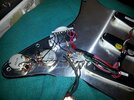
Tell me this copper doesn't work...in the studio, my guitar is the ONLY one that doesn't start 'chirping' before someone receives a text message.
View attachment 17198
Its called A Faraday cage .
Faraday cage - Wikipedia
Absolutely! Every time someone tells me the copper tape 'doesn't work' in a guitar, I plop my cell phone down on the guitar plugged in and amp turned up and have them call it...then do the same with their rig and you should hear the electronic chaos!!!!

Absolutely! Every time someone tells me the copper tape 'doesn't work' in a guitar, I plop my cell phone down on the guitar plugged in and amp turned up and have them call it...then do the same with their rig and you should hear the electronic chaos!!!!
Of course it works!
As Don O points out, it is a Faraday cage, after all.
But, it is not entirely effective with true single coils. Whereas the wiring and other components may be shielded, the business end of the pickup is still exposed to any interference.
I’ve done a complete copper shielding job on my Strat and it doesn’t silence it. I didn’t really expect it to, but I was curious to see if I could make things better.
Last edited:
Of course it works!
As Don O points out, it is a Faraday cage, after all.
But, it is not entirely effective with true single coils. Whereas the wiring and other components may be shielded, the business end of the pickup is still exposed to any interference.
I’ve done a complete copper shielding job on my Strat and it doesn’t silence it. I didn’t really expect it to, but I was curious to see if I could make things better.
True, I never had that trouble with the stacked single coils, but I still used a full-size aluminum shield behind the pickguard...