Wood shop design

RVA

Ambassador
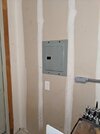
I am having an electrician to the house to equip it with a subpanel, a 220 outlet and a few more 110 outlets. I will fill it with things that I do not yet know how to use well, and I will give many the opportunity to make jokes about lawyers with equipment that they do not deserve due to their meager skill, and that it should rightfully be turned over to those more deserving (just like guitars). My bandsaw will get here in early June, and I have plans for a planer, jointer, and a Sawstop table saw down the road. I am not going to install a real dust collection system due to the limited use and the fact that I can just open the garage door much of the year.

Anyway, I need shop design ideas. Are shelves better than draws? Placement of outlets? Floor surfacing?

Thanks for any advice.
 
As far as the electrical aspects:
I'd go with a minimum of a 60Amp sub panel (240/120v obviously). Being that its a garage, you'll need to have GFCI protection, so pending on how many outlets you have, might be cheaper and easier to use GFCI breakers vs outlets ( you wont need to GFCI the 240v outlet as its considered special purpose/dry-damp location being in a garage)

As far as placement of outlets? Go with the basic footage rule of 6ft lineal between basic convenience outlets. If you have a piece of equipment that will take up a circuit on its own ( 10amps or higher typically is a dedicated circuit), then you place those within 3ft of wherever you want to set your equipment. From what you mentioned of the equipment, don't know which ones are 120 or 240v but i would probably dedicate each of those on their own ( Planer, Jointer, Table Saw). If you have a bench top? Id say go with at least 2 circuits, broken up by at least 4 outlets on that alone for general usage.

Again, not knowing the dimensions of your garage : id estimate you're going to have at least 7 circuits minimum ( figure 1 for lighting, 1 for jointer, 1 for planer, 1 for saw, 2 bench top, 1 general convenience around the walls).
Few things to remember, that seems alot on 60amps but thats rated as both 60Amps per phase ( 60a A phase- 60a B Phase) and at total usage at one time, so reastically, you wouldnt be running more than 2 of these devices at once if even that. Also on the topic of GFCIs: motor loads can SOMETIMES cause an immediate trip, because the inrush current when the motor engages can exceed 5mA. If that becomes a continuous problem? Change it out to a standard breaker/outlet after the fact, it'll be fine.

Good luck!
 
As far as the electrical aspects:
I'd go with a minimum of a 60Amp sub panel (240/120v obviously). Being that its a garage, you'll need to have GFCI protection, so pending on how many outlets you have, might be cheaper and easier to use GFCI breakers vs outlets ( you wont need to GFCI the 240v outlet as its considered special purpose/dry-damp location being in a garage)

As far as placement of outlets? Go with the basic footage rule of 6ft lineal between basic convenience outlets. If you have a piece of equipment that will take up a circuit on its own ( 10amps or higher typically is a dedicated circuit), then you place those within 3ft of wherever you want to set your equipment. From what you mentioned of the equipment, don't know which ones are 120 or 240v but i would probably dedicate each of those on their own ( Planer, Jointer, Table Saw). If you have a bench top? Id say go with at least 2 circuits, broken up by at least 4 outlets on that alone for general usage.

Again, not knowing the dimensions of your garage : id estimate you're going to have at least 7 circuits minimum ( figure 1 for lighting, 1 for jointer, 1 for planer, 1 for saw, 2 bench top, 1 general convenience around the walls).
Few things to remember, that seems alot on 60amps but thats rated as both 60Amps per phase ( 60a A phase- 60a B Phase) and at total usage at one time, so reastically, you wouldnt be running more than 2 of these devices at once if even that. Also on the topic of GFCIs: motor loads can SOMETIMES cause an immediate trip, because the inrush current when the motor engages can exceed 5mA. If that becomes a continuous problem? Change it out to a standard breaker/outlet after the fact, it'll be fine.

Good luck!
Great advice, thank you!
 
If the garage is empty now, epoxy the floor first. It will make cleanup easy in the future.

As for electricity, go 15 amp on your breakers, outlets, and wiring. You could use two or three circuits for regular usage, as you'll only use one power tool at a time. As, you won't have a belt sander running while using a drill press. Lights would be their own circuits. Go wall mount six inches or so higher than your average bench height. Maybe have a couple of spare outlets on the ceiling for unknown additions to the garage later. And, a couple down low near the garage doors for using a shop-vac for cleaning your car, etc.

As for drawers or shelves, since you'll have no dust collection you should go with drawers or cupboard style doors on shelving. That way you can keep stuff relatively clean and dust free. Also looks nicer than random stuff piled on shelves.

Try to draw it out first. You may find you will want outlets every 16" on a wall that will have a work bench with many things to be powered. One wall here in my cellar has them every 32" and another every 16", including two spots where the boxes are mounted to each side of the stud. At one of the benches, I have outlets above and below the bench for powering computer and amps. I also mixed up the circuits so no more than two in a row were on the same circuit. But, I did the wiring myself. A hired electrician may not want to oblige as it's more work.
 
Last edited:
If the garage is empty now, epoxy the floor first. It will make cleanup easy in the future.

As for electricity, go 15 amp on your breakers, outlets, and wiring. You could use two or three circuits for regular usage, as you'll only use one power tool at a time. As, you won't have a belt sander running while using a drill press. Lights would be their own circuits. Go wall mount six inches or so higher than your average bench height. Maybe have a couple of spare outlets on the ceiling for unknown additions to the garage later. And, a couple down low near the garage doors for using a shop-vac for cleaning your car, etc.

As for drawers or shelves, since you'll have no dust collection you should go with drawers or cupboard style doors on shelving. That way you can keep stuff relatively clean and dust free. Also looks nicer that random stuff piled on shelves.

Try to draw it out first. You may find you will want outlets every 16" on a wall that will have a work bench with many things to be powered. One wall here in my cellar has them every 32" and another every 16", including two spots where the boxes are mounted to each side of the stud. At one of the benches, I have outlets above and below the bench for powering computer and amps. I also mixed up the circuits so no more than two in a row were on the same circuit. But, I did the wiring myself. A hired electrician may not want to oblige as it's more work.
Under the NEC, you can also use #12 AWG 12-2/w Ground NM wire ( Romex) with 20A Breakers into 15A outlets vs 20A outlets if you have more than one plug on the circuit, you cant do it with a dedicated single circuit however ( NEC210.21(B)(1) and 210.21(b)(3) )
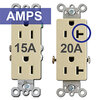
You can use either, but commonly most plug in tools have a standard 15amp connection that will go into either outlet. Specialty tools that run high amperage sometimes have 20A plugs and you can only use 20A outlets with them ( part of the failsafe design).
info-outlet-types-15a-vs-20-amp.jpg

Most breakers are designed to trip at 80% of their rated load during the initial inrush, so a 15A breaker will kick immediately if you power a tool that has more than 12A inrush ( which is a lot of saws), where as a 20A breaker will kick out 16A inrush , preventing nuisance tripping.
 
Under the NEC, you can also use #12 AWG 12-2/w Ground NM wire ( Romex) with 20A Breakers into 15A outlets vs 20A outlets if you have more than one plug on the circuit, you cant do it with a dedicated single circuit however ( NEC210.21(B)(1) and 210.21(b)(3) )
You can use either, but commonly most plug in tools have a standard 15amp connection that will go into either outlet. Specialty tools that run high amperage sometimes have 20A plugs and you can only use 20A outlets with them ( part of the failsafe design).
View attachment 66008

Most breakers are designed to trip at 80% of their rated load during the initial inrush, so a 15A breaker will kick immediately if you power a tool that has more than 12A inrush ( which is a lot of saws), where as a 20A breaker will kick out 16A inrush , preventing nuisance tripping.


I'll have to use a 20 when I set up the circuit for the table saw. The band saw has never had a problem on the 15. It's slow to get up to speed anyway.
 
Under the NEC, you can also use #12 AWG 12-2/w Ground NM wire ( Romex) with 20A Breakers into 15A outlets vs 20A outlets if you have more than one plug on the circuit, you cant do it with a dedicated single circuit however ( NEC210.21(B)(1) and 210.21(b)(3) )
You can use either, but commonly most plug in tools have a standard 15amp connection that will go into either outlet. Specialty tools that run high amperage sometimes have 20A plugs and you can only use 20A outlets with them ( part of the failsafe design).
View attachment 66008

Most breakers are designed to trip at 80% of their rated load during the initial inrush, so a 15A breaker will kick immediately if you power a tool that has more than 12A inrush ( which is a lot of saws), where as a 20A breaker will kick out 16A inrush , preventing nuisance tripping.
I think at least 1X GFI 20A circuits in the garage, 2X 20A GFI required in the kitchen, and 1X 20A outdoor GFI too.
I thought that was minimum.
If he wants 14 GA wire, you need to talk it over w/ him; fireside chat.
We have title 24 here in Left Coast, which makes stuff like LEDs mandatory, and bathroom humidity sensors, and all other robotic light switches sort of stuff.
 
  • Like
Reactions: RVA
I think at least 1X GFI 20A circuits in the garage, 2X 20A GFI required in the kitchen, and 1X 20A outdoor GFI too.
I thought that was minimum.
If he wants 14 GA wire, you need to talk it over w/ him; fireside chat.
We have title 24 here in Left Coast, which makes stuff like LEDs mandatory, and bathroom humidity sensors, and all other robotic light switches sort of stuff.

Yeah pretty much the entire garage is considered a GFCI area and typically you'd have a minimum of at least one circuit.
As for #14 AWG, its fine as long as you use 15A Breakers and 15A Receptacles accordingly. At the current prices of breakers and outlets, there's almost no difference in the cost between 15 and 20. Wire cost between 14 and 12 gauge is certainly a big difference though and something to consider in budgeting.

That California Title 24 is pretty astringent! I get it though, as its energy focused and Green Certified. California often leads the industry standards in electrical requirements, especially influencing the NEC every 3 years


Pardon the formality but heres the requirements on GFCIs in general.

210.8(A) Dwelling Units. All 125-volt, single-phase, 15- and 20- ampere receptacles installed in the locations specified in 210.8(A)(1) through (10) shall have ground-fault circuit interrupter protection for personnel.

(1) Bathrooms
(2) Garages, and also accessory buildings that have a floor located at or below grade level not intended as habitable rooms and limited to storage areas, work areas, and areas of similar use
(3) Outdoors
Exception to (3): Receptacles that are not readily accessible and are supplied by a branch circuit dedicated to electric snow-melting, deicing, or pipeline and vessel heating equipment shall be permitted to be installed in accordance with 426.28 or 427.22, is applicable.
(4) Crawl spaces — at or below grade level
(5) Unfinished portions or areas of the basement not intended as habitable rooms

Exception to (5): A receptacle supplying only a permanently installed fire alarm or burglar alarm system shall not be required to have ground-fault circuit-interrupter protection.

Informational Note: See 760.41(B) and 760.121(B) for power supply requirements for fire alarm systems.

Receptacles installed under the exception to 210.8(A)(5) shall not be considered as meeting the requirements of 210.52(G).

(6) Kitchens — where the receptacles are installed to serve the countertop surfaces
(7) Sinks — where receptacles are installed within 1.8 m (6 ft) from the top inside edge of the bowl of the sink
(8) Boathouses
(9) Bathtubs or shower stalls — where receptacles are installed within 1.8 m (6 ft) of the outside edge of the bathtub or shower stall
(10) Laundry areas
 
  • Like
Reactions: RVA
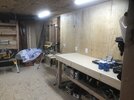
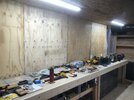
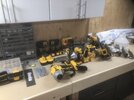
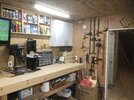
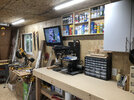
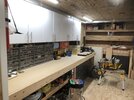
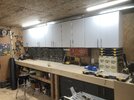
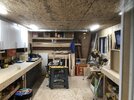
Ray, here’s mine. I put on a 50 amp sub panel and installed two 20 circuits and 1 15 amps circuit in the shop. 6 outlets (3 boxes) for each 20 amp circuit (north and south walls) all at above bench height level. I have 4 15 amp outlets below the bench top and 1 up high for the TV and Roku.

I built 3 8 ft long benches with 3/4 MDF tops and a pine 1x6 front with a routed edge. I find a combination of shelves, drawers and cabinets works for me. This is roughly a single car garage size, 20ft x 12 ft.

F8916666-D017-4563-8CEC-6C425BD43688.jpeg672F5667-3502-4386-B163-D23D0FE9CAA5.jpegA294BAAB-BEEC-4836-8873-59E19EA09E66.jpeg4D68DF8F-4624-4DF4-8321-86F6673540D1.jpegC5945276-D565-437C-84C3-834AC8B82817.jpeg9D3FD77D-7FEA-48E5-98AB-67AF1B66AECE.jpeg8B13B12B-A034-4F35-A4EE-973AF6C5C9D4.jpeg55A70D5C-D7D7-4D9E-85F3-58F603086CE5.jpeg
 
Last edited:
Ray, here’s mine. I put on a 50 amp sub panel and installed two 20 circuits and 1 15 amps circuit in the shop. 6 outlets (3 boxes) for each 20 amp circuit (north and south walls) all at above bench height level. I have 4 15 amp outlets below the bench top and 1 up high for the TV and Roku.

I built 3 8 ft long benches with 3/4 MDF tops and a pine 1x6 front with a routed edge. I find a combination and shelves, drawers and cabinets works for me. This is roughly a single car garage size, 20ft x 12 ft.

View attachment 66060View attachment 66061View attachment 66062View attachment 66063View attachment 66064View attachment 66065View attachment 66066View attachment 66067
Sweet setup!

Does anyone feel that a 220 outlet is necessary?
 
Sweet setup!

Does anyone feel that a 220 outlet is necessary?
Probably not if none of your equipment doesnt require it. Like @Don O said, very easy to add later, especially if your panel is surface mounted. Check your planer, jointer and table saw requirements, if they are all 120v, probably skip it
 
  • Like
Reactions: RVA
Probably not if none of your equipment doesnt require it. Like @Don O said, very easy to add later, especially if your panel is surface mounted. Check your planer, jointer and table saw requirements, if they are all 120v, probably skip it
My time machine would trip that 15A breaker in a heartbeat.
It's funny, we don't even use 14 GA wire :rolf: we don't install any 15A circuits.
But I did use 14 to hook up lights in a shed one time.
 
Last edited:
Probably not if none of your equipment doesnt require it. Like @Don O said, very easy to add later, especially if your panel is surface mounted. Check your planer, jointer and table saw requirements, if they are all 120v, probably skip it
It seems that all the free standing planers and jointers are 220. Thanks for encouraging me to check
 
My time machine would trip that 15A breaker in a heartbeat.
It's funny, we don't even use 14 GA wire :rolf: we don't install any 15A circuits.
But I did use 14 to hook up lights in a shed one time.
Yeah truthfully we quit using it back in the late 90s in residential in homes here because it was just as cost effective and more sensible to go with 12gauge/20A. Only 14 we use today in commercial and industrial is 14-2 FLPL Plenum rated Fire Alarm cable for NAC circuits and as a start/stop lead on motor starters
 
If the garage is empty now, epoxy the floor first.
This^^^^^^^^^^^^^^^^^^if you’re on bare concrete.
It is, by far, the best thing I did in the studio. Clean up is soooooooooooooooooo much easier. Way less dust to contend with. I wish I had been able to finish the whole slab before for piling junk in...but I did manage to get around 7/8 covered.
 
This^^^^^^^^^^^^^^^^^^if you’re on bare concrete.
It is, by far, the best thing I did in the studio. Clean up is soooooooooooooooooo much easier. Way less dust to contend with. I wish I had been able to finish the whole slab before for piling junk in...but I did manage to get around 7/8 covered.
Absolutely agree with you and @SG John . If you have any finished concrete, thats the only way to go. Keeps down the stains as well!
 
Back
Top