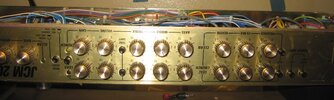
TSL60 FX loop and channel switching delay

The 60 does NOT have the bias issues. I also have had zero issues with my 122.
We know the boards have issues.
We have tested them and repaired them many times.

The bias adjust pots in your amp will fail.
I suggest you replace them with new ones every few years.
(when the pots fail the tubes will red plate)

If your amp gives you zero problems it's sort of lucky....
The more hours accumulated, the worse the insulation failure becomes.
 
Hi all!
Recently I bought a used cheap TSL60. It is the cheapest Marshall heads that I bought ever. The seller said It works perfectly but It is unused for 5 years. I took a chance and bought it. When It arrives I get really pissed off. I felt cheated. Take a look at the pictures. Burned and bridged HT fuse. Speaker output broken. Faulty on 6 pin Din connector from TSL footswitch. I fixed all. I replaced power tubes.View attachment 48852View attachment 48853

Now It runs ok but It has a delay when I'm switching channel clean to OD channels, just a few miliseconds but my TSL100 don't do It. Also when I switch off the reverb you can listen a little pop. I can live with that smalls issues.

The parallel FX loop it's strange. It has to much guitar signal from the amp. I can ajust It on my multieffects rack but If I use a looper It sounds weak and low.
Can I mod It to get a properly serial FX loop? Can I mod It to get more return signal?

Thanks in advance.
The main circuit board (area of failure)---
This is a difinitive test, to determine if the circuit board is good or bad.

If you really want to test it you can:

Unplug mains power.
Set meter for ohms.
Take out the tubes.
Connect red meter probe to pin 5 of output tube socket...
Connect black meter probe to pin 4 of same output tube socket.

Now allow about one minute or more, for the ohm reading to stop moving....
wait until the reading stabilizes, and is steady.

Report the ohm reading for the first output socket measuring between pin 4 and 5....

Now repeat again, for the second output tube socket. Report the ohm reading between pin 4 and 5.

These readings will show how much insulation failure has occurred, between the high voltage power supply, and the bias power supply.

If the reading shows low resistance between pin 4 and pin 5 of either output tube socket...
The board is usually shot.

Step 2
bias adjustment test, bias stability test.

Step 3
Transformer tests.

Step 4 Filament voltage tests.

Step 5
Output tube cathode resistors test.

Step 6
Speaker jack test.
Beware that one of the speaker jacks may be cooked at the ground (sleeve) switch contact.
This jack may need to be replaced.
 
Last edited:
The main circuit board (area of failure)---
This is a difinitive test, to determine if the circuit board is good or bad.

If you really want to test it you can:

Unplug mains power.
Set meter for ohms.
Take out the tubes.
Connect red meter probe to pin 5 of output tube socket...
Connect black meter probe to pin 4 of same output tube socket.

Now allow about one minute or more, for the ohm reading to stop moving....
wait until the reading stabilizes, and is steady.

Report the ohm reading for the first output socket measuring between pin 4 and 5....

Now repeat again, for the second output tube socket. Report the ohm reading between pin 4 and 5.

These readings will show how much insulation failure has occurred, between the high voltage power supply, and the bias power supply.

If the reading shows low resistance between pin 4 and pin 5 of either output tube socket...
The board is usually shot.

Step 2
bias adjustment test, bias stability test.

Step 3
Transformer tests.

Step 4 Filament voltage tests.

Step 5
Output tube cathode resistors test.

Step 6
Speaker jack test.
Beware that one of the speaker jacks may be cooked at the ground (sleeve) switch contact.
This jack may need to be replaced.
Good Lord! Just take a sledgehammer to it and be done with it... :facepalm:

Sorry.. English language no es la meva llengua materna.
Hello Mr TheVoider! Welcome to TTR... :cheers:
 
We know the boards have issues.
We have tested them and repaired them many times.

The bias adjust pots in your amp will fail.
I suggest you replace them with new ones every few years.
(when the pots fail the tubes will red plate)

If your amp gives you zero problems it's sort of lucky....
The more hours accumulated, the worse the insulation failure becomes.
The 60s I think have a different board - they have a master volume and shared EQ for OD channels unlike the 100. Seems it would be different.
Many of those amps have failed, yes, for sure. But the horror stories that every one will die a horrible death is exaggerated. Mine has had zero issues and is it liveevil or headache that plays one as well?
I will continue to use mine and as I rotate amps it doesn't get that much use anymore. But was used steady from 2004 till a few years back.
 
The 60s I think have a different board - they have a master volume and shared EQ for OD channels unlike the 100. Seems it would be different.
Many of those amps have failed, yes, for sure. But the horror stories that every one will die a horrible death is exaggerated. Mine has had zero issues and is it liveevil or headache that plays one as well?
I will continue to use mine and as I rotate amps it doesn't get that much use anymore. But was used steady from 2004 till a few years back.
I have one, had issues, was a project for sure but she rocks now.
 
The 60s I think have a different board - they have a master volume and shared EQ for OD channels unlike the 100. Seems it would be different.
Many of those amps have failed, yes, for sure. But the horror stories that every one will die a horrible death is exaggerated. Mine has had zero issues and is it liveevil or headache that plays one as well?
I will continue to use mine and as I rotate amps it doesn't get that much use anymore. But was used steady from 2004 till a few years back.
It's the same as DSL 50.
 
Hi all!
Recently I bought a used cheap TSL60. It is the cheapest Marshall heads that I bought ever. The seller said It works perfectly but It is unused for 5 years. I took a chance and bought it. When It arrives I get really pissed off. I felt cheated. Take a look at the pictures. Burned and bridged HT fuse. Speaker output broken. Faulty on 6 pin Din connector from TSL footswitch. I fixed all. I replaced power tubes.View attachment 48852View attachment 48853

Now It runs ok but It has a delay when I'm switching channel clean to OD channels, just a few miliseconds but my TSL100 don't do It. Also when I switch off the reverb you can listen a little pop. I can live with that smalls issues.

The parallel FX loop it's strange. It has to much guitar signal from the amp. I can ajust It on my multieffects rack but If I use a looper It sounds weak and low.
Can I mod It to get a properly serial FX loop? Can I mod It to get more return signal?

Thanks in advance.
Well, unless it passes board test (see post 42 above )
it's not worth trying to fix anything else effects or channel switching....
because the bias won't hold, and the output tubes are going to burn up.(the fuse will blow)
 
It's the same as DSL 50.
DSL 50 is 2 channel, shared EQ and 2 gains and volumes. Totally different from TSL 60 I don't see how you can use the same board for a 3 channel, overall master volume, dual sets of EQs with 3 gain and volume controls?
Nope I don't buy that, sorry.
As far as I know from many threads on MF the 60 has a different board from the others as it is a different amp, and is not subject to the bias drift issues.
 
Back
Top