Traditions, Advertising, Habits and Technology:

Inspector #20

Ambassador of Tone
Fallen Star
Country flag
Admittedly, my mind works in strange ways, but I thought this was actually interesting, so I wanted to post my ramblings, not as an attempt to convince anyone that these notions are somehow universal truths, but rather to offer some insight into a fanatical set of traditions and habits that have sent me on a bizarre gear quest for the past several years.

Recently, I posted a audio interview with producer Beau Hill about how Warren DiMartini bought 25 or 30 Marshall's - in search of the 'Holy Grail' - and was unable to find a sonic difference in them. Quite recently, in the same thread, @gball wisely posted his own personal revelation about gear acquisition and the blood lust for tone that advertising - and perhaps, to some extent - our own traditions and brand loyalty - can create, that extract so much time and money from us. Below, I have included his post which was the catalyst for what I am writing this morning:

I truly love this story (NOTE: Referring To Warren DiMartini's Unsuccessful Quest For A Holy Grail Marshall) I've thought for a long time that a lot of the differences we perceive when making small changes is placebo effect. We mess around with minute things as players, chasing tone and telling ourselves the money and time were worth it, but in the end I suspect 90+ percent of the differences we hear are imagined or could have been done easier with a twist of a knob. I finally gave up on "boutique" pedals and got a board full of Boss, and I stopped replacing pickups and electronics for this reason. I've been a hell of a lot happier since I stopped obsessing about the little things....

In our modern age of the Internet, we have connected people and their access to information like never before. We have videos now that demonstrate (and prove) the scientific facts that tone capacitor construction does not change tone, and that cloth wiring does not alter the signal passing through them. We maintain our perception of these things as if they are somehow better, when, in reality, they are just traditions hammered home by years of advertising and discussion among players. This phenomena is capitalized upon by gear vendors and it fuels the multi-million dollar per year (or perhaps more???) guitar and gear acquisition frenzy.

As a kid, growing up in my parent's recording studio, I was exposed to Gibson guitars at an early age. I considered them the "professional's Instrument" and I liked how they sounded. The Les Paul - Mom had a '58', a '79 LPC and an early 70's Recording Model - kind of fascinated me. I remember seeing Rick Derringer playing a black one and that stuck with me. I would later see Frampton with his 'Black Beauty' and Randy Rhoads' with his '74' Les Paul Custom. These videos and images would solidify my own internal desires to find my own 'Holy Grail' Gibson.

When I met Dolores Rhoads at her Burbank home, in March of 2002, I listened very intently to her account of young Randy and - as I recall - he too was exposed to Gibson's at an early age. There are two things that really stand out to me that I took away from that conversation - but never really paid attention too. When Randy acquired his 1974 Les Paul Custom - from a SoCal Guitar Sinner - he almost immediately had the frets replaced with the thin, vintage-style Fenders. Dolores also said that as much as he loved that guitar, he had a love-hate relationship with it. Randy often told her it was heavy and uncomfortable to play for long periods and that he struggled with tuning issues, especially outdoors, despite having numerous - and reputable - SoCal Luthiers perform setups and adjustments on it. Dolores told me that as soon as Randy had money coming in from his work with Ozzy, that he set about to find a better guitar.

For some reason, at the time, this never really registered with me. I think the impact of being inside Randy's childhood home was so surreal, that I remained in a sort of stupor, but as I think back, I can recall the events of that afternoon with amazing clarity because I listened so intently to what Mrs. Rhoad's had to say.

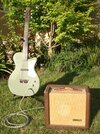
My first guitar was a 1959 Sears Silvertone (Danelectro U1) that Mom and dad gave me along with the 5 watt Silvertone amp.
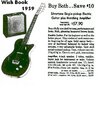
1959 Sears Silvertone 1450 Guitar & Amp Ad.jpg

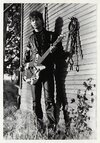
Robert 1982.jpg

Silvertone 1450 & 1451 Amp (1).jpg

The guitar had only 18 frets and a single lipstick pickup, which I quickly replaced with a Duncan Quarter Pounder. Looking back, I desperately wanted one of the Les Paul's, but I think Mom was testing my resolve for playing and in some ways, perhaps wanted to show me that I could make do with just about any guitar if I applied myself, and that a Gibson would not make me a better player.


To Be Continued....
 
Last edited:
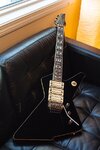
My first 'real' guitar was a pre-production Ibanez DT555 Destroyer I saved up and bought from an Ibanez retailer in 1983 - months before they were officially released. No photos exist of it to this day, but this is the replica I commissioned in 2016 to replace it:

Destroyer Replica 2017.JPEG

After seeing a photo of Phil Collen with this beast of a guitar, I started calling Ibanez retailers to find one. I ended up on the phone with Joan Chesbro at Chesbro Music in Idaho Falls. I told her what I wanted and she said, "I'll see what I can do." A couple of weeks later, I got a phone call from Joan at the studio. She said, "I can get you one of the Phil Collen models, but it's not cheap. It will cost you $1,100.00 with a case and you'll need to pay for shipping as well." I got the money together - which I had been saving for a Gibson Les Paul of my own - and Mom wrote Chesbro Music a check on her publishing company's account. I don't think I was ever quite that excited to get a guitar. The best part was having one - and playing one - several months before the iconic videos came out.

From 1983 until 1989, that was my main guitar and I literally wore it out. I moved to So Cal in 1987 - settling in Wilodmar - and supported myself as a gigging musician. The Destroyer had developed cracks in the finish around the neck joint and the Ibanez tremolo was so unreliable that I had Wayne Charvel put a Floyd Rose on it. In late 1989, the guitar was stolen after a show at 'The Whisky' from my car. It was in the winter of 1989 that I went home for the holidays and realized that I wasn't 'making it' in music and I decided to come home permanently. I auditioned for a local band with a (borrowed) Mako Strat Copy.

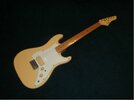
1980 Mako TB-1.jpg

I got the part, and the bandmates drove me to White's Music in Tulare, California to buy me a guitar.

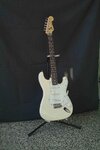
I remember seeing this white Stratocaster in the window and it looked like Ritchie Blackmore's guitar. It had the added bonus of being cheap too, so I played it and it felt good, so they bought it for me. It is the 'E7' Serialized 1987 Korean Made Squire I still have to this day. I played our first show with it that night.

1987 Squire Stratocaster.jpg

The Stratocaster was lacking. The tone was thin and the buzz under fluorescent lights was awful. I quickly swapped in a DiMarzio HS-3, which would later evolve into a Virtual Vintage Solo/HS-3/YJM combination. This was probably the best pickup combination I ever had in this guitar, although it had at least 20 different pickup combinations in it over the years.

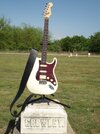
_Robert Strat Crowley Grave.jpg

I still have a register tape from May 11, 2004 when I bought a new Dimarzio to replace a vintage model that had shorted out.

In 2004, I bought my first brand new Gibson - an SG Standard. It was the biggest disappointment I ever encountered with a guitar. It hummed and buzzed wildly, had uneven frets, and hump in the fret-board - which I would later experience on several other brand new Gibson's - and was generally unusable in the studio where I worked. Gibson warranty offered a replacement, but the experience left a bad taste, so I just returned it.

later in 2004, through a buddy who owned a music store in Visalia, California, I had the chance to buy a pre-release Schecter C1 which was a Hellraiser prototype. The guitar was stunningly beautiful with it's ornate, abalone inlay, and I recall thinking back that this was the first guitar that impacted me in such a way that I actually saw it as an art form. The EMG's were quiet, the setup and intonation were perfect and it became my #1 guitar.

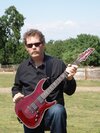
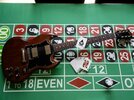
The photo below was taken in 2011 at Deep Creek Cemetery in Farmersville, California. The strap in this photo is the same strap in the black & white image of me above and the 'Crowley' grave photo. I made that strap in 1980 and still use it to this day on all Stratocaster-shaped guitars. It is non-adjustable.:

Robert & Schecter C1 2011 - Close.jpg

Ironically, this guitar had no bad habits, no tuning or intonation issues, came fully shielded and I somehow saw it as not measuring up to a Gibson. Everyone I knew that had a vintage Gibson had some trouble with it, whether it be tuning, or intonation, or electronics, but they always justified it because, well - after all -it was simply a USA made Gibson.

To Be Continued...
 
Last edited:
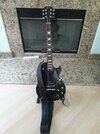
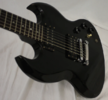
In 2016, I started searching for the 'Holy Grail' Gibson again. I started looking at reasonably priced Gibson's from the 1980's and all had issues that required work. I then purchased a total of 4 brand new Gibson's in 2016 and 2017. All had quality control issues which were beyond what the local Gibson tech could repair, including incorrect neck angle, one neck with a radial twist, buzzing pickups/electronics, picking up and transmitting radio stations and two-way radio communications, humps in the fretboard, and loose, uneven frets. I ended up keeping only two of these guitars - a 2016 SG and a 2016 Les Paul 50's Tribute. Both required shielding to make them RFI resistant enough to work with in the studio. The SG required replacement of the original Gibson 490's due to shorting problems and a huge stack of Faber washers on the tailpiece to compensate for a neck glued in at the wrong angle.

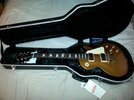
2016 Gibson Les Paul 50's Tribute.jpg

These were all issues that I was able to find posted by others online, not only here, in TTR, but on other forums and in You Tube Videos. Clearly I'm not imagining these things, as much as some die-hard Gibson fans actually tried to convince me that i was.

Rob's S-G SMALL.jpg

Even when completed, the Gibson SG irritated me so much - because of the expense & months of work required to just make it a usable studio guitar, that I just gave it to our friend Adrian.

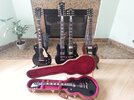
Here's a few shots of my Gibson acquisitions in 2017:

Gibson Family 2017.jpg

2016 Gibson 50's Tribute.jpg

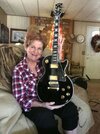
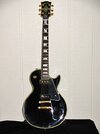
I must thank Gibson for this negative purchasing experience and credit them for being the catalyst that caused me to take up Luthiery. I would eventually build a Les paul Custom Replica from scratch - under the guidance of a SoCal Luthier - which I presented to Mom in 2017 as a Mother's Day Gift.

Mom Mothers Day 2017.jpg

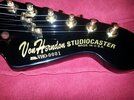
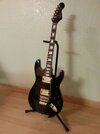
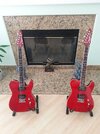
This guitar really gave me a confidence boost in tuning and repairing guitars and I consider it my transition from paying to have guitar's setup, to actually doing all my own stunts. I would eventually trademark my 'Von Herndon' stagename and build 27 guitars under that banner, supplying one twin-humbucker telecaster-style guitar to Marty Stuart.

Von Herndon First One.jpg

Von Herndon Number 1.jpg

#12 and #13.jpg

To Be Continued...
 
Last edited:
Over the years, I have often wondered why I insisted on seeking out the musical equivalent of a Model T Ford, when better, more modern instruments were available. I remember playing Jackson's and Schecter's that didn't need any work to make them serviceable, and yet i still thought a Gibson was somehow better. I ended up with a Chinese Les Paul replica/copy/forgery/whatever from Adrian and once outfitted with good hardware and electronics, worked with it in the studio on a full-time basis on recordings for hire.

A group of us recently sat at the console in the studio and listened as we tried to differentiate it from a documented 1959 Gibson Les Paul on a recording and we could tell no difference. That experience floored all of us and upset a few in attendance who are die hard Gibson fanboys. But, this event and this entire TTR experience, has taught me a lot about gear, but perhaps - even more - about myself.

Our September 7th outdoor performance would be a pivotal event in my musical transformation. The direct sunlight took my 2016 Gibson Les Paul out of action. The heat also affected the tuning on my Chinese Les Paul, and even had a negative - yet not so pronounced - effect on the tuning of my Black LPC replica. These are all guitars which stay in perfect tune in a studio environment, but that performance stressed me out. My guitars were going flat while playing, to such an extent that I was having to pull notes slightly sharp to stay in tune with the rest of the band. The last straw for me was when I missed my cue on a song because I forgot to un-mute my tuner. I had brought my 1988 squire along and it saved the day, staying in perfect tune throughout the event, despite being hot to the touch before the sun thankfully went down behind the mountain:

Crestline September 7, 2019 - Small.jpg

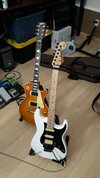
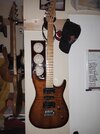
Another real eye opener was when Adrian was kind enough to recently send me the Jackson Adrian Smith Super-Strat:

Jackson 10-15-2019.jpg

No noise, no buzz, no hum, no picking up radio signals, no fretwork needed other than a cosmetic polish, stays in perfect tune, and has dead-nuts fret-to-fret intonation, something none of my Gibson's - even Gibson constructed replicas - have ever displayed. I swapped in a set of 2004 GFS pickups as a mater of sonic taste, but nothing was needed to make it a great guitar.

I've often heard of people saying a certain neck was 'fast.' I've always played - and favored - the big 58 Les Paul / Fender U-profile necks. The Jackson was very different. It was thinner, but wider and the string spacing was also wider. The narrow string spacing was something I had always hated/struggled with on my Squirecaster, so this change was something I felt immediately. I started using the Jackson during rehearsals and also in the studio on recordings for hire. My band mates recently told me the Jackson sounded better than any of my Les Paul's.

I have this need to be able to justify and/or explain/discover why certain things either feel good or feel bad to me when it comes to guitars. I couldn't quite put my finger on what made the Jackson feel "faster" so I started playing them back to back on recordings and listening to the results.

The difference is, the Jackson plays more 'cleanly' than any of my other guitars. I do not really think I play "faster" on it, but I can tell you that individual notes and strings of notes, chords, are all far more clean and accurate sounding when evaluated sonically. Listening to my isolated tracks, everything is just cleaner and more articulate on the Jackson. Some of this could be the pickups, but most of it is a physical thing. I've tested this theory with all my guitars, borrowed fenders from the 1960's, a colleague's 'Holy Grail' (documented) 1959 Les Paul.

In my hands, the Jackson - despite having more string tension at A440Hz - seems easier to fret, even with the same .070" @ the 12th action height as all my other guitars and even when compared to other guitars with physically lower action heights. Both chords and legato phrases are effortless and articulate.

I am now wondering why I would disregard everything the industry has learned in 50+ years of guitar building, and insist on driving a Model T Ford, when more mechanically efficient guitars are out there in abundance??? What early experiences made me so blindly loyal to not just a Gibson Les Paul - but to the Gibson Les Paul construction methodology in general - that I would repeatedly charge the Les Paul windmill over and over again, despite negative experiences and substantial resale loss on these ventures???

Clearly, the biggest issue here was with my thinking.

The Jackson sent to me by Adrian - and the September 7 live performance - really made me realize that my general approach to the guitar needed to change drastically. While I do feel the 24.75" scale to be more comfortable to play, I realize now that it is largely a mater of reduced string tension at a given tuning. The Floyd Rose - even on a 25.5" scale, feels very much like the 24.75' stop-tail, because of the bridge movement while bending strings. Unison bends are a little challenging on a Floyd, but they are manageable. The Floyd also stays in prefect tune. Even when setting the Jackson out in the sunlight, the tuning didn't change enough to hear it.

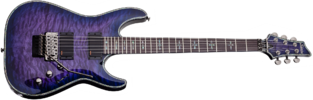
I also realized that I favor more ornate guitars, like the Les Paul Custom and that I love colors and contrast in general. I really missed my C1 Hellraiser and it's boringly-perfect studio mannerisms, so when I discovered that Schecter had a Floyd Rose model in Transparent Purple Burst, I decided it was time to make a change:

HELLRAISER C-1 FR STPB TILT.png

I'm putting aside the guitars of my heroes, early influences, habits, traditional prejudices and even those highly prized guitars of my esteemed colleagues, and approaching this new venture from a different perspective. I am choosing to embrace new technology, like active pickups, compound radius boards, multi-piece neck construction, and the accuracy and durability of the Floyd Rose 1000, as opposed to the licensed variants.

There's nothing wrong with Gibson's, but they cost me more money and time than they ever yielded, and like a bad relationship, it's time for a change....
 
Last edited:
Great story about your journey. I confess that for me it is hard to resist the hype. I've gone through several Gibson SGs. Les Pauls, a V and a Explorer and only one is still with me. The rest just didn't do it for me. I didn't have the quality control problems you experienced but there was something about them that was just blah, no mojo. The Explorer did have some mojo. I loved the guitar but on stage I kept hitting the cymbals behind me with the pointy back of the guitar. In fit of pique I sold it. I regretted it the next day. My 3 knob special SG is something special. It just feels right in my hands. Other than that I agree with you. The big name brands are way over hyped for what you get. I now stick to Squiers, Epiphones, and Godins. They are cheap to buy used and easy to make them mine if they need anything. I have come to the conclusion that every guitar is different and may need a bit of work to get it to where I like it so why not start off from a less expensive starting point. I have two stock guitars now, a Godin A12 which has had no changes except strings since I bought it new, and a 1980's Vantage VP795 that needed a bit of fret work when I bought it used.

All that said I still fall victim to the hype. I have been looking for a slope shouldered Gibson acoustic for a over a year now. I love the sound but haven't found one I can live with yet.
 
That was a good read Robert.

My problem is, I’m not a good enough guitar player to know a Holy Grail if it slapped me in the face. I’m not tone deaf..... just struggle to get to that point. I know it’s not the guitars or amps. My youngest can pick up any one of my electrics or my acoustic and make those suckers sing like I can only dream about.

Ultimately. Being primarily a bedroom player, I guess my holy grail would be whatever happens to be in my hands at any given time. The quest continues.
 
That was a good read Robert.

My problem is, I’m not a good enough guitar player to know a Holy Grail if it slapped me in the face. I’m not tone deaf..... just struggle to get to that point. I know it’s not the guitars or amps. My youngest can pick up any one of my electrics or my acoustic and make those suckers sing like I can only dream about.

Ultimately. Being primarily a bedroom player, I guess my holy grail would be whatever happens to be in my hands at any given time. The quest continues.

Wishing you all the best...it will come to you!!!
 
1571257606015.png

DIdnt think ya was -- just letting you know they do exist --- :)

I have been on the "hunt" for one--- I mean I LOVE odd ball SG's as we all know ;)


HEY Robert -- if you want to try a REALLY quiet bone stock guitar right otta the box---------------------

GODIN! (not kidding)

BONES stock (used even) quiet as the SG you sent me ;)
Godin Freeway 1.jpg
 
View attachment 33002

DIdnt think ya was -- just letting you know they do exist --- :)

I have been on the "hunt" for one--- I mean I LOVE odd ball SG's as we all know ;)


HEY Robert -- if you want to try a REALLY quiet bone stock guitar right otta the box---------------------

GODIN! (not kidding)

BONES stock (used even) quiet as the SG you sent me ;)
View attachment 33003

@eSGEe Well I found a couple for you, in fact one is not far from me. Maybe 10 miles away.

near me
 
Last edited:
Back
Top