Thoughts About Converting My Tweedy 5E3 to a Brownface 6G3?

syscokid

Ambassador of War & Peace
Country flag
I'm trying to keep myself busy, and I don't have any more practical room for another amp. So I've been thinking...: What if I converted my 5E3's cathodyne phase inverter to a more modern LTP phase inverter, replace the first preamp tube's 12AY7 with a 12AX7 and gainier plate voltage, replace the rectifier's 5Y3 with a GZ34, and separate and remove the interactive circuit between the 5E3's volume controls and tone control. I'm hoping I can complete the conversion without having to hack out any extra holes from the chassis. Compared to the 5E3's one tone control pot, the 6G3 has two Tone control pots. I think I can get away with a dual gang pot to cover the transition of the tone controls. Enter Leo's next revolution of his Deluxe line of amps, the brownface 6G3 minus its tremolo circuit.

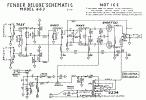
Posting three schematics: Late 50's 5E3, early 60's 6G3, and my suggested modded 6G3. What y'all think?
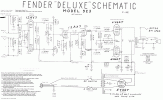
5E3_Schematic_Annotated.gif

6G3_Schematic.gif


I'll have to build a new circuit board and basically add a few more components, including another filter cap, but I think I can easily keep the new board to the same size to what's in the amp right now. Need to add another tube socket for the extra 12AX7, and fortunately there's already a hole cutout for that purpose on the chassis. Plan to keep the same trannies too:
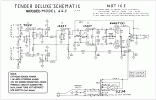
Fender Deluxe 6G3 MODDED Schem.gif
 
I'm trying to keep myself busy, and I don't have any more practical room for another amp. So I've been thinking...: What if I converted my 5E3's cathodyne phase inverter to a more modern LTP phase inverter, replace the first preamp tube's 12AY7 with a 12AX7 and gainier plate voltage, replace the rectifier's 5Y3 with a GZ34, and separate and remove the interactive circuit between the 5E3's volume controls and tone control. I'm hoping I can complete the conversion without having to hack out any extra holes from the chassis. Compared to the 5E3's one tone control pot, the 6G3 has two Tone control pots. I think I can get away with a dual gang pot to cover the transition of the tone controls. Enter Leo's next revolution of his Deluxe line of amps, the brownface 6G3 minus its tremolo circuit.

Posting three schematics: Late 50's 5E3, early 60's 6G3, and my suggested modded 6G3. What y'all think?

View attachment 105822

View attachment 105823


I'll have to build a new circuit board and basically add a few more components, including another filter cap, but I think I can easily keep the new board to the same size to what's in the amp right now. Need to add another tube socket for the extra 12AX7, and fortunately there's already a hole cutout for that purpose on the chassis. Plan to keep the same trannies too:
View attachment 105824
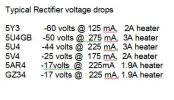
I think 5Y3 has better sag.
 
Whats cool on the 6G3 Deluxe is the 220K plate resistors
I have two Tweedle Dee Deluxe amp and like them GZ34 6V6 RCA black Plates and 12AX7 x 2
I've never researched the trannies for a Tweedle Dee. Its filtering is quite a bit heavier than the 5E3. I assumed the trannies would have to be differently specked for a Tweedle Dee build. This is interesting...

I think 5Y3 has better sag.
Yeah, it has lots of it, too. Sounds huge. Always will have the option to try different rectal tubes and solid state adapters.
 
Greg, used stock Deluxe PT from Mojotone and a 1959 OPT runs cool

View attachment 105834
I just got through reading the 22 page Tweedle Dee Deluxe thread at The Amp Garage forum. Noticed that you made quite a few worthy contributions to that thread too. All kinds of cool info. But yeah, using the same trannies I’ve got now for a semi-6G3 or a Tweedle Dee build is very doable.

My 5E3 does get a bit hot, especially the PT, but it seems to be the norm with these circuits. What do you mean by “1959” OT?
 
My friend Robert was a engineer at Fender and they found a storage unit full of transformers from the year 1959
and it had 4 and 8 ohm taps my friend Mark worked on Kenny Wayne Sheppard's amp and sent me a hand drown layout with voltages
my first build was a day project my next build 400 hours tried 5 brands of transformers I begged Robert for a other 1959 OPT a friend of his let one go
score and went with a Mojotone PT like the first build they sound the same hard lessons not forgotten
Robert sold me exact transformer sets that Dumble used and some prototypes that he designed for Tony Bruno
sad part of the story when flood in Nashville happened Robert was cleaned out of his vintage transformer supply restoring the amps of the stars.
 
My 102 build used a 1971 Fender Twin transformer set spent 8 hours a day fine tuning it voltages exact components the same
I called Robert told him It was 90% Brenda my girl friend said I was driving her crazy Robert sold me a Magic Parts transformer set at that time was 28 years
old NOS set the bias and adjusted the dropping string amazing a NOS quad of 6L6GC RCA gray plate 12AX7 matched Siemens matched 12AX7 PI
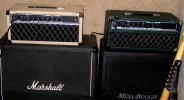
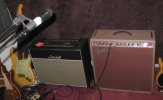
I let a friend use it lasted 3 world tours until the 6L6GC were burned up the cream amp on the left in the photo.

#102 001.jpg
 
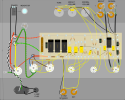
Since I made multiple purchases with three different vendors yesterday, it's safe to say that I've decided to follow the idea to create an amp chassis and circuit with a topology based on the combinatio of a 5E3 and 6G3 circuit. Which also means that I will not deconstruct my current 5E3 build... It's too good! All parts will be new.

I'm not very adept with the DIYLC software that's being used to create a pretty accurate layout. It took me many hours to figure a lot of this stuff out, but that's my obsessive nature and keeps what's left of my brain exercising those little cells in there. If anyone sees an issue with the layout of the circuit, PLEASE let me know!

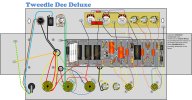
5E3to6G3 CHASSIS resized.png
 
OK. I didn't say anything earlier because you were going to reuse an existing build.

The 6G3 circuit is probably my favorite-just as it was.

Suggestion from someone who built one, follow the schematic, bias vary trem and all.

When chasing grails and all...
 
Can't speak to the technical aspects, but a guy I regularly play with has a matched pair of '61 brownfaces and they're some of the best sounding Fender amps I've ever heard.
 
OK. I didn't say anything earlier because you were going to reuse an existing build.

The 6G3 circuit is probably my favorite-just as it was.

Suggestion from someone who built one, follow the schematic, bias vary trem and all.

When chasing grails and all...
Point taken… :cheers:

But there’s no turning back now. I await this journey :drive:


Can't speak to the technical aspects, but a guy I regularly play with has a matched pair of '61 brownfaces and they're some of the best sounding Fender amps I've ever heard.
And the king of them all, is the brownface Vibrolux. That would be a worthy build!
 
I also came very close to ordering an Allen Amp’s Hot Fudge with Nuts kit. Very 6G3-ish with, the always good, David Allen-style mods.
 
Since I made multiple purchases with three different vendors yesterday, it's safe to say that I've decided to follow the idea to create an amp chassis and circuit with a topology based on the combinatio of a 5E3 and 6G3 circuit. Which also means that I will not deconstruct my current 5E3 build... It's too good! All parts will be new.

I'm not very adept with the DIYLC software that's being used to create a pretty accurate layout. It took me many hours to figure a lot of this stuff out, but that's my obsessive nature and keeps what's left of my brain exercising those little cells in there. If anyone sees an issue with the layout of the circuit, PLEASE let me know!

View attachment 105987
I think I would
a. move the grid resistors away from the preamp tube socket.
The grid resistors are going to induct too much hum from the magnetic field of the filament wires.
The grid resistors were originally positioned at the input jack, for just that reason. To keep them far away from the filament wires.

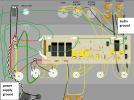
b. I think I would split the grounding.
The power supply filter grounds, the CT of the filament winding, the CT of the HT winding, the bias supply filter ground, the mains earth wire, should all be grounded on the power transformer side of the chassis.

The audio circuit ground should be on the opposite side of the chassis. As far away from the power supply grounds as possible.

These grounds should not be bussed together but separated. The resistance of the chassis should be between the 2 grounding points.

What's going to happen is: there is going to be a bunch of ripple (hum) in your audio path if you don't separate the grounds.
 
At the retirement point of building amps, hobby, I have three amps left to tidy up. One is a 6G3 that I had built in a chassis to match an existing cabinet, and kept the filter caps inside so space ran out quickly for those. I added a small daughter board, not my best work, to adjust voltages to hit Fender specs. I hit nightmares trying to tame the tremeolo. It always had issues, you name them.

I finally thought , just finish it up as a playable amp, maybe in the future retry again. So it is a 6G3 with the tremomo gutted out and it now has cathode bias, instead of the fixed bias (I left the bias trim pot in place).

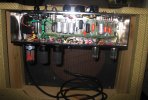
Ugly with the hole in the center of the turretboard, but It sings. I haven't stuffed it back in the cabinet as I'm awaiting some more tubes, and will try a 5751 in V1. Right now I subbed a 12 AY7 in there on V1 and the cleans are Black Face amp era, but probably will want that small extra gain. It was fine with the stock 12AX7 in V1, just doodling around.

 
I think I would
a. move the grid resistors away from the preamp tube socket.
The grid resistors are going to induct too much hum from the magnetic field of the filament wires.
The grid resistors were originally positioned at the input jack, for just that reason. To keep them far away from the filament wires.

b. I think I would split the grounding.
The power supply filter grounds, the CT of the filament winding, the CT of the HT winding, the bias supply filter ground, the mains earth wire, should all be grounded on the power transformer side of the chassis.

The audio circuit ground should be on the opposite side of the chassis. As far away from the power supply grounds as possible.

These grounds should not be bussed together but separated. The resistance of the chassis should be between the 2 grounding points.

What's going to happen is: there is going to be a bunch of ripple (hum) in your audio path if you don't separate the grounds.


Yes, reroute your grounding idea.

The PT CT ground and the filament ground should be together and a short ways away from other grounds.

The grounds from the preamp up to the PI go to the ground at the input.

The PI ground, Cathode bias ground, and the rest of the reservoir grounds go together.

The green /yellow ground in the drawing needs removed from the positive end of the cathode bias, that's a direct short to ground. The positive end of the cathode bias is tied together bypass cap positive/ resistor and they go to pin 8 as shown in your drawing.


Your rectifier looks off a bit. THe yellow wires go to pins 2 and 7 with the yellow going to the OT and B+ off of pin 8 too
 
Back
Top