Speaker Cable Ohms Poll:

Inspector #20

Ambassador of Tone
Fallen Star
Country flag
For you dudes with amp/cabs - can you check the resistance values of your speaker cables and post the results to this thread???

I've noticed some strange ohm readings on two of my speaker cables.

This one is commercially made and comes from Sweetwater with Neutrik ends.
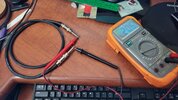
20210215_064235.jpg

This one I made myself from heavy speaker with Neutrik ends I bought from Philadelphia Luthier Tools.
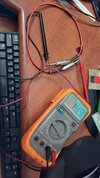
20210215_064051.jpg

The interesting part about the resistance values in both cables is how the value "disappears" once you plug it in.

For example. The hand-soldered by me red & black cable has 14.9 ohms on the bench.

My 2x12 speaker cabinet has two 16 ohm speakers, wired for 8 ohms in parallel. The cabinet itself measures about 10 ohms in the 8 ohm switch position.

If I plug this red/black cable - that reads 14.9 ohms on the bench- into my 2x12 cabinet, one would expect to see 24.9 ohms.

14.9 cable plus 10 ohm cabinet should be about 25 ohms, right????

No.

It reads only 11.4 ohms when plugged into the cabinet!!!

Curious to see what your measurements are...
 
Last edited:
If you are checking at the far end of the cable when plugged into the cab wouldn't you expect 39.8 ohms? You are only checking one side of the cable measuring tip to tip.
 
For you dudes with amp/cabs - can you check the resistance values of your speaker cables and post the results to this thread???

I've noticed some strange ohm readings on two of my speaker cables.

This one is commercially made and comes from Sweetwater with Neutrik ends.

View attachment 59121

This one I made myself from heavy speaker with Neutrik ends I bought from Philadelphia Luthier Tools.

View attachment 59122

The interesting part about the resistance values in both cables is how the value "disappears" once you plug it in.

For example. The hand-soldered by me red & black cable has 14.9 ohms on the bench.

My 2x12 speaker cabinet has two 16 ohm speakers, wired for 8 ohms in parallel. The cabinet itself measures about 10 ohms in the 8 ohm switch position.

If I plug this red/black cable - that reads 14.9 ohms on the bench- into my 2x12 cabinet, one would expect to see 24.9 ohms.

14.9 cable plus 10 ohm cabinet should be about 25 ohms, right????

No.

It reads only 11.4 ohms when plugged into the cabinet!!!

Curious to see what your measurements are...
You need to get in there with the ohm meter and test the actual wire where it connects to the plug.
It's not a matter of opinion.
It's a matter of a defect wire or a defect plug.

No short speaker cable is going to read 14 ohms from end to end unless the plug or wire is defective.

It doesn't matter where you bought the parts from.
Testing is the only way to know the answer.
 
Last edited:
I just checked a cheap 4 foot Marshall speaker cable. It was .3-.4 ohms. You definitely have too much resistance in your cable.
 
So, going back to your original scenario if you have a 10ish ohm speaker and plug in a cable that is about .5 ohm per side you would end up with 11 and change for ohms, which you did. Definitely something wrong with that cable giving you a high initial reading.
 
You need to get in there with the ohm meter and test the actual wire where it connects to the plug.
It's not a matter of opinion.
It's a matter of a defect wire or a defect plug.

No short speaker cable is going to read 14 ohms from end to end unless the plug or wire is defective.

It doesn't matter where you bought the parts from.
Testing is the only way to know the answer.
I just checked a cheap 4 foot Marshall speaker cable. It was .3-.4 ohms. You definitely have too much resistance in your cable.

I checked several speaker cables here at the studio and all have 8-10 ohms when tested. However, when connected to ANY speaker cabinet, the resistance disappears - meaning that the known value if the speaker cabinet does not "stack" with the ohms reading on the cable itself.

So, for @Amp Mad Scientist, I took the cables apart and also measured the cable ends that I have here in stock.

I measured a 26" section of the red/black speaker cable on the bench. It also shows 10-15 ohms, But it doesn't impart that resistance to any circuit. The Neutrik ends have zero resistance when unsoldered and measured individually.

Example:

My speaker cable measures 10ohms on the bench.

My 2x12 speaker cabinet measures 11 ohms in the 8 ohm switch position (two 16 ohm speakers in parallel)

If the cable had 10 ohms of "real" resistance, when plugged into the cabinet, we would see cable resistance (10 ohms) plus speaker cabinet resistance (11 ohms) for a total of 21 ohms.

But the cables do not add their resistance to the circuit.


When I plug the 10 ohm wire into the 11 ohm speaker cabinet, I read 11.4 ohms on the end of the cable.

The transient resistance disappears once the cable is attached to a load.

I believe that we are dealing with a type of 'transient resistance' phenomena.

Interesting!!!!
 
Mine don't do that. You are getting faulty meter readings for some reason.

Snap-On/Fluke Multi-Meter. I will try a different meter later...but I found an article on this phenomena on an electrical engineering website, where it discussed "transient resistance" in copper cables that "disappears" when the cable is connected to any kind of circuit.

My 10 ohm cable should add that 10 ohms when connected to any circuit, and it does not...
 
Zero out your meter set to ohms and short out your test leads what does that read ??

Will do that when I get home. Also, gonna borrow a newer Fluke DVOM from my drummer colleague for testing later tonight...

My amp ran Saturday for 6 hours with the master volume between 7 and 8 and for 5-1/2 hours at Sunday's performance. If something was seriously wrong, I am sure it would have died during those performances...
 
I also found this on www.soundcertified.com:

Actual Speaker impedance DC resistance/Ohms range chart

Speaker impedanceDC resistance
2 ohms1.2-2 ohms
4 ohm3.1-4.0 ohms
8 ohm5.7-8 ohms
6 ohms4.0-6 ohms
1 ohm*0.5-1.0 ohms
16 ohms*11-16 ohms

"Remember that you won’t measure exactly 4 ohms for a 4 ohm speaker or 8 ohms for an 8 ohm speaker, for example. The DC measurement is almost always 30% lower than the impedance rating on the speaker’s package or label..."

This statement is consistent with the numbers I am actually measuring at my speakers...
 
Back
Top