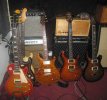
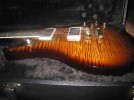
I've been a PRS guy for decades. Have a bunch of 'em now and I love nearly all of them.
(There aren't any that I dislike, just a few I don't reach for as often. )
Anyway, my main gigging guitars have been PRS since I first discovered them back in the 80s.
I can sorta understand some players not liking them though. No brand suits everybody, after all.
Still, PRS have their own thing going, perhaps more than the older big brands.
There are a few levels to this, I think.
First, you can't expect them to sound and feel like your favorite Gibson or Fender.
I've often said, you have to accept a PRS and appreciate it for what it is, not for what it isn't.
The basic design may be an approximate midpoint between Gibson and Fender standards, but it isn't an analog of either.
I like being able to touch on both words, both tonally and feelwise.
The PRS scale length can feel a bit unnatural after a lifetime of playing 25½" and 24¾" axes.
For me at first this was subliminal - it was a while before I could identify it.
Didn't stop me from loving that first PRS from the moment I picked it up.
My personal thing is lively necks. And nearly all the PRSi I've played have delivered on that. Even the import series, with very few exceptions.
Second issue: PRS pickups aren't always what you'd expect from looking at the guitar.
The original 80s 'T&B' hums are crunchy, glassy and immediate-yet-singing. They split incredibly well thanks to rod mags hiding in their slug coils.
But they're entirely different from ordinary humbuckers and require their own rig settings.
Ditto for the DGT set - amazingly touch responsive & detailed but you can't use the same settings you would with a Les Paul. Too different.
The VB/HFS set were great for classic rock tones.
I liked the Dragon One set for high gain work, though not ideal for cleans; in the long run I found it a little limiting.
Some of the more conventional PAF-type PRS humbuckers are very, very good.
Big fan of the 57/08s for 3D sepiatone blues sound, also the 59/09s, for a more modern 'rock' character in vintage output.
The low wind ones didn't suit my taste quite as well. But they were exceptionally open-sounding, lots of air in the top end.
The core Starla hums are vintagey too, and pretty classic sounding. I could swear there's a little Gretsch in their DNA.
McCarty hums have their own charms, though being A4-loaded they can seem pretty lackuster until you turn up. They come alive at volume.
Anyway, I think a big part of the general perception of PRS as 'flat' is the character of their pickups. Many require specific dialing-in to be at their best.
Most of these pickups don't impose a lot of their own peronality; they let the wood and the player determine more of the character.
This is a different approach to many modern humbuckers. You have to be a little more attentive but you're rewarded with a more articulate voice.
That said, several of my PRSi have had the pickups swapped out so I can use them live without having to redial every time I switch guitars.
(I've changed pickups in many of my Gibsons too - some more than once over the decades. The Fenders not so much - only a few got swaps.)
Not unrelated to that pickup issue - PRS generally seem to respond well to a certain level of consistency; they aren't quite as 'forgiving' as a typical Gibson.
That's not to say they demand mechanical precision - on the contrary, I find them highly responsive to nuance and to my mood of the moment.
Just that they arct a bit like a magnifying glass: they accentuate the subtle details that matter, and they won't smooth over any sloppiness.
It takes a little getting used to.