Peavey Beantown Boom Stick

RVA

Ambassador
I am hoping this will be a short and boring thread, in that there is no real work to be done, but all are welcome on the ride however long it lasts!

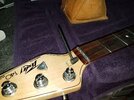
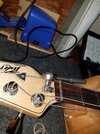
The truss rod nut on this bass was a bit deep, so it had to be dug out

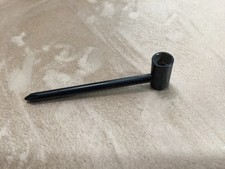
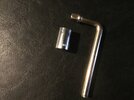
Cool tools:
20190130_231849.jpg

Next, I stacked the rod with nuts and washers. This will provide additional leverage (tension) and makes it so you will never have to dig deep for the nut again
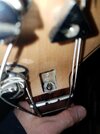
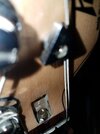
20190130_233043.jpg

20190130_233441.jpg


Even with this, the TR nut access makes me nervous. You can see the stress marks from prior turns. The channel may have even been repaired. Hopefully, we can set it and forget it after this ride.

I will take the next step when I get my 34" notched straight edge, hopefully by Friday!
 
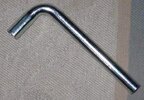
This is probably what the original Peavey truss rod tool looked like.

C7679534-3961-492C-9680-D72944DE3A73.jpeg

I guess they were notoriously deep set in the T series, and Foundation, basses.
The stacked nut/washer fix should be a fine solution.
The fact that the bass arrived in tune, asfter shipping halfway across the con US, makes me hope that the neck is fairly stable and will hold adjustment for a reasonable period of time.
 
Good move with stacking the washers Ray.
That's bought me additional adjustment on nuts that had bottomed out.
I've used a regular old Gibson (5/16") truss rod wrench successfully on my Peavey Patriot.

Not sure if it would have been deep enough to have worked in your situation or not.
 
This is probably what the original Peavey truss rod tool looked like.

View attachment 21808

I guess they were notoriously deep set in the T series, and Foundation, basses.
The stacked nut/washer fix should be a fine solution.
The fact that the bass arrived in tune, asfter shipping halfway across the con US, makes me hope that the neck is fairly stable and will hold adjustment for a reasonable period of time.

Ive never had one that didnt........and I have owned a CRAP TON of them---I did have issue with a 2013 China made Bass...but...it was a very CRUSTY pawn shop abused animal--- but .never a problem with a USA made one that I can recall
 
Good move with stacking the washers Ray.
That's bought me additional adjustment on nuts that had bottomed out.
I've used a regular old Gibson (5/16") truss rod wrench successfully on my Peavey Patriot.

Not sure if it would have been deep enough to have worked in your situation or not.
I may be able to use that now. Thanks for the thought!
 
Good move with stacking the washers Ray.
That's bought me additional adjustment on nuts that had bottomed out.
I've used a regular old Gibson (5/16") truss rod wrench successfully on my Peavey Patriot.

Not sure if it would have been deep enough to have worked in your situation or not.

I can attest that it would not have worked. I had a socket that dropped in there pretty freely.
My Gibson truss rod wrench didn’t even touch the end of the rod...never mind the actual nut.
C239405A-45A2-4844-A6D0-7CBEAF9B05C2.jpeg
The above combo barely worked. The threaded truss rod protruded most of the way through the socket, but there was enough to grab. I warned Ray of the situation, and he had the above solution.
I had reduced the relief to between 13, and 15 thousandths(from around 28 to 30 thousandths) capo at first fret, fretting 17th, checking with feelers at 7, 8, and 9th frets...but I had no slotted straight edge to verify that the fretboard was truly flat for checking/leveling frets. He needs to be able to adjust it if possible/necessary.
 
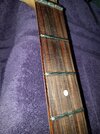
The first 7 frets are failrly well dented. My feeble brain makes me think that the owner was playing with too much relief. I did a poor job of capturing it, but it is under the 2 middle strings


20190131_231758.jpg
 
The first 7 frets are failrly well dented. My feeble brain makes me think that the owner was playing with too much relief. I did a poor job of capturing it, but it is under the 2 middle strings


View attachment 21821
Yeah, frets 2, 4, and 5 especially. The relief was crazy...like where I keep my action on a couple of guitars.
 
  • Like
Reactions: RVA
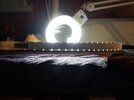
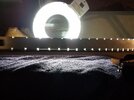
I got my notched straight edge tonight. The truss rod was completely loose since it was shippied to me, so I did not want to apply too much pressure all at once. I got to this point after about 1 1/4 turns. I have travel left, but I may wait until tommorow to crank anymore. I am not certain if it will go dead flat. The frets seem to be scalloped due to use (honest wear). Since the frets are also worn, I feel that this fret job will bring them pretty low, even if it does prove feasable.

20190131_231640.jpg

20190131_231645.jpg
 
I’m hoping another adjustment will bring that gap down between 7th, and 12th. I felt like I had it close when I sent it, but it was pretty cranked up when I got it...then I cranked it about 3/4 of a revolution more, and it definitely flattened out a bit. The thing that bugged me was 19th fret on the 2nd and 3rd string...they fretted out at 17/18th. Before I adjusted the trussrod, and took away the neck tilt, they were fretting out around 15/16th.
 
I’m hoping another adjustment will bring that gap down between 7th, and 12th. I felt like I had it close when I sent it, but it was pretty cranked up when I got it...then I cranked it about 3/4 of a revolution more, and it definitely flattened out a bit. The thing that bugged me was 19th fret on the 2nd and 3rd string...they fretted out at 17/18th. Before I adjusted the trussrod, and took away the neck tilt, they were fretting out around 15/16th.

I am dying to find out, but conventional wisdom says not too crank too much at one time, and to give the wood time to rest between big moves. The smart move is to find out tomorrow. If not, a refret and FB plane will bring this to a new level, but it will visibly "altered"
 
Agreed. My initial adjustments were done over the course of 16 hours. I gave it a break in between each quarter turn. Then I took away all neck tilt, and raised the bridge pieces on strings 2&3 beyond the 12 inch radius that they should be at. That resulted in the best action, and the most playable frets... But not, at all, cool.
 
Agreed. My initial adjustments were done over the course of 16 hours. I gave it a break in between each quarter turn. Then I took away all neck tilt, and raised the bridge pieces on strings 2&3 beyond the 12 inch radius that they should be at. That resulted in the best action, and the most playable frets... But not, at all, cool.
Is the micro tilt removed from the equation (fully retracted)?
 
The pivot point for the neck tilt is the two neck screws closest to the headstock. Around 17th fret.
It had some tilt when I got it. Maybe 1 full turn, approximately, from touching.
The “fretting out” problem definitely improved without any tilt.
Any tilt was like jacking the 19th further up in the way of things.
For example: with the neck tilt engaged as received, and truss rod reducing relief to ~14 thou(post my adjustment)...the D string was choked at 15th fret, and began voicing 19th fret at 16th.
Then with no neck tilt engaged, the D string choked at 17th fret, and began voicing 19th fret at 18th.
Give or take.
 
Back
Top