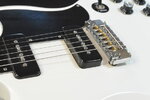
Nut compensaton and bridge on SG

bea

AmBASSador of the F Clef
Country flag
I finally did it - approximately compensate the nut on my SG and give it a better wraparound bridge - the old Schaller 455 bridge i finally found again in my stack of garbage (that needle in haystack thing...)

Luckily i could use a rest of rosewood for the nut compensation, and it turns out that the wood is hard enough to provide a good sound of the open strings as well. Wood is somewhat easier to work on than bone, and in this case it has the advantage that the compensation is hardly visible.
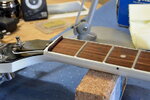
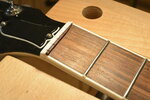
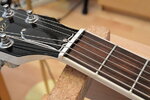
DSC_3472.JPG

DSC_3474.JPG

DSC_3475.JPG

DSC_3476.JPG
 
slightly better than before. But i changed two parameters - the bridge toward something intonating better that the original bridge as well, so it is hard to tell what makes the bigger difference.

I had the guitar compensated using toothpicks and matches with the original bridge as well, and that made a huge difference. But the soft wood damped the empty strings noticeably.
 
You would have to move the bridge forwards the same distance as you moved the nut to preserve octave intonation.
 
But quite surprisingly the amount uf saddle compensation reduces if You introduce nut compensation.
 
So in Lamens terms,why did you do this Bea ? i had a ESP guitar with the nut itself compensated. You do this nut compensation because theres not enough travel on the bridge ? Stud holes in the wrong spot ?
 
Myself ive went to all Leo Quan Badass bridges on my 3 JRs.Plenty of travel on those things.
 
Well done bea......however I am AGHAST! that lovely SG ----has-------- NIBS!!!!!!!!!!!!!!!!!!!!!!!!!!!

200.webp
 
Well, it is all reversible, and i will, of course, put the original bridge in the guitar's case. And the nut compensation can be easily removed with a chisel.

I gave it the nut compensation to achieve a better overall intonation, and no, the nut was not compensated in the factory. Easy to check - the lengths of two adjacent frets have a ratio of 1.0595. Nut compensation will make the 1st fret shorter.

And lovely or not - if Gibson saves money in production and gives us 3rd class quality components like that wraparound bridge - we have to do something about it. At least that bridge had been used by Gibson in some of their guitars. I am aware of the corvus.
 
That's an amazing piece of subtle fabrication. If I understand correctly, you are using a piece of wood as a shelf for individual string compensation. Since you seem to have been successful with the wood, you should try it with bone or some other dense material. Maybe get a blank nut of the GraphTech material and carve it down to a shelf size. Call it the BEArvana.

On the other hand, BEArvana might get noticed by Earvana and the Ernie Ball Music Man company. Then both of them will invite you to their lawsuit party that's been going on for years... :victoire:
 
Mhmm, that wood is Katalox, which is a very dense and very hard wood, and it does a really good job as a saddle - in my V -bass too. After a week of intense playing it i do not feel any need to replace it. It is just good as it is.
 
Katalox is "Mexican Ebony", a very hard and stiff wood. Color similar to dark rosewood, structure and stiffness similar to ebony. It is used by Martin and a few others for the fingerboards. Available here: ESPEN - Tonewood for Guitars • Turnery • Humidors • FSC®

They ship worldwide, and AFAIK they are suppliers for american manufacturers as well. And the company is not too far away from our rehearsal room...
 
Back
Top