Musical Epiphanies

Fiesta Red

Well-Known Member
Country flag
Every once in a while, I realize something I about music, bands, instruments, singing, songs, songwriting or performing that changes the way I play or the way I approach my craft.

Here’s a few of mine:

-Rhythm guitar is more important to the song than lead guitar.

-Using a pedal, guitar, amp, or even a complete rig just like your hero will not make you sound like him/her.

-Just because a band/player is revolutionary, groundbreaking and/or technically brilliant doesn’t mean I like their music (or that their music is great)…I’m looking at you, Roy Buchanan and Yngwie Malmsteen!

-A song can get away with having two verses and a chorus.

-A song doesn’t have to have a chorus.

-A song doesn’t have to have a bridge.

-It’s better to sound like yourself than to exactly copy a famous guitarist.

-Cover bands get more gigs. Original bands are a lot more fun.

-It’s ok to have a lot of pedals, and conversely, it’s ok to just plug directly into an amp.

-Just because someone is a better player than you (more technically proficient) doesn’t mean your contributions to the song/recording/performance aren’t important, or that they have to take all the solos within a performance.

-A sideman/sidewoman is often more important to the band or more musicially proficient than the frontman/frontwoman.

-It’s ok (and often important) to transpose or re-key a song to fit the singer’s range or voice—even your own songs as your voice changes.

-A great album doesn’t always have a hit single on it.

-A band that has a bunch of hit singles doesn’t necessarily have a bunch of great albums.

-It’s ok to do your own interpretation or arrangement of a song, even a “Classic” (except when your guitarist wants to play John Lennon’s “Imagine” on the freakin’ banjo)

-Just because you love a particular instrument or your hero plays a particular instrument doesn’t mean that instrument works for you (for example, I love the looks and sound of Les Paul guitars and I love Billy Gibbons but I can’t find a Les Paul that I like playing).

-The most virulent critical/insulting players are usually concerned that you’re going to outshine them.

-If someone doesn’t like my music, they can kiss my left butt cheek…or the right one…or both…I don’t care. I’m playing for my own amusement and pleasure.

-Band chemistry is more important than band proficiency…a band of decent-to-good players that work well together will often put on a better performance than a band of great players who don’t like each other or aren’t on the same page.

-A technically complicated song is not necessarily better than a simple one.

What are your musical epiphanies?
 
Last edited:
No chorus. No bridge. Very first song that comes to mind is Wreck Of The Edmund Fitzgerald. Four chords. Repeat those four chords till the song ends sometime tomorrow. Love the song, both for what it is….. and it’s four of the five chords I can play. :pound-hand:
 
However. Epiphany. Probably two. I’ve shared both here before.

Saw or read an interview. Guy was sorta talking about covering songs. But the part that spoke to me basically went like “stop trying to be like Pete, Angus, EVH…. Etc. You will forever be frustrated since you will never do it. You can only play like you. That screamed volumes to me and I approached songs differently after that.

The other was from our very own Robert Herndon. We were having a conversation one day and I threw out my standard line when someone would ask me if I play guitar. My line: “I play at guitar.” Robert gave me a 2x4 moment. Told me in only the way Robert could say it…. “You put fingers on a fret board and make music. That’s something the overwhelming percentage of the population cannot do. That makes you a musician.” These days when asked I just say, “Yes I do.”
 
Mine came under the "better late than in the grave" category. First, I discovered that I love Humbuckers in my Black Strat. For decades, it was anathema for me to disturb the S/S/S look. Now it's hard to imagine it without them. I've been migrating more toward a heavier sound lately but didn't want to sacrifice my beloved Strat cleans. Now I have both. As Archimedes once proclaimed, "Eureka!" I will not, however, run naked through the forum as he did.

Second, I have discovered alternate tunings. Boy was I missing out on some tonal bliss. Still experimenting.

My thanks to Mick Mars for both inspirations.
 
Interesting Red, if Glen Tipton had taken this statement in to account maybe KK Downing would have remained in Priest

“-Just because someone is a better player than you (more technically proficient) doesn’t mean your contributions to the song/recording/performance aren’t important, or that they have to take all the solos within a performance.”
 
I love the original post. I agree with many, especially creating your own sound and original bands being more fun.

My own epiphany... It has never been about "your sound." Especially if you're in a band. You are only one part of the puzzle, and you do what you need to do to make everything and everyone sound awesome. Especially the song. That is what's most important. I often agonize over the songwriting process because I want it to be something I would want to listen to, or buy.

The formula that works well for my band is when I play my Billy-Bo copy, Flying V, ES-335, or an SG. I usually use a JTM-45 (sometimes a JMP), a DST Engineering (Hiwatt clone), or my Matamp. At practice I love my Trainwreck build, but have not tried it at a gig. Those all work well with Tom's Acoustic or Ampeg amps and then Music Man, Gibson EB, Rickenbacker, Jerry Jones basses. Even though he doesn't like Fender amps, he will tell you that my best sound ever is with my '90 Rickenbacker 330 and '63ish Fender Bandmaster. If the fingerboard wasn't so narrow, I would use it more often. Unfortunately, it is very tough for me to play that guitar without covering two strings per fingertip. But, it sounds great for the stuff we play.

We are a mashup of '60s garage, '70s heavy psych, and some punk and stoner mixed in. I've somehow managed to keep a consistent (but eclectic) sound by being the songwriter and singer, and everything else is color. We've been compared to Joy Division, and others have called it Prog-Punk.

I do like to find my own sounds at home. For example, my mongrel '62 Strat has an incredibly lush sound that none of my other guitars have. It doesn't matter what amp I use, I just need to make sure there's some delay and overdrive. Again, it has a neck that's tough to play for a long time, but also does not work well with the band. But, it has been used on several recordings. It's a great guitar, and has it's role in my color palette. Learning what all the tools do is half the fun, then bringing the lessons learned to rehearsal is what makes it really special.
 
Last edited:
I have a musical Epiphone....

bkjBZVZ.jpg
 
I love the original post. I agree with many, especially creating your own sound and original bands being more fun.

My own epiphany... It has never been about "your sound." Especially if you're in a band. You are only one part of the puzzle, and you do what you need to do to make everything and everyone sound awesome. Especially the song. That is what's most important. I often agonize over the songwriting process because I want it to be something I would want to listen to, or buy.

The formula that works well for my band is when I play my Billy-Bo copy, Flying V, ES-335, or an SG. I usually use a JTM-45 (sometimes a JMP), a DST Engineering (Hiwatt clone), or my Matamp. At practice I love my Trainwreck build, but have not tried it at a gig. Those all work well with Tom's Acoustic or Ampeg amps and then Music Man, Gibson EB, Rickenbacker, Jerry Jones basses. Even though he doesn't like Fender amps, he will tell you that my best sound ever is with my '90 Rickenbacker 330 and '63ish Fender Bandmaster. If the fingerboard wasn't so narrow, I would use it more often. Unfortunately, it is very tough for me to play that guitar without covering two strings per fingertip. But, it sounds great for the stuff we play.

We are a mashup of '60s garage, '70s heavy psych, and some punk and stoner mixed in. I've somehow managed to keep a consistent (but eclectic) sound by being the songwriter and singer, and everything else is color. We've been compared to Joy Division, and others have called it Prog-Punk.

I do like to find my own sounds at home. For example, my mongrel '62 Strat has an incredibly lush sound that none of my other guitars have. It doesn't matter what amp I use, I just need to make sure there's some delay and overdrive. Again, it has a neck that's tough to play for a long time, but also does not work well with the band. But, it has been used on several recordings. It's a great guitar, and has it's role in my color palette. Learning what all the tools do is half the fun, then bringing the lessons learned to rehearsal is what makes it really special.
Yeah, that was another epiphany I didn’t list…

I had a band mate that spent several months and painstakingly sculpted His Perfect Tone…each pickup, pedal, amp, type of tube and speaker…each knob setting was tweaked to absolutely, positive the exact correct position…he even researched the types of diodes and chips were in the various versions of his favored overdrive pedal…he thought the magnetic field of the pedals would interact negatively so he zip-tied his pedals seven inches apart to a long 2x8 board, which ended up being almost five feet long.

He perfected His Perfect Tone in his bedroom…alone…with nobody else around…(kinda like his love life…I digress)

However, as soon as he started playing with the band, His Perfect Tone was swallowed up and phase cancelled and vanished in the band mix.

But…but…His Tone was Perfect…it couldn’t be anything wrong with His Tone…

So (of course) the first thing he did was turn up his amp and his volume/boost settings on his pedals that had them…so there was added noise, but no discernible or distinct tone…audible but phase cancelled still means you can’t hear it in the mix.

He decided that I must have put some diabolical, evil plan in place to undermine His Perfect Tone! He made me stop playing…a little more articulate, but still not very distinctive…then told the bassist to stop playing…now he could be heard! So it had to be the fault of me and the bassist!


He told me to change my rig so his would be heard.

I gladly tweaked a few knobs and started playing on the middle pickup of my Strat (instead of my then-favored neck pickup).

The bassist turned one knob in his amp and the tone knob on his bass and said, “That’s all I’m doing.”

His Perfect Tone still cancelled out during certain passages, so I was asked to change my settings further…instead, I reached down and adjusted his amp and turned off one of his three (yes, three) overdrive pedals.


He would have looked happier if he’d found me urinating on his grandmother’s grave.

I told him to shut up and play.

That was one of three dozen reasons I left that band.

When I left, they continued as a trio…but he couldn’t understand why some of the songs sounded so thin and empty…y’know, it couldn’t have been my rhythm guitar or slide guitar or harmonica passages that filled in those empty gaps…because he had His Perfect Tone!


So I realize I have to play to the song, to the band, to the mix and to the room, and I’ll adjust whatever is needed to sound good and not phase-cancel my sound or the other guitarist or bassist or whatever…thus, in my current band, I play on the bridge pickup of my Fiesta Red Strat or Big Tex Tele a lot more than I normally would.
 
I'm just wondering what Imagine would sound like on a banjo.
It was terrible...especially when he started his pseudo-spiritual sermon about how Lennon must have been “divinely inspired and was obviously on a higher plane of consciousness and existence” when he wrote the song.

But the banjo part sucked too…and I like banjos, so…
My wife has a banjolele.............
I have heard of them but never seen nor played one…interesting
 
If you need to “cut through the mix,” then you’re dealing with a lousy mix.

But if you can hear yourself clearly, you’re too loud.
 
I have heard of them but never seen nor played one…interesting

I played one on a video game soundtrack, for a turn-based strategy game called Lost Frontier. It was great once I figured out to just play the top four strings, and to fingerpick like a banjo player. If you just start playing guitar licks on it, not so much.
 
But if you can hear yourself clearly, you’re too loud.
That would depend on stage and setup. With a combo, I angle them back on an angle stand so it is pointed up at me where I can hear it well. Do I hear every inflection when the drummer does a snare roll? No for sure not. But I can hear myself reasonably (otherwise what's the point) and I would bet I rarely use even 5 watts even in a larger hall or space. Angled cabinets. Use FOH on the guitar cabs.
That is not "too loud". Drums drown me out acoustically at FOH.
 
That would depend on stage and setup. With a combo, I angle them back on an angle stand so it is pointed up at me where I can hear it well. Do I hear every inflection when the drummer does a snare roll? No for sure not. But I can hear myself reasonably (otherwise what's the point) and I would bet I rarely use even 5 watts even in a larger hall or space. Angled cabinets. Use FOH on the guitar cabs.
That is not "too loud". Drums drown me out acoustically at FOH.
I loved when we went in ear monitors while I was on worship team. I could adjust things how I needed it. I usually stood next to the drummer, so he didn’t need to be in my mix. The bass and electric guitar(s) were never an issue. I put at least one vocal in so I could keep my place in the song…. And add in his guitar if he was doing acoustic….. so what I was playing was complimenting what he was playing rather than contradicting. And of course myself since I couldn’t always hear myself onstage. Even with the sound hole only 18” or so from my ears.
 
That would depend on stage and setup. With a combo, I angle them back on an angle stand so it is pointed up at me where I can hear it well. Do I hear every inflection when the drummer does a snare roll? No for sure not. But I can hear myself reasonably (otherwise what's the point) and I would bet I rarely use even 5 watts even in a larger hall or space. Angled cabinets. Use FOH on the guitar cabs.
That is not "too loud". Drums drown me out acoustically at FOH.
I should add I don't set up right in front of the drummer.

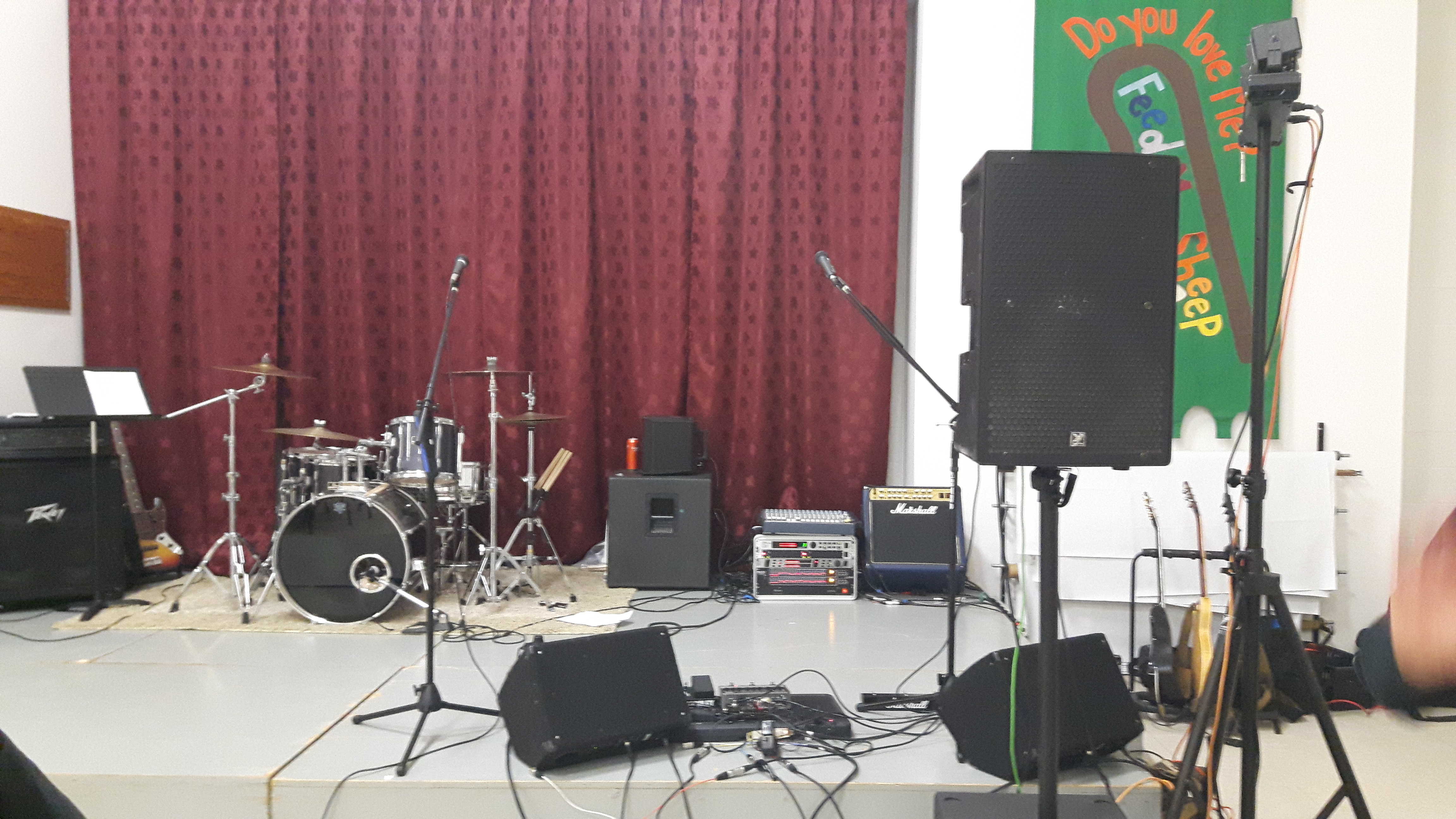
One example.
I am on the right. My little 6101 combo is angled at the back. Hard not to hear yourself reasonably even witn a pounding drummer. FOH is not too loud for venue or audience either. Proper setup and you should well be able to hear yourself and not be too loud.


Znqx6hG.jpg
 
Back
Top