SOLD JCM800 2204 50Watt PCB Board Marshall ST1 Replica

This has been sold
Status
Not open for further replies.

T-Rex

Well-Known Member
Country flag
Up for sale is a new PCB for a JCM800 50Watt style of cascaded amp. This board started off as a blank Granger PCB and I have populated and wired it for use in either a Marshall style JCM800 50watt amp or use it to build an amp of your own. This board is built from the best premium quality components that are either new or Vintage Old Stock. All plate resistors are 2watt Vishay metal film for quiet operation, and the rest of the resistors are either the same style Vishays or Vintage Old Stock 1/2watt Draloric carbon film resistors. The coupling caps are Philips MKT the same as Marshall used for a short period, dropping resistors are 3.75watt Dale, the bias resistors are 2watt Vishay metal film, tone bypass caps are Spraque, new fresh caps in the bias supply, and the board is wired with ValveStorm Top Coat Hookup wire, the very best and extra length for any application. The owner can reconfigure this board's rectifier diodes to use for a 100watt version of a 2203 type amp too ! Price is $189.00

Shipping is a flat $16 to the Continental US only by USPS Mail.

The components used on this board are:

Granger Amps blank PCB board
Vishay 2watt metal film resistors
Draloric 1/2watt Vintage Old Stock resistors
Dale 3.75watt dropping resistors
Philips MKT coupling caps
ValveStorm Top Coat Hookup wire
New fresh bias caps
Spraque bypass caps
UF4007 fast recovery diodes
Phier bias trim pot
Kester .031 solder on all solder joints
Turrets added for transformer bias feed wire, OT/Choke node, and Dropping resistor node
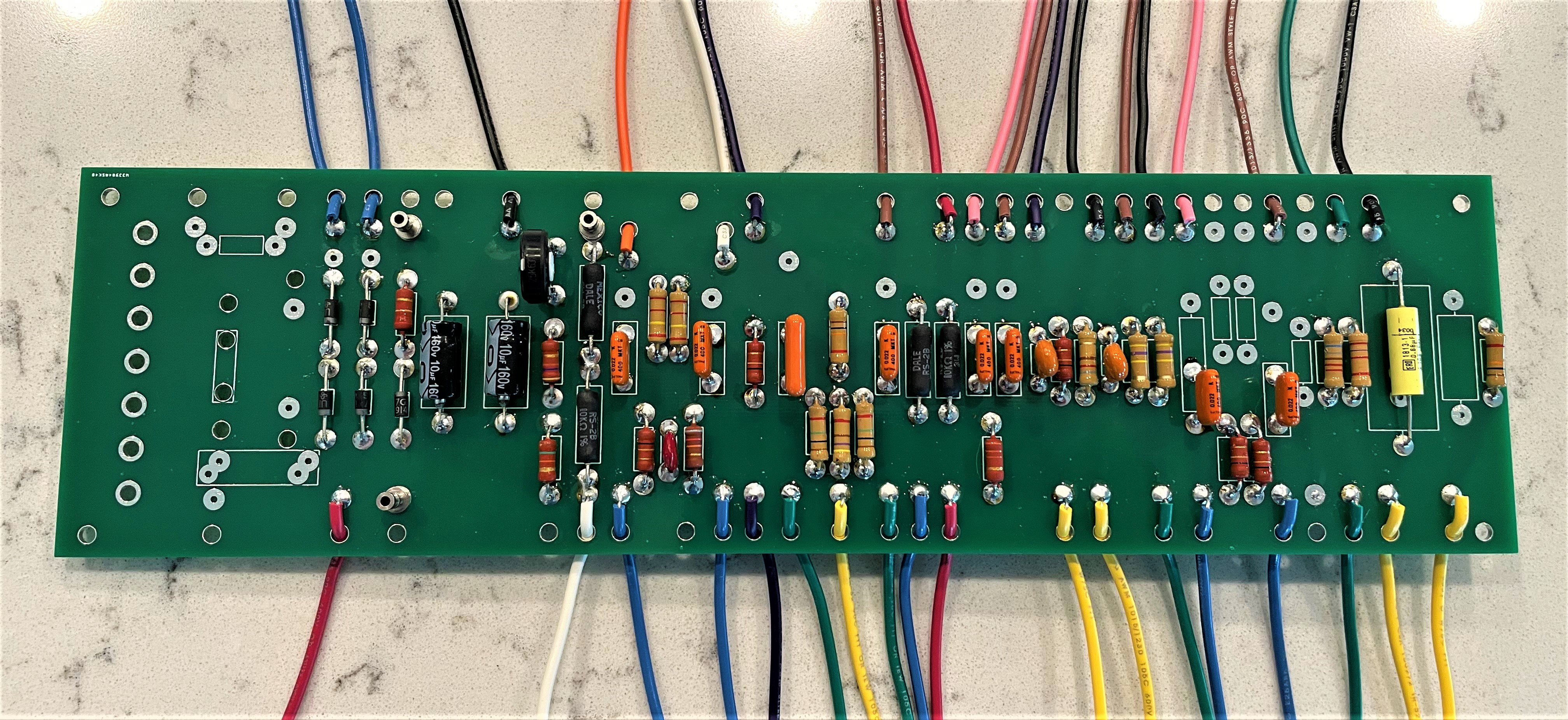
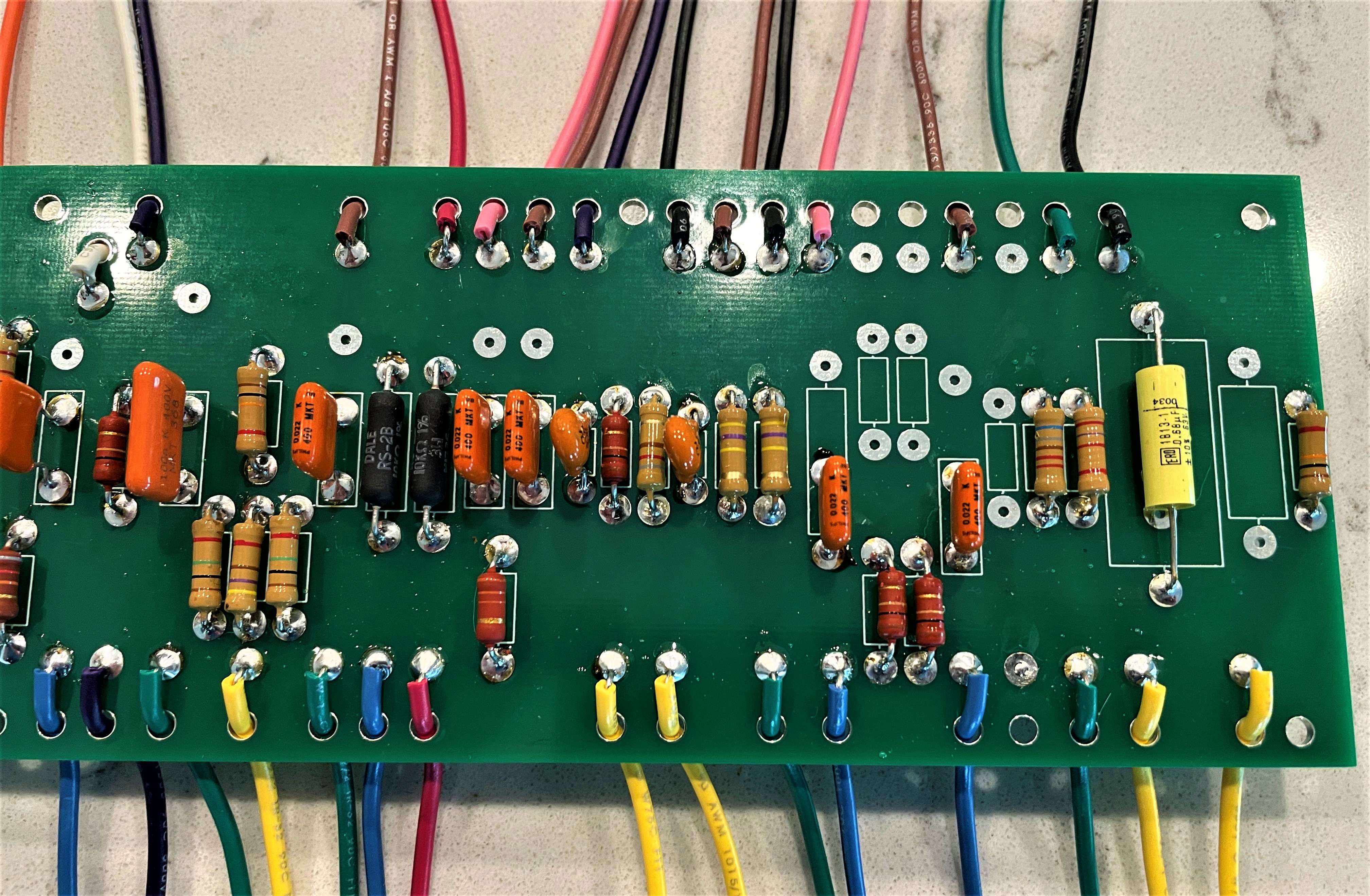
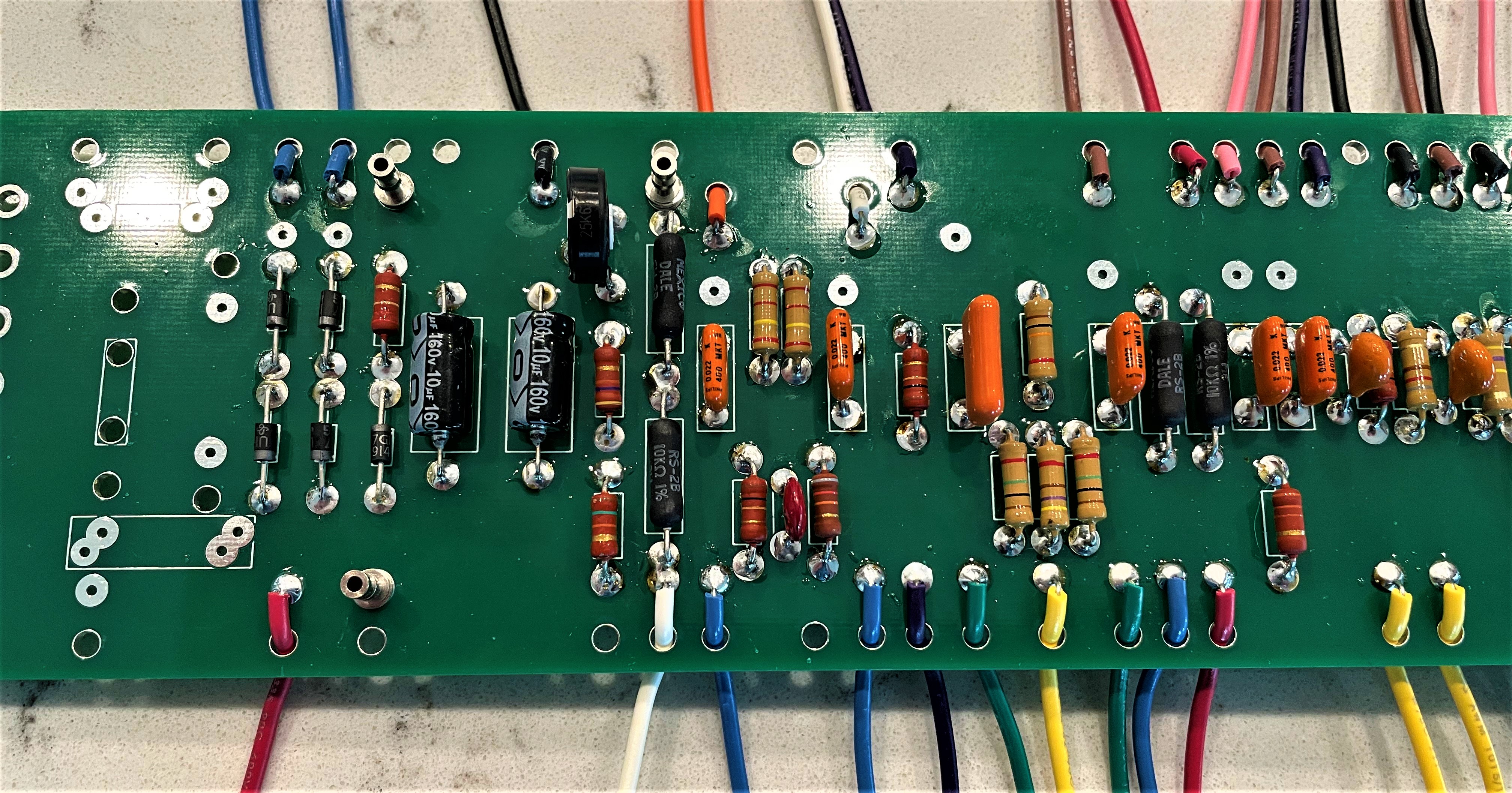


Up for sale is a new PCB for a JCM800 50Watt style of cascaded amp. This board started off as a blank Granger PCB and I have populated and wired it for use in either a Marshall style JCM800 50watt amp or use it to build an amp of your own. This board is built from the best premium quality components that are either new or Vintage Old Stock. All plate resistors are 2watt Vishay metal film for quiet operation, and the rest of the resistors are either the same style Vishays or Vintage Old Stock 1/2watt Draloric carbon film resistors. The coupling caps are Philips MKT the same as Marshall used for a short period, dropping resistors are 3.75watt Dale, the bias resistors are 2watt Vishay metal film, tone bypass caps are Spraque, new fresh caps in the bias supply, and the board is wired with ValveStorm Top Coat Hookup wire, the very best and extra length for any application. The owner can reconfigure this board's rectifier diodes to use for a 100watt version of a 2203 type amp too ! Price is $189.00

Shipping is a flat $16 to the Continental US only by USPS Mail.

The components used on this board are:

Granger Amps blank PCB board
Vishay 2watt metal film resistors
Draloric 1/2watt Vintage Old Stock resistors
Dale 3.75watt dropping resistors
Philips MKT coupling caps
ValveStorm Top Coat Hookup wire
New fresh bias caps
Spraque bypass caps
UF4007 fast recovery diodes
Phier bias trim pot
Kester .031 solder on all solder joints
Turrets added for transformer bias feed wire, OT/Choke node, and Dropping resistor node


Bonus
You can use that board to build 50 watt, 100 watt, or a Plexi.
It's 3, three, III amps in one.
 
I wasn't sure of the quality of the board upon arrival, but usually Kurt's products are well made. The actual thickness of the board is 1.5mm, and I had hoped/thought that they may be 2mm. The board did firmly hold the three each 2mm turrets that I staked onto it though.

The shine of the solder pads made me wonder a bit at first on how well the pads would take solder and if they were sturdy. I am pleased to say the pads flowed solder very well, and I hit both top and bottom with solder and am pleased with the solder joints.

I also like the metal rings that are around the wire entry holes as they provide a smoother pass through for the wire (they appear to be the same material as the solder pads).

I am finding out with each Vendors take on the PCB board idea (Granger, Head First, Sirius), that each manufacturer has their own vision / design idea of what a builder can use the board for. So it depends on the situation of what someone is building as far as the versatility of each board's design. So far I have no problem putting my name on any of the three options, but I have my favorites.
 
Man T Rex,

I often wondered what a JCM 800 was like. AM I correct that a JCM 800 is a Master Volume type head?
Also, as was with the JMP board, I had not seen this one yesterday, so this leaves the Black Flag one as the board I PM'd you with questions for.

This does not mean that if I am interested, it is going to be the Black Flag one necessarily. I will have to do some figuring and see what might be my best choice.

Thanks.
 
A JCM800 can be both a Superlead style, and a cascaded style and I'm not sure if there is a better way to describe it. To me even though there were still Superleads being produced under the JCM800 model run, the JCM800's were more known as the first series of cascaded Marshalls like the 2203 and 2204 models.
 
Man T Rex,

I often wondered what a JCM 800 was like. AM I correct that a JCM 800 is a Master Volume type head?
Also, as was with the JMP board, I had not seen this one yesterday, so this leaves the Black Flag one as the board I PM'd you with questions for.

This does not mean that if I am interested, it is going to be the Black Flag one necessarily. I will have to do some figuring and see what might be my best choice.

Thanks.
The 2204 2203 changed guitar amps forever.
The design was so successful, that almost all "high gain" amps today are a copy of it, or a modification of the original.
The difference is:

The JCM 800 2204 / 2203 was a guitar amp with 2 preamp stages in a row; this doubled the sensitivity compared to many other guitar amplifiers.
(some people call this "cascade.")

Tube phonograph preamps and PA mixers had been doing this 2 stage trick since 1940s, so it was really nothing new.

The previous super lead had 1 preamp stage and 1/2 as much sensitivity compared to the 2204 2203 JCM 800.

The JCM 800 2204 2203 produced preamp distortion.
This allowed reducing loudness of power amp. (master volume)

The previous super lead had a relatively clean preamp....and produced power amp distortion.
Therefore very loud.

In a nutshell, the 2204 2203 allowed a lot of distortion, at a low loudness.
The super lead could not do that.

Master volumes on tube audio amps, PA mixers, have been used since the 1940s.
Therefore the master volume was nothing new for tube audio amplifiers.
 
Status
Not open for further replies.
Back
Top