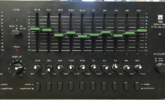
Graphic EQ vs Para EQ

RVA

Ambassador
I am enticed by the lower cost of graphic EQ, but I am very put off by the limitations in frequency selection imposed by the sliders. As most of you probably know, a para eq allows you to pick any frequency, even overlapping ones at some points, and then decide how far the values to the left and right are affected. Then you choose to boost or cut that range.

Maybe the human ear is not so accurate as to need so much precision and 10 bands is already overkill. Maybe a graphic EQ is superior in some other way.

Any thoughts on this are appreciated.
 
Brian lays out functionality well. He does not indicate a preference directly, but I glean one between the lines.

 
So my 2 cents, the Para EQ can be more effective in shaping your tone, but will take more time to fine tune in at each venue you play.
I think it is over kill with just a bit of snake oil.

As musicians we strive for perfection in our sound.

As a member of an audience, they want to hear a song that they know that sings reasonably well that they can dance to,
have a few drinks to, or enjoy some herb to.

With that being said, how well will a person under the influence discern the fine tonal
difference of just a boost in the 100 hz band, or a band spread of 90 - 110 hz. In a bar, over a bunch of drunks talking and laughing.
 
So my 2 cents, the Para EQ can be more effective in shaping your tone, but will take more time to fine tune in at each venue you play.
I think it is over kill with just a bit of snake oil.

As musicians we strive for perfection in our sound.

As a member of an audience, they want to hear a song that they know that sings reasonably well that they can dance to,
have a few drinks to, or enjoy some herb to.

With that being said, how well will a person under the influence discern the fine tonal
difference of just a boost in the 100 hz band, or a band spread of 90 - 110 hz. In a bar, over a bunch of drunks talking and laughing.
One vote one for the "not discernible" - but that is by the audience. There is the part where some tend to play better if you like your tone.

Also, I have had the paraEQ in the video for years, and at the present time, I could dial it in MUCH easier that a graphic. B-M-T, left or right (just like any old EQ). And while it then has a switch, that switch takes the place of at least 3 sliders. And then, you can boost the gain separately instead of a master gain, which can complete everything by boosting B-M-T frequencies equally, and requiring you to touch EVERY slider, instead of a section

In addition you could just mark your settings and not think at all. It is all about what you are used to IMHO
 
In addition you could just mark your settings and not think at all. It is all about what you are used to IMHO

So if you play multiple places you have marks for each place you play then?
What about the one off gig. Yes it is about what you are use to.
I played better when I knew the song inside out, and not worried about the tone all that much.

Playing bars, school gyms, and church halls we just worried about feedback, and not screwing up the song.
 
I am enticed by the lower cost of graphic EQ, but I am very put off by the limitations in frequency selection imposed by the sliders. As most of you probably know, a para eq allows you to pick any frequency, even overlapping ones at some points, and then decide how far the values to the left and right are affected. Then you choose to boost or cut that range.

Maybe the human ear is not so accurate as to need so much precision and 10 bands is already overkill. Maybe a graphic EQ is superior in some other way.

Any thoughts on this are appreciated.

Wow...

The tone of that Telecaster made it tough to get through the video...That is one guitar that should never be played on anything but a clean channel. It's such a one-dimensional sound when over-driven...like all six strings are .046" gauge.

Honestly,

I wouldn't get too caught up in the minute details, or the infinite level of adjustments one EQ offers over another. I have used the GE-7 for many years. I have two of them on my board. I recall seeing Gilmour's board once and he had five GE-7's - one for each effect pedal.

I currently use two GE-7's - one for rhythm, that is left on 100% of the time - and a second one that is adjusted to boost low/mids and trim highs and it is used only for solos.

GE-7 #2 is in the FX loop so the added 'signal boost' doesn't increase gain....no other reason to put an EQ in the FX loop as far as I am concerned.

Unless you just have $$$$ and time to burn - and your 'tone quest' is really just to burn $$$$ and write about the results - then I would always suggest to err on the side of simplicity and low cost.

It takes me about 4-5 minutes to dial a GE-7 in for a pleasing tone. I find it to work well in the studio on projects for hire, which might me a jazzy effort one minute and a Latin project the next.

I think the 10 band's have a little more 'colour' available, which can be a good thing, especially if you are playing 'cleaner' passages and tones.

In listening to your recent recordings, I am hearing that you would like to have more of a richer tonal spectrum, almost as if you could EQ each string. If that is the tone you are shooting for, then having more influence over the individual frequencies might make the parametric a better choice.

My question to you would be, what exactly is your tonal goal?????
 
So if you play multiple places you have marks for each place you play then?
What about the one off gig. Yes it is about what you are use to.
I played better when I knew the song inside out, and not worried about the tone all that much.

Playing bars, school gyms, and church halls we just worried about feedback, and not screwing up the song.
Under that theory, you do not have much need for an EQ at all, since it has little or no effect on feedback. I was wondering about preference between them

Also, you now suggest that a graphic EQ can be kept constant from room to room. But previously you said it will take MORE time to fine tune a paraEQ, which we now seem to agree depends on what you are used to. You never said that a graphic EQ does not require tweaking from place to place. In this regard, it would seem that they are the same.
 
One vote one for the "not discernible" - but that is by the audience. There is the part where some tend to play better if you like your tone.

Yes, I have to agree. For me, especially, it's being able to hear myself on a stage with a live band, and I find that to be my greatest challenge.

I frequently get compliments on my tone and most are along the lines of 'traditional' or a '1970's rock metal tone' which I am always very appreciative of. Interestingly, when we have been in venues where I could hardly hear myself playing - and I know that I played very conservatively, it was on those nights I seemed to have gotten the most compliments on my sound!!!!
 
Last edited:
Wow...

The tone of that Telecaster made it tough to get through the video...That is one guitar that should never be played on anything but a clean channel. It's such a one-dimensional sound when over-driven...like all six strings are .046" gauge.

Honestly,

I wouldn't get too caught up in the minute details, or the infinite level of adjustments one EQ offers over another. I have used the GE-7 for many years. I have two of them on my board. I recall seeing Gilmour's board once and he had five GE-7's - one for each effect pedal.

I currently use two GE-7's - one for rhythm, that is left on 100% of the time - and a second one that is adjusted to boost low/mids and trim highs and it is used only for solos.

GE-7 #2 is in the FX loop so the added 'signal boost' doesn't increase gain....no other reason to put an EQ in the FX loop as far as I am concerned.

Unless you just have $$$$ and time to burn - and your 'tone quest' is really just to burn $$$$ and write about the results - then I would always suggest to err on the side of simplicity and low cost.

It takes me about 4-5 minutes to dial a GE-7 in for a pleasing tone. I find it to work well in the studio on projects for hire, which might me a jazzy effort one minute and a Latin project the next.

I think the 10 band's have a little more 'colour' available, which can be a good thing, especially if you are playing 'cleaner' passages and tones.

In listening to your recent recordings, I am hearing that you would like to have more of a richer tonal spectrum, almost as if you could EQ each string. If that is the tone you are shooting for, then having more influence over the individual frequencies might make the parametric a better choice.

My question to you would be, what exactly is your tonal goal?????
This is just an academic exercise. My cat does not notice any difference in my tone, which is my sole audience, other than you fine fellows, who are too kind to tell me my tone is amatuer-ish, and will be about the same with any guitar, amp or EQ without more practice. But hey, what else are we gonna talk about on a guitar forum.
 
Under that theory, you do not have much need for an EQ at all, since it has little or no effect on feedback. I was wondering about preference between them

Also, you now suggest that a graphic EQ can be kept constant from room to room. But previously you said it will take MORE time to fine tune a paraEQ, which we now seem to agree depends on what you are used to. You never said that a graphic EQ does not require tweaking from place to place. In this regard, it would seem that they are the same.

A note about venues....

I have, for many years, heard complaints from guitarists about the venue requiring all manner of different settings. Then, I had occasion to work with some really proficient studio guitarists on some projects and I noticed they never changed EQ/Amp Tone Band settings from room to room....only volume.

I never change my EQ/Tone Bands ever. I only alter my volume to the level of the kick drum's sonic spike.
 
This is just an academic exercise. My cat does not notice any difference in my tone, which is my sole audience, other than you fine fellows, who are too kind to tell me my tone is amatuer-ish, and will be about the same with any guitar, amp or EQ without more practice. But hey, what else are we gonna talk about on a guitar forum.

You mentioned - I do believe - that you have the Empress shown in the video??? I would suffice to say that you have the right tool for the job and I do not believe the GE-7 would add anything to your sonic pallette.

Here's what I do sometimes....

Record a passage or too, using a tone that is similar to what you normally play with.

Then 'colour' that passage with your DAW's EQ and listen to the passage with phones (cans) with your eyes closed. Pick 3 or 4 and save them under different titles and record the 'slider' settings for each one. Then, listen to them played looped together and pick the one that sounds the best.

One of the producers I work with told me recently - during a Q&A discussion on the smoke deck, "If you are adjusting your entire rig based on the venue you are playing, you are losing the rabbit and wasting time. The acoustics of the venue will be impacted by reverb, delay and volume. Your tonal bands should not be altered from room to room."

His background involves live sound production for various artists in everything from a large to a small venue. I subscribed to this, and I have noticed a very consistent recorded tone between the different rehearsal and performance venues we have payed at where the only thing I changed was my volume settings...
 
Last edited:
So if you play multiple places you have marks for each place you play then?
What about the one off gig. Yes it is about what you are use to.
I played better when I knew the song inside out, and not worried about the tone all that much.

Playing bars, school gyms, and church halls we just worried about feedback, and not screwing up the song.

Beam Blockers....

ChasFRed:

Recently, I was critiquing my Beam Blocker in a live rehearsal setting with other guitarists. Have you noticed the Beam Blocker requiring more high frequency EQ????
 
I am enticed by the lower cost of graphic EQ, but I am very put off by the limitations in frequency selection imposed by the sliders. As most of you probably know, a para eq allows you to pick any frequency, even overlapping ones at some points, and then decide how far the values to the left and right are affected. Then you choose to boost or cut that range.

Maybe the human ear is not so accurate as to need so much precision and 10 bands is already overkill. Maybe a graphic EQ is superior in some other way.

Any thoughts on this are appreciated.

Toa used to make a killer paragraphic where you could dial the freq and Q of each slider.
And that EQ has slipped into obscurity...
The parametric is a better EQ but it also takes more tweaking and experimenting to find the sweet spot.
 
I believe the graphic EG is simpler because you adjust 1 freq at a time. The Para you first adjust your band with, the Q and then the boost.
and I did not use an EQ, other than what was on my amp, they did not exist then, remember I was playing in the mid to late 60's early 70's.
I have a 10 band EQ now that just sits in the corner.
 
Hmmmmm.....

Why not try your primary EQ in the loop????
I had it in the loop for most of the time I owned it, but moved it in front to experiment. Now I am spoiled by having it in front and want a second one. I was considering getting a slider because it is nearly half the price, and wanted to gauge the amount of practical value from the additional cost. I have never owned a graphic EQ
 
Last edited:
Back
Top