
You are using an out of date browser. It may not display this or other websites correctly.
You should upgrade or use an alternative browser.
You should upgrade or use an alternative browser.
Fake 59 Les Paul worth more than your car?
- Thread starter eSGEe
- Start date
-
- Tags
- 59 les paul fake les paul


Paul G.
Well-Known Member
I wouldn't pay $25K for one but there are a few things to remember.
Everything he said about the mahogany is true. The old-growth wood came from bigger trees, bigger boards allowed better cuts of wood. The old stuff was harvested on flat ground because it was easier. Later loggers started harvesting wood from hillsides. Because of water running down the hills, the wood picked up lots of mineral content. This is why the wood used in the 70s and beyond is so heavy and often sounds dead.
Brazilian rosewood used in these guitars is harder and denser than the Indian and other species used nowadays. Makes a difference.
Also the glue and finish. Yup, all true all makes a difference you can hear and feel.
Eastern Rock maple is also harder and more tightly grained than the Western species commonly used.
Modern woods are kiln and chemically dried. They never stabilize the way shed-dried wood did.
Back in the day, Gibson made a few thousand guitars a year. The wood was laying around for years.
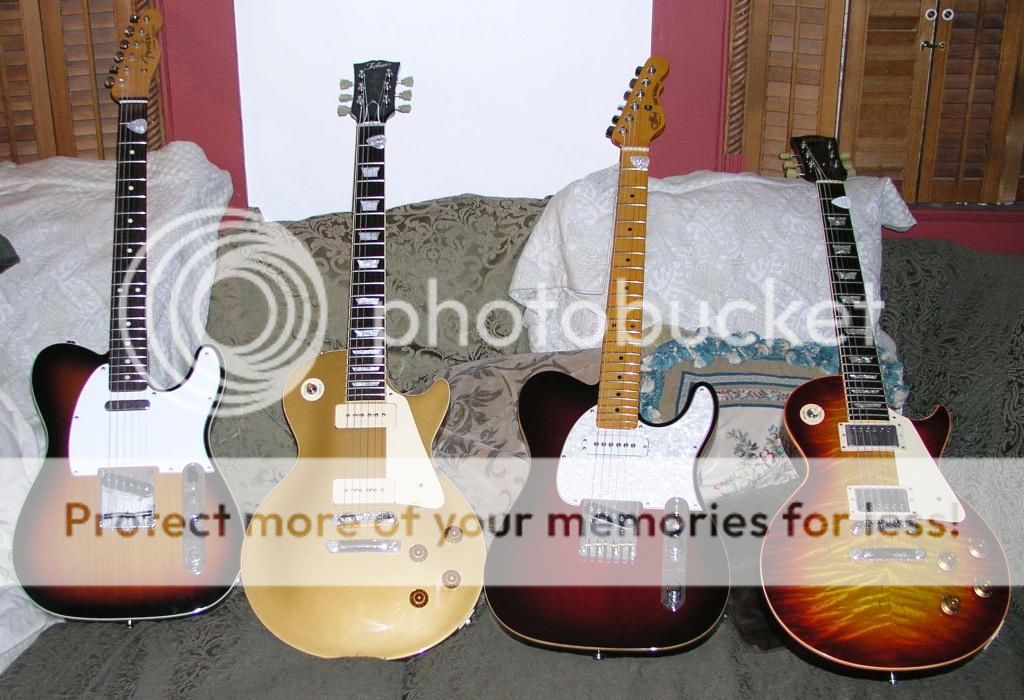
Two stories: First, I had a copy made in the 80s by a luthier (Mike Koontz) from 100-year-old shed dried mahogany, 50-year-old Maple and a salvaged Brazilian board. Regardless of the pickups in there (originally real PAFs, they were sold when the money got too good), and later a variety of custom pickups, the guitar had "it". Sounded better than some original 'bursts, not as good as some others, but it was in the hunt. Here's a picture (on the right):
Second: Not sure of his work, Peter took a Flying V he made to be authenticated -- I believe it was Dan Erlewine, but maybe another shop. The thing passed with flying colors, even smelled right.
This is just esoteric stuff for us old farts, though. Plenty of great music being played on Squiers and Epiphones.
P.
Everything he said about the mahogany is true. The old-growth wood came from bigger trees, bigger boards allowed better cuts of wood. The old stuff was harvested on flat ground because it was easier. Later loggers started harvesting wood from hillsides. Because of water running down the hills, the wood picked up lots of mineral content. This is why the wood used in the 70s and beyond is so heavy and often sounds dead.
Brazilian rosewood used in these guitars is harder and denser than the Indian and other species used nowadays. Makes a difference.
Also the glue and finish. Yup, all true all makes a difference you can hear and feel.
Eastern Rock maple is also harder and more tightly grained than the Western species commonly used.
Modern woods are kiln and chemically dried. They never stabilize the way shed-dried wood did.
Back in the day, Gibson made a few thousand guitars a year. The wood was laying around for years.
Two stories: First, I had a copy made in the 80s by a luthier (Mike Koontz) from 100-year-old shed dried mahogany, 50-year-old Maple and a salvaged Brazilian board. Regardless of the pickups in there (originally real PAFs, they were sold when the money got too good), and later a variety of custom pickups, the guitar had "it". Sounded better than some original 'bursts, not as good as some others, but it was in the hunt. Here's a picture (on the right):

Second: Not sure of his work, Peter took a Flying V he made to be authenticated -- I believe it was Dan Erlewine, but maybe another shop. The thing passed with flying colors, even smelled right.
This is just esoteric stuff for us old farts, though. Plenty of great music being played on Squiers and Epiphones.
P.


I think the video is mis-named. Those are replica 1959 Les Pauls, not simply fake Les Pauls.
It sounds like splitting hairs, but there is nothing dishonest about creating a replica IF it is not misrepresented as a genuine article during marketing and sale.
This guy, Peter Max, does not seem to be interested in just building a fake Lester and cheating people. He seems interested in recreating what he feels are the essential characteristics of a very specific model of Les Paul.
I do see a risk in someone else buying one and dishonestly passing it off as a genuine 1959 Gibson Les Paul. But, a little searching on Peter Max, himself, suggests that he is not trying to mislead people. I would hope that there is some distinguishing mark to make it plain that it is a Max Les Paul.
I would say the guitar is worth it if people, knowing full well what they are getting, are willing to pay for it. In the estimation of some people, it is a guitar that so closely matches the details of the original 1959 that they pay the price for it.
I would not pay it. But, that's me.
It sounds like splitting hairs, but there is nothing dishonest about creating a replica IF it is not misrepresented as a genuine article during marketing and sale.
This guy, Peter Max, does not seem to be interested in just building a fake Lester and cheating people. He seems interested in recreating what he feels are the essential characteristics of a very specific model of Les Paul.
I do see a risk in someone else buying one and dishonestly passing it off as a genuine 1959 Gibson Les Paul. But, a little searching on Peter Max, himself, suggests that he is not trying to mislead people. I would hope that there is some distinguishing mark to make it plain that it is a Max Les Paul.
I would say the guitar is worth it if people, knowing full well what they are getting, are willing to pay for it. In the estimation of some people, it is a guitar that so closely matches the details of the original 1959 that they pay the price for it.
I would not pay it. But, that's me.
Paul G.
Well-Known Member
Mine had no serial number. Some makers stamp "REPLICA" in pickup route or control cavity.
For a while, Billy Gibbons was using a Tokai Love Rock when Pearly Gates didn't want to go out on the road anymore.
It's about playing something as close to a 'Burst (or V or Explorer) as possible without risking your life savings everytime you take an original out.
P.
For a while, Billy Gibbons was using a Tokai Love Rock when Pearly Gates didn't want to go out on the road anymore.
It's about playing something as close to a 'Burst (or V or Explorer) as possible without risking your life savings everytime you take an original out.
P.

BlackSG91
Ambassador of Anarchy
I wouldn't pay $25K for one but there are a few things to remember.
Everything he said about the mahogany is true. The old-growth wood came from bigger trees, bigger boards allowed better cuts of wood. The old stuff was harvested on flat ground because it was easier. Later loggers started harvesting wood from hillsides. Because of water running down the hills, the wood picked up lots of mineral content. This is why the wood used in the 70s and beyond is so heavy and often sounds dead.
Brazilian rosewood used in these guitars is harder and denser than the Indian and other species used nowadays. Makes a difference.
Also the glue and finish. Yup, all true all makes a difference you can hear and feel.
Eastern Rock maple is also harder and more tightly grained than the Western species commonly used.
Modern woods are kiln and chemically dried. They never stabilize the way shed-dried wood did.
Back in the day, Gibson made a few thousand guitars a year. The wood was laying around for years.
Two stories: First, I had a copy made in the 80s by a luthier (Mike Koontz) from 100-year-old shed dried mahogany, 50-year-old Maple and a salvaged Brazilian board. Regardless of the pickups in there (originally real PAFs, they were sold when the money got too good), and later a variety of custom pickups, the guitar had "it". Sounded better than some original 'bursts, not as good as some others, but it was in the hunt. Here's a picture (on the right):
Second: Not sure of his work, Peter took a Flying V he made to be authenticated -- I believe it was Dan Erlewine, but maybe another shop. The thing passed with flying colors, even smelled right.
This is just esoteric stuff for us old farts, though. Plenty of great music being played on Squiers and Epiphones.
P.
I really love that Gold-Top LP with the P-90 pickups...it's a Spinal Tap guitar! The Lester on the far right sure has a beautiful and dramatic flame in maple on top. Your custom Teles are real nice also. Nice collection of guitars you have there.

;>)/
OP

eSGEe
Ferengi Ambassador of Trade
SO my obvious confusion
COPY a les Paul--- to the "LETTER" from 1959 .....make 1 a year -- sell for 45,000.00-70,000.00 or what have you .......and be hailed a genius.....
Crank them out for 190.00 ---- criminal----
WHY is Mr. Max not under arrest----- why didnt Gibson murder him in his sleep?
is it the Corksniffer-ien-ness of it all
"Well Biff if you can AFFORD a 70,000.00 artis homage to a 59 Les Paul we shall allow it" But hey Bob if you buy a chinese copy for under 2 bills your an evil poo eating stinker sniffer -------
feel free to argue among yourselves........I need afresh robe........and need to find that damn rug.......
COPY a les Paul--- to the "LETTER" from 1959 .....make 1 a year -- sell for 45,000.00-70,000.00 or what have you .......and be hailed a genius.....
Crank them out for 190.00 ---- criminal----
WHY is Mr. Max not under arrest----- why didnt Gibson murder him in his sleep?
is it the Corksniffer-ien-ness of it all
"Well Biff if you can AFFORD a 70,000.00 artis homage to a 59 Les Paul we shall allow it" But hey Bob if you buy a chinese copy for under 2 bills your an evil poo eating stinker sniffer -------
feel free to argue among yourselves........I need afresh robe........and need to find that damn rug.......

Tony M.
Ambassador
It's about money, not production quality and brand name protection.
Gibson doesn't give a flying f**k through a rolling donut what you
think of them as long as you give them money for their guitars.
If you make 1 guitar a year and charge more for it than Gibson does, no foul.
If you make a few thousand and charge less than Gibson does, you cut into their profits.
Gibson doesn't give a flying f**k through a rolling donut what you
think of them as long as you give them money for their guitars.
If you make 1 guitar a year and charge more for it than Gibson does, no foul.
If you make a few thousand and charge less than Gibson does, you cut into their profits.
