Fuzz Face pedal build

ivan H

Ambassador of Tubes & Grooves
Country flag
Almost a year ago I made the acquaintance of a very talented & accomplished, multi instrumentalist musician, quite a high calibre player. After a month or two of knowing him, he takes me to his studio to diagnose/repair one of his amps. While there we get talking FX pedals & he tells me he's wanting a germanium Fuzz Face (& not a new Dunlop). So a couple of days later I show him some of my germanium pedal builds (several fuzz's, treble booster). We discuss exactly what he wants & he gives me the nod to get started on one for him. His only stipulations were that it be a standard 125B sized enclosure & that it has to be red. No problem. I ordered a red powder coated enclosure & everything else needed that I did not already have. For transistors I chose to use Mullard black glass type CV7003's (military spec OC44's), carefully selecting the hfe & leakage current to be fuzz face ideal.
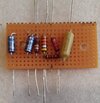
Drilled out the enclosure & asked if he wanted to print out any decals/labelling for it. Nah, just get it built, decals/labelling can be added later. So, here's the perfboard populated with all components except the two germanium transistors.
IMG_20220915_073321.jpg
Note the component leads are not yet trimmed or soldered & fly leads are not yet fitted.
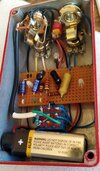
Transistors were added after the board/components/fly leads construction was completed. Of course, the germanium transistor leads were well heatsinks while soldering them into the circuit. With the transistors properly chosen to suit a fuzz face they biased up pretty much perfectly, with the circuit using all stock fuzz face values & no trimpots needed. Here's a gutshot of the completed pedal.
IMG_20221018_073754.jpg
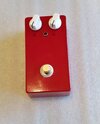
And the completed pedal
IMG_20220920_125141.jpg
Notice the "F" & "L" (fuzz & level) labelling, done with a sharpie type marker so he can wipe it off with some alcohol & add his own decals (pretty sure it's still on his 'boards as is though). When giving it to him to try, I made sure he understood that if he did not like it, he did not have to buy it. So what does he think of it??
I'll quote the text message he sent me after using it for the first gig. "Wow, this thing is fluffy & muddy & it rocks, I'm loving it. Makes my tele sound like a Gibson for slide & heavy stuff". He later told me he loves the way it responds to & cleans up with the guitar's volume control. He's been using it for maybe 6 weeks (or more) & no negative reports.

I have pair of Mullard AC128 transistors also specifically chosen for a fuzz face, to maybe build myself a similar one someday. Another fuzz pedal can't hurt, can it. Cheers
 
Almost a year ago I made the acquaintance of a very talented & accomplished, multi instrumentalist musician, quite a high calibre player. After a month or two of knowing him, he takes me to his studio to diagnose/repair one of his amps. While there we get talking FX pedals & he tells me he's wanting a germanium Fuzz Face (& not a new Dunlop). So a couple of days later I show him some of my germanium pedal builds (several fuzz's, treble booster). We discuss exactly what he wants & he gives me the nod to get started on one for him. His only stipulations were that it be a standard 125B sized enclosure & that it has to be red. No problem. I ordered a red powder coated enclosure & everything else needed that I did not already have. For transistors I chose to use Mullard black glass type CV7003's (military spec OC44's), carefully selecting the hfe & leakage current to be fuzz face ideal.
Drilled out the enclosure & asked if he wanted to print out any decals/labelling for it. Nah, just get it built, decals/labelling can be added later. So, here's the perfboard populated with all components except the two germanium transistors.
View attachment 86966
Note the component leads are not yet trimmed or soldered & fly leads are not yet fitted.
Transistors were added after the board/components/fly leads construction was completed. Of course, the germanium transistor leads were well heatsinks while soldering them into the circuit. With the transistors properly chosen to suit a fuzz face they biased up pretty much perfectly, with the circuit using all stock fuzz face values & no trimpots needed. Here's a gutshot of the completed pedal.
View attachment 86968
And the completed pedal
View attachment 86969
Notice the "F" & "L" (fuzz & level) labelling, done with a sharpie type marker so he can wipe it off with some alcohol & add his own decals (pretty sure it's still on his 'boards as is though). When giving it to him to try, I made sure he understood that if he did not like it, he did not have to buy it. So what does he think of it??
I'll quote the text message he sent me after using it for the first gig. "Wow, this thing is fluffy & muddy & it rocks, I'm loving it. Makes my tele sound like a Gibson for slide & heavy stuff". He later told me he loves the way it responds to & cleans up with the guitar's volume control. He's been using it for maybe 6 weeks (or more) & no negative reports.

I have pair of Mullard AC128 transistors also specifically chosen for a fuzz face, to maybe build myself a similar one someday. Another fuzz pedal can't hurt, can it. Cheers

I'm not surprised at your prowess for this sort of thing. Great work!!!!
 
What I like on the “original” fuzz face is that it’s really simple circuitry. The magic comes in choosing and matching the actual components…. Which you obviously are doing. Love it!
 
Thanks guys, appreciated.
What are you using for these type of measurements?
Good question.
So first let's look at what "leakage current" IS.
Germanium transistor leakage is the leakage current across the reverse biased collector-base junction. This current then crosses the base-emitter junction, which causes a collector current equal to the leakage current multiplied by the hfe of the transistor (just as any current from the base to emitter does).
From this, we can see that simply using the transistor hfe function on our multimetre will give incorrect readings, & how incorrect the reading is will be proportional to the transistors leakage current.
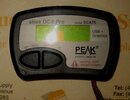
I use a Peak atlas DCA Pro

View attachment 86997
This is a good unit to use for germanium transistors as it takes the leakage current into account to determine a "true" hfe reading.
Or, one can use the method that the very knowledgeable Mr R G Keen gives us on the GEOFX site http://www.geofex.com/article_folders/ffselect.htm
This method's accuracy is dependent the value of the resistors used being spot on (& the source voltage being exactly 9V). You'll find people demonstrating this method on YouTube. I've used R G's method many times.
Of course, regardless of the readings, germanium transistor leakage current & hfe will vary with just the ambient temperature. Even soldering them into the circuit changes their characteristics somewhat. This is why we must heatsink their leads well when soldering them in, get in & out quickly with the iron & not use excessive temperature settings for the iron. Exposure to excessive temperatures while soldering can cause damage to the transistor.
Ok, onto transistors to use in a fuzz face. We read on stompbox forums of people using as low as 35 hfe & as high as 180 hfe & more. Of course, this can affect, among other things, how much gain the pedal produces.
As ol' mate wanted a "middle of the road" pedal in regards to the gain produced, I stuck pretty much with the standard transistor recommendations. IIRC, I used around 70~80 hfe for Q1 (transistor 1) & 100~110 hfe for Q2 (I'd have to check my notes to give accurate figures. Leakage current for both was around 40uA (microamps). Cheers
Edit:
For anyone that gets lost in R G Keen's method, reading this may be of help. How to Calculate Transistor Leakage?
Cheers
 
Last edited:
Or, one can use the method that the very knowledgeable Mr R G Keen gives us on the GEOFX site http://www.geofex.com/article_folders/ffselect.htm
This method's accuracy is dependent the value of the resistors used being spot on (& the source voltage being exactly 9V).
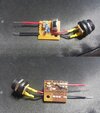
The last couple of days I've been researching the above info. Looks like this would be a nice and inexpensive diy project for creating a little adapter to use with a meter and still get accurate results. I found this pic of one such example:
hd6szbcx3b351.jpg
Looks like a pair of resistors in series to get that 2.742k value needed is installed. I guess I could substitute a 5k multi-turn trim pot instead. This example is set up for a (9v) DC power supply too. Are the regulated 9v power supplies usually putting out exactly 9v's?
 
Last edited:
I know which end of the soldering iron gets hot and am relatively competent using it. But you guys are so far over my head I need binoculars just to see.
 
@ivan H what is the best temperature for soldering germanium transistors. I’ve got a Tone Bender project I need to finish someday.

By the way, great looking pedal. I’m sure it’s top notch.
 
@ivan H what is the best temperature for soldering germanium transistors. I’ve got a Tone Bender project I need to finish someday.

By the way, great looking pedal. I’m sure it’s top notch.
Thanks SG John.
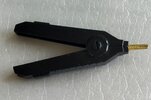
I use the 60/40 solder (60% tin, 40% lead) that melts at a lower temperature than the lead free stuff. After making sure the transistor leads are clean & ready for soldering, I clip a few of these type heatsinks onto the lead being soldered.
IMG_20221108_121425.jpg
Then, a temp of around 350C~380C & a clean, well wetted tip will allow me to quickly flow sufficient solder into the join & get out quickly. Remember though that I'm usually just soldering transistor leads twisted with other component leads. If using veroboard as was used in the original tonebenders, this should still be sufficient tip temperature.
If your using lead free solder you'll probably need to use a higher tip temperature, but so long as the transistor lead being soldered is well heatsinked it should be fine.
The last couple of days I've been researching the above info. Looks like this would be a nice and inexpensive diy project for creating a little adapter to use with a meter and still get accurate results. I found this pic of one such example:
View attachment 87031
Looks like a pair of resistors in series to get that 2k742 value needed is installed. I guess I could substitute a 5k multi-turn trim pot instead. This example is set up for a (9v) DC power supply too. Are the regulated 9v power supplies usually putting out exactly 9v's?
I've made several of these type arrangements. Whenever I've wanted to measure transistors, which isn't often, it's usually easier/quicker to throw one together out of components that I have on hand than to try & find an old one. For the first couple I used series'd & paralleled resistors to get the 2.472k, though for later ones I used a resistor in parallel with a trimmer. A multi-turn trimmer would be easier though. I've got a couple of variable 7~12V supplies on my FX board's power supply, so dialling in exactly 9V isn't a problem. Cheers
 
Back
Top