Tinkering With My SLO (Clone) 50: Background Hiss & FX Loop Concerns

syscokid

Ambassador of War & Peace
Country flag
My C3 Amp kit build was completed a little over one year ago. But first of all: Has anybody here ever played through a real Soldano SLO-100? Specifically, the SLO-100's built before 2020, and not the newer ones built by B.A.D.? If so, what might be your experience with the amp's background noise, if any?

Around the internet, some say the SLO-100 is very quiet. Others say that the overdrive channel will sound like roaring ocean waves in the background if the amp is operating at blistering volumes... which is how I would describe my SLO-50! And with a lot of preamp gain dialed up, the same goes for my two (JCM800) 2204's... or my Fryette Memphis 30! Therefore, it's safe to say that one's interpretation of "quiet", can be very different from another's.

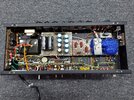
OK... Back to "Tinkering" and obligatory pics:
I wanted to see and hear for myself if I can do something to minimize the background hiss I'm hearing. Also, I think I'm hearing some very slight 120Hz buzz (DC). Remember: All this with amp set to very loud volumes!

First I checked all the ground connections and all the solder joints. All good!

Checked all the coupling and signal caps for DC leakage. No leakage!

Checked all the filtering caps for excessive ESR. All where extremely low, indicating high quality!

68k input grid resistor for V1 was reduced to 33k, which actually lowered the hiss level by a very subtle amount!

Added a DC elevated heater circuit. This did not make any noticeable difference on the background noise, but it is a good mod to reduce the stress put upon the preamp tubes that operate with high voltages at the cathodes like most cathode follower circuits. In my SLO-50, V3 & V4 cathodes are pushing 200v.

Installed a new power supply board with all new components. I think this might have reduced the slight 120Hz hum that I think I was hearing through the hiss!

Rearranged the layout of one of the paralleled heater buss wire of the power tubes, and rearranged the OT's primary wires. No change in background noise!

And... implemented an fx loop mod that reduces the fx loop send level, from a +4, down to zero. It only involved adding a cap in parallel to one resistor, and adding a resistor in parallel to another resistor!

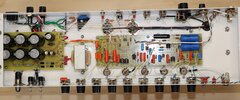
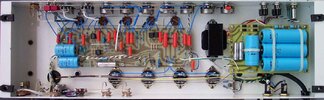
Before this current round of molestation:
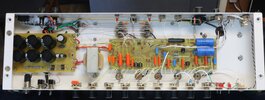
slo mods (4).JPG

And after:
slo mods (1).JPG
The OT's primary wires are now laid out like old-school Soldano style!

But last week, I stumbled upon a different fx loop mod for this circuit...
... to be continued
 
I think some noise is considered normal - how much I dont know.
Aiken's article on resistors talks about noise - more hiss from carbon comps, etc.

Did you try pulling the first preamp tubes or triodes from each channel, then moving toward the output, etc. to help narrow down the source?

This reminds me I need I have some guitars that need shielding....
 
I think some noise is considered normal - how much I dont know.
Yup, and neither do I. I've never played through a real Soldano SLO. Im hoping that someone here at TTR has some experience with a real SLO.

Aiken's article on resistors talks about noise - more hiss from carbon comps, etc.
Fortunately, besides a couple metal oxides and a wirewound resistor in the power supply board, all other resistors are metal film... true to the Soldano circuit style.

Did you try pulling the first preamp tubes or triodes from each channel, then moving toward the output, etc. to help narrow down the source?
Yes! The SLO-50 has five 12AX7's: Four for the preamp; one for the phase inverter. Plus, two 5881's for the power. Pulling the overdrive channel's V2 tube, reduced the hiss by a very small amount. Pulling V1, V3, and V4 didn't make a difference. But, pulling the V5 phase inverter tube made the amp very quiet! Not sure if this means anything... :unsure:
 
Quiet with the PI tube out means the noise source is not downstream of that - power tube / OT / output jack circuits.
NFB loop could introduce noise farther upstream I suppose, if it has NFB. More for possible oscillation than hiss.

From here, start with all the preamp tubes removed, with just the PI and power tubes installed.
Same / less / more hiss? Yes. No? Flowchart from there.

If noise is not isolated to PI or downstream, move upstream in the circuit (towards the input) 1 tube at a time on 1 channel. Pay mind if / where one of the triodes combines the signal on its way to the PI.
That mix point, while maybe or maybe not specifically a cause for noise, could be misleading.

This may or may not help isolate noise in the preamp, as they share circuitry -power node / plate voltage connections, etc.

Is this noise enough to lose sleep over?
Is the time tinkering worth any gain in noise floor reduction, or are you tinkering for the benefit of learning / building knowledge base?

I'm no expert, just sharing my experience.
 
Check your grounds power cord 16 AWG and add a input jack preamp ground to chassis and ground rail
In your reply, I think that you're suggesting four different things to either test for, or try to implement.
Grounds: I'm strictly following the Soldano SLO style grounding layout. Everything that needs to be grounded in the amp's circuit is grounded to one "star" point at the chassis. The only exception is the OT's ground that is connected to the speaker jacks which are directly grounded to their respective location at the chassis, where the steel chassis's powdercoat was purposely omitted. I also moved the 16 AWG power cord's IEC's ground off that main star ground, and grounded it to the chassis all by its lonesome self.
 
NFB loop could introduce noise farther upstream I suppose, if it has NFB.
Yes, it does have quite a bit of NFB through a 39k resistor.

From here, start with all the preamp tubes removed, with just the PI and power tubes installed.
Same / less / more hiss? Yes. No? Flowchart from there.
I'll try this again. What do you mean by "Flowchart from there"?

Is this noise enough to lose sleep over?
For normal people: No! For me: Yes, ha ha!

Is the time tinkering worth any gain in noise floor reduction, or are you tinkering for the benefit of learning / building knowledge base
Yeah, that's it... :sneaky:. Don't want to think of myself as a crazy person... :rolleyes2:

I'm no expert, just sharing my experience.
Neither am I, but you're much more experienced that I am... :cheers:

main-qimg-a18715901888e7866e5499f151238dd9-pjlq.jpeg
 
I'll try this again. What do you mean by "Flowchart from there"?
I mean the divide and conquer troubleshooting method.
Doesnt always work straight up if there are multiple issues or loop backs - like the NFB.

With just the PI and power tubes, you have removed the preamp section, or cut the circuit signal path roughly in half.

By flowchart I mean - does this remove or significantly reduce the noise? In a flow chart - Yes would point to follow the source upstream into the preamp. No would point to down stream - the PI through the output jack.

Then the next step creates another Yes or No, and so on.
 
My C3 Amp kit build was completed a little over one year ago. But first of all: Has anybody here ever played through a real Soldano SLO-100? Specifically, the SLO-100's built before 2020, and not the newer ones built by B.A.D.? If so, what might be your experience with the amp's background noise, if any?

Around the internet, some say the SLO-100 is very quiet. Others say that the overdrive channel will sound like roaring ocean waves in the background if the amp is operating at blistering volumes... which is how I would describe my SLO-50! And with a lot of preamp gain dialed up, the same goes for my two (JCM800) 2204's... or my Fryette Memphis 30! Therefore, it's safe to say that one's interpretation of "quiet", can be very different from another's.

OK... Back to "Tinkering" and obligatory pics:
I wanted to see and hear for myself if I can do something to minimize the background hiss I'm hearing. Also, I think I'm hearing some very slight 120Hz buzz (DC). Remember: All this with amp set to very loud volumes!

First I checked all the ground connections and all the solder joints. All good!

Checked all the coupling and signal caps for DC leakage. No leakage!

Checked all the filtering caps for excessive ESR. All where extremely low, indicating high quality!

68k input grid resistor for V1 was reduced to 33k, which actually lowered the hiss level by a very subtle amount!

Added a DC elevated heater circuit. This did not make any noticeable difference on the background noise, but it is a good mod to reduce the stress put upon the preamp tubes that operate with high voltages at the cathodes like most cathode follower circuits. In my SLO-50, V3 & V4 cathodes are pushing 200v.

Installed a new power supply board with all new components. I think this might have reduced the slight 120Hz hum that I think I was hearing through the hiss!

Rearranged the layout of one of the paralleled heater buss wire of the power tubes, and rearranged the OT's primary wires. No change in background noise!

And... implemented an fx loop mod that reduces the fx loop send level, from a +4, down to zero. It only involved adding a cap in parallel to one resistor, and adding a resistor in parallel to another resistor!

Before this current round of molestation:
View attachment 84548

And after:
View attachment 84545
The OT's primary wires are now laid out like old-school Soldano style!

But last week, I stumbled upon a different fx loop mod for this circuit...
... to be continued
The hiss is caused by the resistors.
The first resistor at the input jack is about 70% of the hiss.
Carbon resistors are the most noise, and all of the controls are carbon resistors.

Buzzing 120 Hz is caused by the magnetic field of the filament wires, especially in the preamp. Changing The layout of the filament wires can reduce or cancel the buzz.
But in this layout it's going to be more challenging because the pre amp filaments are so close to the controls and input jack.
DC filament power is one alternative and there are others....

When the output is biased hot (around 70%) there will be more noise.
When the output is biased colder the output tubes shut off and act like a noise gate.

But this is typical for many tube amps. Nothing wrong or unusual.
 
and all of the controls are carbon resistors.
Real Soldano SLO's use Clarostat pots with plastic conductive elements. AFAIK, these are quieter than pots with carbon elements. The pots on my SLO-50 are CTS 450 series (with carbon elements). C3 Amps used to sell their kits with Clarostats, but they are no more. Old Clarostats can still be found, but I've seen prices of $50 to $100 each... think I'll pass on those. However, the new Soldano's that are built at B.A.D., show pots with the Clarostat name all over them. I'm assuming these are custom made for Soldano only.
 
@Amp Mad Scientist you mention bias point, I have been reading some bias point vs. crossover distortion articles lately.
Nothing to do with Greg's noise, just interesting stuff.
It's that the colder the bias is, the more crossover distortion.
And you lose the headroom.
Less noise because the tubes are shutting off, and longer tube life.

With hotter bias the crossover distortion is minimized , maximum headroom, but shorter tube life.

But all these are not specific to this SLO design, but rather all tube amps.
Designing for lower noise is always the hardest part.
Real Soldano SLO's use Clarostat pots with plastic conductive elements. AFAIK, these are quieter than pots with carbon elements. The pots on my SLO-50 are CTS 450 series (with carbon elements). C3 Amps used to sell their kits with Clarostats, but they are no more. Old Clarostats can still be found, but I've seen prices of $50 to $100 each... think I'll pass on those. However, the new Soldano's that are built at B.A.D., show pots with the Clarostat name all over them. I'm assuming these are custom made for Soldano only.

I need bulk metal foil precision pots, and BMF resistors.
wire wound would be another idea, you will get approx the same noise performance.
BMF is becoming more widely available, there is a lot of surface mount BMF and the price is not so high.
But the thru -hole bulk metal foil parts are more custom ordered limited production.

I think if you compare BMF to carbon resistors there is about 40db noise difference.
But can I afford 10- $20 each for resistors?
 
Real Soldano SLO's use Clarostat pots with plastic conductive elements. AFAIK, these are quieter than pots with carbon elements. The pots on my SLO-50 are CTS 450 series (with carbon elements). C3 Amps used to sell their kits with Clarostats, but they are no more. Old Clarostats can still be found, but I've seen prices of $50 to $100 each... think I'll pass on those. However, the new Soldano's that are built at B.A.D., show pots with the Clarostat name all over them. I'm assuming these are custom made for Soldano only.

You start with phase inverter and power tubes only.
Preamp tubes are pulled.
Then you check your filament noise (buzz) and correct it if there is any.

Then, after noise is checked:
Insert the next tube, before the phase inverter.
Leave the other preamp tubes out.
Then test and correct the buzz filament noise in this one tube.

After that previous tube is tested / corrected:
Now insert the next tube and test correct the buzz in that one tube.

Continue with each stage, working your way from the PI first, to the V1 preamp tube, last.
V1 preamp tube will be the last tube checked for buzz and corrected.

Work on buzz / filament noise isolating one stage at a time starting at the power amp.
Add one tube at a time and test correct noise for each tube, till you work thru to the input stage tube (V1) last.
 
You start with phase inverter and power tubes only.
Preamp tubes are pulled.
Then you check your filament noise (buzz) and correct it if there is any.

Then, after noise is checked:
Insert the next tube, before the phase inverter.
Leave the other preamp tubes out.
Then test and correct the buzz filament noise in this one tube.

After that previous tube is tested / corrected:
Now insert the next tube and test correct the buzz in that one tube.

Continue with each stage, working your way from the PI first, to the V1 preamp tube, last.
V1 preamp tube will be the last tube checked for buzz and corrected.

Work on buzz / filament noise isolating one stage at a time starting at the power amp.
Add one tube at a time and test correct noise for each tube, till you work thru to the input stage tube (V1) last.
Thanks AMS. jtcnj suggested this method too. I'll give it another try, probably tomorrow. I got a feeling that this amp's hiss level is standard for this circuit and layout design. Still wish I can have the opportunity to fiddle with a real Soldano SLO for comparison.

And to reiterate for the purpose of this thread, I'm testing and listening to this amp with nothing plugged into the input. The Normal and Overdrive channel's master volume is about 1 o'clock, as the power section is being pushed pretty well at this point. Normal gain control around noon to 2 o'clock, & Overdrive gain control is around 10 o'clock to noon. All other controls are set to noon
 
Thanks AMS. jtcnj suggested this method too. I'll give it another try, probably tomorrow. I got a feeling that this amp's hiss level is standard for this circuit and layout design. Still wish I can have the opportunity to fiddle with a real Soldano SLO for comparison.

And to reiterate for the purpose of this thread, I'm testing and listening to this amp with nothing plugged into the input. The Normal and Overdrive channel's master volume is about 1 o'clock, as the power section is being pushed pretty well at this point. Normal gain control around noon to 2 o'clock, & Overdrive gain control is around 10 o'clock to noon. All other controls are set to noon
But where is the schematic?
What sounds like hiss could be high frequency oscillation.
You need to look at it with a scope.
 
The design looks quite a lot like mesa boogie...
Which is a modified Marshall / bassman.
In other words a 2203 with an extra gain stage added.

But 70% of the hiss comes from 1 resistor.
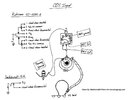
rehisstor68K.png
 
Back
Top