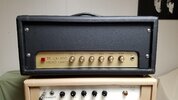
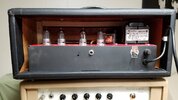
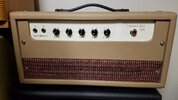
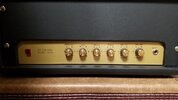
ivan H
Ambassador of Tubes & Grooves

I wasn't even aware that the micro design had been updated, so mine is based on the old schematic. I did make a few changes to get a little more pre-amp dirt, 18k V1a grid stopper instead of 68k, so the guitar signal hits the front of the amp a bit harder, 4k7 V1b cathode resistor instead of 10k, so a bit more grit there. Using a pre PI master volume as well as the type 3 post PI master volume is handy as I can control how hard the PI is overdriven & how hard out 12AU7 output tube is overdriven.Thanks for the info!
I had not been watching for red plating but think I would have noticed it (I know better but forgot).
The updated layout / schematic uses a 10k for the NFB resistor which is what I used. I wont sweat the presence for now.
I just swapped the 470Ω I used for the 12au7 cathode resistor (what i have on hand instead of the listed 510Ω) to 1k.
This brought my plate voltage up to 391v and 16.6v at the cathode.
That brings me to 16.6/1k x 391 = 6.49w total / 2 = 3.25w per triode which is more in range.
I went with the updated circuit MV; I think it is pre PI.
I only played it briefly and didnt get a chance to dial it in. If anything it did not sound as good, but it could be my day to day perception of what I hear.
@syscokid - my plate voltages were always the same when I put a meter to them; so I figure the wall voltage was what I just measured at 121.9v ac.
I should check the 12AU7's quiescent current to see if the cathode resistor's value needs increasing for ideal bias.
It's not really a lot of NFB (the NFB series resistor value is mis-leading). Using the equation to determine output power (off the OT secondary) of voltage squared divided by impedance = power in watts, we could look at say, a 2 X EL34 amp driven to 50 watts out,,, this requires a voltage of 20VAC at the 8 ohm tap (20 X 20 = 400 ÷ 8 = 50 watts).That's a lot of NFB! Do you plan to try with less NFB? 22K? 47K? I vote for: Let the one watter run wild... :dood:
Now let's look at the 12AU7 driven to 1 watt output, again using the 8 ohm tap, it takes only 2.83VAC to give a smidge over 1 watt power output (2.83 X 2.83 = 8.0089 ÷ 8 = 1.0011125 watts).
So that's 20 volts on the 8 ohm tap vs 2.83 volts on the 8 ohm tap.
I'd have to hit the text books when I get home to find the equation needed to compare the amount of NFB taken (db) between the two, but we can see from the voltage that, even though the micro has a much smaller value NFB series resistor, it's most probably still taking quite a bit less NFB than a 50 watt Marshall with a 47k/8 ohm tap NFB arrangement. Cheers