Mic placement and monitoring

RVA

Ambassador
So I get the importance of mic placement when recording. I also understand that there is much more to it than one might initially imagine, and that it is a topic that deserves its owm thread, which I may start soon. But I first need to start at the beginning.

I have nice cabs, decent mics, nice monitors and a nice mixer. The problem is that they are all in the same room. I imagine that most people don't have their monitors in a room well isolated from the source. So how do you know what tone you are getting from your mic in the first place, and how can you discern the differences caused by slight mic placement shifts? Headphones don't help me, both because they are a poor representation of the recorded sound and I am still be in the same room while listening to them.

The short question:

How are you able to hear what sounds you are getting from the placement of a mic before you record.
 
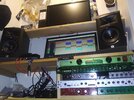
Have all them stacks & amps in my 16 x 16 master bedroom. When i built the bedroom after the Mrs couldn't do steps anymore since the accident. I made His & hers closets in the corners. Took all my clothes out & put computer & preamps & monitors all in there. So i can blast away. Hearing precisely is critical for tracking. I hate headphones & IEM's..use my monitors during tracking & when i sing..use headphones & stand in the ISO. Clothes..who needs em..ISO booth rules !! lol
 
Last edited:
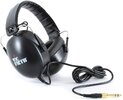
Honestly @RVA ... I’m using a Monoprice set these days...similar to these..:no mic though...

But I know most of my cab’s pretty well.
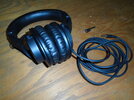
Good isolation (not excellent, but good)...fairly flat...maybe a little bit extra low end...but I’ve learned them too. They were a gift a few years back. The AT50 headphones have an excellent rep...I know a few people, that I do trust, that swear by them.
 
I was setting up another amp today and realized why my setup works....

I play at wussy levels. :D

I put my headphones on and I can't hear it. :D
Hbbcp5T.gif
 
I was setting up another amp today and realized why my setup works....

I play at wussy levels. :D

I put my headphones on and I can't hear it. :D
Hbbcp5T.gif
Hahahahaha! I had some time in the studio today, and I had no problem with my crappy closed headphones while setting up to record some clean material. I tend to leave the amps set to “practice with a live drummer” volume. So....not “wussy levels”....but clean guitar is easy, for me, to work with. It’s the dirt that takes more effort, for me.
:cheers:
 
So I get the importance of mic placement when recording. I also understand that there is much more to it than one might initially imagine, and that it is a topic that deserves its owm thread, which I may start soon. But I first need to start at the beginning.

I have nice cabs, decent mics, nice monitors and a nice mixer. The problem is that they are all in the same room. I imagine that most people don't have their monitors in a room well isolated from the source. So how do you know what tone you are getting from your mic in the first place, and how can you discern the differences caused by slight mic placement shifts? Headphones don't help me, both because they are a poor representation of the recorded sound and I am still be in the same room while listening to them.

The short question:

How are you able to hear what sounds you are getting from the placement of a mic before you record.

It's (something that we used to call) "tape head monitor."
In other words, you are hearing what is actually "on" the recording, played back instantaneously.
This usually produces a short delay.

You can monitor the input, that's typical.

But you can also monitor the playback, as soon as it's recorded. This shows you what is actually on the recording.
And this will reflect exactly what adjustments need to be made to obtain the best recording quality. By listening to what is actually played back.

I will adjust something, but it takes 2 seconds to hear the result of my adjustment in the playback....
Do you understand the concept?
The engineer is isolated from the musicians, to avoid confusion because of the playback delay.

Effects and balancing the levels
is done in mix down. You don't record the effects. You use the effects on the board when you are mixing many tracks down into 2 tacks.

And again
When you are mixing down into 2 tracks, you are listening to the playback of the 2 track.
You are not listening to the input of the 2 track.
And any adjustment you make will be delayed as before / as above.
 
Last edited:
  • Like
Reactions: RVA
It's (something that we used to call) "tape head monitor."
In other words, you are hearing what is actually "on" the recording, played back instantaneously.
This usually produces a short delay.

You can monitor the input, that's typical.

But you can also monitor the playback, as soon as it's recorded. This shows you what is actually on the recording.
And this will reflect exactly what adjustments need to be made to obtain the best recording quality. By listening to what is actually played back.

I will adjust something, but it takes 2 seconds to hear the result of my adjustment in the playback....
Do you understand the concept?
The engineer is isolated from the musicians, to avoid confusion because of the playback delay.

Effects and balancing the levels
is done in mix down. You don't record the effects. You use the effects on the board when you are mixing many tracks down into 2 tacks.
Thank you, Very interesting and helpful

My current problem was getting past go. I was mostly concerned about separation for the source so as to hear what is in the monitors. I envisioned listening via headphones or monitors from the board, but it is so close to my speakers
 
It depends
if you are laying a track, you are listening to the input of your guitar - not the playback.

If you are the engineer then you can listen to the playback while the track is being recorded.
Do you see what I am talking about?
One person -You can't do both (monitor input and playback) at the same time.
 
Back
Top