
You are using an out of date browser. It may not display this or other websites correctly.
You should upgrade or use an alternative browser.
You should upgrade or use an alternative browser.
Marshall Phase Inverter Voltages
- Thread starter SG John
- Start date


syscokid
Ambassador of War & Peace

John...
I hope the party was a good time.
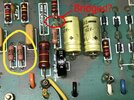
The 2 grid resistors in the yellow circle:
I'm reading their values at 220 ohms. Please double check with a meter. THEY SHOULD BE 220K OHMS (or 220,000 ohms)
syscokid
Ambassador of War & Peace
Notice the width of the braid... That's the perfect size to work with in this type of circuitry.Hi SG John, sorry I didn't see this earlier. If you can get hold of some de-soldering braid View attachment 28815
aka "solder wick" it will remove the unwanted solder quite easily & well. You need to have the iron tip clean & well thinned for it to work (otherwise the heat won't "transfer"). Simply place the braid on the unwanted solder & apply the hot, tinned iron. If there is a lot of solder to remove, place the braid a bit from its end on the solder & when the solder melts, drag the braid through it with the iron still applied.
As to the main question, yes, if you have accidentally "bridged" two connections it could cause a problem like this, depending on exactly what they are. As it is important, I would like to be fully awake to properly answer (I've not long woken up & had a big night), so will get back to you. Cheers
Here's what I use and is a brand more commonly available in the USA at electronics parts stores:
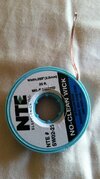
NOTICE THE SAME SIZE?
syscokid
Ambassador of War & Peace
Looking at that same pic again, it looks like you stuffed a 475K in there. It should be a 47K.Could it have been some of the solder accidentally joining the 470K and the 150K when I made sure the 470K was soldered tight.
syscokid
Ambassador of War & Peace
Actually... If your using EL34's, that bias range resistor should be a 56K instead. You might still be in an acceptable bias range with a 47K in there, but have a 56K on hand just in case.Looking at that same pic again, it looks like you stuffed a 475K in there. It should be a 47K.
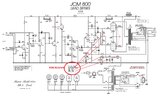
And yes: Those components are suppose to be all connected together where you have red circled with the word Bridged.
Check it out, John:
Last edited:

ivan H
Ambassador of Tubes & Grooves

It was, at least up until it all becomes kind of a blur.
I hope the party was a good time.
Good catch on the resistance values Sysco.
With the correct values installed, check for proper operation of the bias circuit without power tubes installed. Cheers
syscokid
Ambassador of War & Peace
Gotta love detailed pics...Good catch on the resistance values Sysco.

syscokid
Ambassador of War & Peace
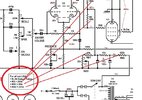
Yes sir! 56K is stock value for RB1 when using EL34's. But RB2 has to be 220K, and RG has to be 220K for everybody to get along with EL34's.In this cropped view of the EL34 schematic, it shows a 56K resister being used in RB1. Is this what I should be using instead of a 47K resistor?
OP

SG John
Ambassador of Cool Guitars and Amps.
Yes sir! 56K is stock value for RB1 when using EL34's. But RB2 has to be 220K, and RG has to be 220K for everybody to get along with EL34's.
Yes, I also bought several of the 220K resistors.


I have read through this thread, I have nothing to contribute, but I do gain some very valuable information from reading!
SG John I do hope you get this amp back to its roots, because it is one of my favorite Marshall’s!
Cheers Mitch
SG John I do hope you get this amp back to its roots, because it is one of my favorite Marshall’s!
Cheers Mitch

Some aspects are easier than others, I have full respect for those who can, If I don’t research anything about it, I will never gain any knowledge of it, so that I canI gained a firm reconfirmation of my desire to NEVER WORK ON AMPS --------EVER
at least trouble shoot some items, it will save me some dough in the long run
Cheers Mitch
OP
SG John
Ambassador of Cool Guitars and Amps.
John read the B+ voltage at the yellow wire 1 watt 10k resistor and you have a jumper wire ( 10k 1 watt 50w link )
that is your dropping string to your PI I would shoot for 300v on your PI pin 1 and 6 and 200v V-1 and V-2 pin 1 and 6
use a 2 watt resistor on that jumper remove the wire and add a 10k to start with and go up in value to drop the PI to 300v
look at the 1969 Hendrix amp at that time the dropping resistors look like a 15k and a 2k2 17.2k total
that said back then USA wall voltage was 110 VAC My Park 75 has two 15k for a total of 30k
Hi Guys,
I got everything working on the amp. V4 and V5 biased in at around 40.2 and 40.8 mA.
After I was sure it worked, I tried looking at V3.
My initial values were V3, pin 3 (yellow wire) = 34.9 VDC
I forgot to check pins 1 and 6.
V1 pin 1 = 200 VDC
V1 pin 6 = 235 VDC
V2 pin1 = 151 VDC
V2 pin 6 = 276 VDC
After adding a 10K 2 watt resistor between pins 3 and 8, I got the following values:
V3 pin 3 = 26.0 VDC
V3 Pin 1 = 185 VDC
V3 pin 6 = 286 VDC
V1 pin 1 = 203 VDC
V1 pin 6 = 235 VDC
V2 pin1 = 154.8 VDC
V2 pin 6 = 275.8 VDC
I guess the questions are:
Is the voltage to the cathodes supposed to drop that much when adding the resistor between pins three and six? In the schematic, it looked like it should have 39 VDC.
Is there supposed to be that drastic a difference between the #1 and #2 side of each 12ax7? Shouldn't I be getting a more balanced value if looking for 300 volts in V3 and200 volts in V1 and V2?
Thanks
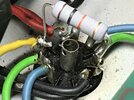
The photo is kinda crappy, but I added it to make sure I didn't install it 180 degrees off.
ivan H
Ambassador of Tubes & Grooves
Hi Guys,
I got everything working on the amp. V4 and V5 biased in at around 40.2 and 40.8 mA.
After I was sure it worked, I tried looking at V3.
My initial values were V3, pin 3 (yellow wire) = 34.9 VDC
I forgot to check pins 1 and 6.
V1 pin 1 = 200 VDC
V1 pin 6 = 235 VDC
V2 pin1 = 151 VDC
V2 pin 6 = 276 VDC
After adding a 10K 2 watt resistor between pins 3 and 8, I got the following values:
V3 pin 3 = 26.0 VDC
V3 Pin 1 = 185 VDC
V3 pin 6 = 286 VDC
V1 pin 1 = 203 VDC
V1 pin 6 = 235 VDC
V2 pin1 = 154.8 VDC
V2 pin 6 = 275.8 VDC
I guess the questions are:
Is the voltage to the cathodes supposed to drop that much when adding the resistor between pins three and six? In the schematic, it looked like it should have 39 VDC.
Is there supposed to be that drastic a difference between the #1 and #2 side of each 12ax7? Shouldn't I be getting a more balanced value if looking for 300 volts in V3 and200 volts in V1 and V2?
Thanks
The photo is kinda crappy, but I added it to make sure I didn't install it 180 degrees off.
View attachment 29046
Hi SG John. You have misunderstood 67plexi's instructions. The "wire link" that needs to be replaced with the 10k 2 watt resistor is the one on the board. It is situated on the "valve socket" side of the board between V3 & V4, closer to V4. The wire link is directly in line with a 10k 1 watt Piher resistor.
The wire link that you removed from the V3 socket (pins 3 & 8) must be replaced for proper functioning of phase inverter.
Well, smoko's over so I gotta get back to work. I'll be back to answer the questions you asked at lunchtime. Cheers
OP
SG John
Ambassador of Cool Guitars and Amps.
Hi SG John. You have misunderstood 67plexi's instructions. The "wire link" that needs to be replaced with the 10k 2 watt resistor is the one on the board. It is situated on the "valve socket" side of the board between V3 & V4, closer to V4. The wire link is directly in line with a 10k 1 watt Piher resistor.
The wire link that you removed from the V3 socket (pins 3 & 8) must be replaced for proper functioning of phase inverter.
Well, smoko's over so I gotta get back to work. I'll be back to answer the questions you asked at lunchtime. Cheers
OK, I replaced that wire on V3. Now I get the following voltages:
V3, pin 1 = 202 VDC
V3, pin 6 = 197 VDC
V3, pin 3 = 34.9 VDC
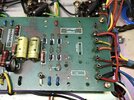
I'm still not quite sure which wire link I'm to experiment with.
Is it the red wire on the end of the PCB, with one lug next to where the PCB is printed to have a 10 something in that place? Since this is a '78, it seems things are a bit off from '77 and earlier, and '79 and up for JMPs.
syscokid
Ambassador of War & Peace
Voltages are kind of crazy here...V3 pin 3 = 26.0 VDC
V3 Pin 1 = 185 VDC
V3 pin 6 = 286 VDC

These voltages are much better...OK, I replaced that wire on V3. Now I get the following voltages:
Poll
V3, pin 1 = 202 VDC
V3, pin 6 = 197 VDC
V3, pin 3 = 34.9 VDC

I'm still not quite sure which wire link I'm to experiment with.
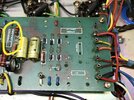
The jumper wire in the yellow circle is what 67plexi is referring to. But if those are your current voltages at V3, I wouldn't bother adding another voltage dropping resistor in place of that jumper wire. The voltages on your phase inverter tube are low enough.
Have you plugged a guitar into it yet and hear how it sounds?
Last edited: