
You are using an out of date browser. It may not display this or other websites correctly.
You should upgrade or use an alternative browser.
You should upgrade or use an alternative browser.
New Kit
- Thread starter gasket
- Start date

eSGEe
Ferengi Ambassador of Trade

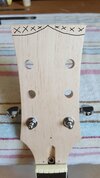
80% set on a headstock shape, any better suggestions???
Something subtle?

OP

gasket
Ambassador of the Guitarded
Something subtle?
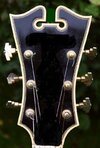
Wow thanks, but no thanks, it hasn't enough gold knobs ;-)
EDIT,
With a little work it may not be so bad.
Last edited:


ChasFred
Ambassador of Smooth Operations
Wow thanks, but no thanks, it hasn't enough gold knobs ;-)
EDIT,
With a little work it may not be so bad.
View attachment 14330
Agreed I like your version better.


syscokid
Ambassador of War & Peace
I like the X's! It adds a lot of attitude...

OP
gasket
Ambassador of the Guitarded
I like the X's! It adds a lot of attitude...
I was going to use ###'s but didn't want people to think I was swearing ;-)
OP
gasket
Ambassador of the Guitarded
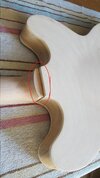
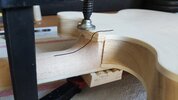
Today I milled a recess for the rear inspection cover, also sanded and timber filled the heel to body joint.
Steady steady, not a race.
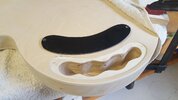
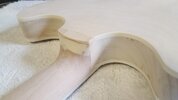
I'm planning on gloss black for the back and sides. Undecided between bright red or natural timber for the front, not sure yet. I have Tru-Oil on the way for the future project but if I go red with this one any suggestions on finish type???
I did a kit some time ago in enamel, it took a long time to fully harden but it's great now. Some look down on such, as said suggestions???
Steady steady, not a race.
I'm planning on gloss black for the back and sides. Undecided between bright red or natural timber for the front, not sure yet. I have Tru-Oil on the way for the future project but if I go red with this one any suggestions on finish type???
I did a kit some time ago in enamel, it took a long time to fully harden but it's great now. Some look down on such, as said suggestions???

RVA
Ambassador
I recently had a great experience with Tru Oil. It is easy to work with and leaves a nice finish. Check my NG Project thread for some helpful tips, or I weill get them for you when I am at a computer if you decide to go that way. If not, poly over nitro every time. Repairs are easy, it does not discolor when it comes into contact with petrolium based products (like rubber) and it doesnot check (crack) in the long term. The argument for nitro is generally that it lets the wood breath and allows a natural aging which is beneficial to resonance, which I discount completely since I do not believe in tone wood for electric guitars.
Nice work with the milling. What tools did you useto mill the back plate recess?
Nice work with the milling. What tools did you useto mill the back plate recess?
RVA
Ambassador
OP
gasket
Ambassador of the Guitarded
I recently had a great experience with Tru Oil. It is easy to work with and leaves a nice finish. Check my NG Project thread for some helpful tips, or I weill get them for you when I am at a computer if you decide to go that way. If not, poly over nitro every time. Repairs are easy, it does not discolor when it comes into contact with petrolium based products (like rubber) and it doesnot check (crack) in the long term. The argument for nitro is generally that it lets the wood breath and allows a natural aging which is beneficial to resonance, which I discount completely since I do not believe in tone wood for electric guitars.
Nice work with the milling. What tools did you useto mill the back plate recess?
I haven't got around (yet) to buying a router so milled the recess with my Dremel. On the outer edge I could use the depth gauge but as the body is convex had to freehand the inner side.
You said "poly over nitro every time". Never used or even know what those products are. Do they require mixing A and B parts and do you require high pressure spray equipment? As said I have had a good result with pressure packed enamel but always happy to lift my game if the effort to reward ratio is good.
OP
gasket
Ambassador of the Guitarded
here is the Tru Oil advice .......
Thanks, I have to go away from PC very soon and help a mate fit a set of French Doors, I'll read (study) that later today.
RVA
Ambassador
I apply poly from a spray can. U-pol # 1I haven't got around (yet) to buying a router so milled the recess with my Dremel. On the outer edge I could use the depth gauge but as the body is convex had to freehand the inner side.
You said "poly over nitro every time". Never used or even know what those products are. Do they require mixing A and B parts and do you require high pressure spray equipment? As said I have had a good result with pressure packed enamel but always happy to lift my game if the effort to reward ratio is good.
syscokid
Ambassador of War & Peace
Poly: polyurethaneYou said "poly over nitro every time". Never used or even know what those products are.
Nitro: nitrocellulose lacquer
OP
gasket
Ambassador of the Guitarded
poly over nitro every time.
I suggested I know nothing of these products.
I read this as spray "poly" then finish with "nitro".
Poly: polyurethane Nitro: nitrocellulose lacquer
Sysco's comment suggests it's "poly" or "nitro".
What I'm getting is one lays colour and then puts the shine with poly or nitro?
eSGEe
Ferengi Ambassador of Trade
RVA is stating he prefers poly as opposed to nitro. Not using them together ...that would be bad. 
Also the base color you use needs to be a chemical formula compatible to EITHER poly OR nitro depending on which you plan to use.
Don't cross the streams .......so to speak.
Also the base color you use needs to be a chemical formula compatible to EITHER poly OR nitro depending on which you plan to use.
Don't cross the streams .......so to speak.
OP
gasket
Ambassador of the Guitarded
RVA is stating he prefers poly as opposed to nitro. Not using them together ...that would be bad.
Also the base color you use needs to be a chemical formula compatible to EITHER poly OR nitro depending on which you plan to use.
Don't cross the streams .......so to speak.
That's what I got from Sysco's post then a search.
So the poly is only a clear (make it shine and look deep) finish?