Ibanez Tube Screamer TS9 Not Working

Thanks Ivan and Flat. I will have to get my head back in gear like when I was researching and learning schematics etc while Ivan and Don helped me fix mine and my buddy's Marshall amps and see if I can actually do it again but with a pedal this time.

On top of that, I am learning to be a Dr., Nurse, Physical therapist, and psychiatrist to get my 80 year old dad hopefully walking again after his back surgery he had the beginning of Nov.
 
Last edited:
There's a possibility that is cheap to fix, but is a little more deep-seated.

The momentary switch SW has no audio running through it. It triggers a flip-flop circuit. Look at the JFET bypass circuit in Ivan's post above. Transistors Q6 and Q5 and their surrounding circuitry compose the flip-flop circuit. Pressing switch SW toggles those transistors either into full conduction or cutoff. When Q6 is on, Q5 is off, and vice-versa, but audio doesn't go through Q6 or Q5, either. Transistors Q6 and Q5, in turn, control JFETs Q2 and Q4, respectively. The audio does pass through these.

JFET Q2 is for the effect branch; Q4 is the bypass branch. So, since your signal is passing through the bypass branch, it seems Q4 and the associated control work. However, it may be that Q2 is not conducting. If this is the case, Q2 is being held in a state of cutoff, or it is bad.

One thing that would be interesting to try is to set the pedal so it is on and jumper around Q2 to see if you get the effect audio.
 
There's a possibility that is cheap to fix, but is a little more deep-seated.

The momentary switch SW has no audio running through it. It triggers a flip-flop circuit. Look at the JFET bypass circuit in Ivan's post above. Transistors Q6 and Q5 and their surrounding circuitry compose the flip-flop circuit. Pressing switch SW toggles those transistors either into full conduction or cutoff. When Q6 is on, Q5 is off, and vice-versa, but audio doesn't go through Q6 or Q5, either. Transistors Q6 and Q5, in turn, control JFETs Q2 and Q4, respectively. The audio does pass through these.

JFET Q2 is for the effect branch; Q4 is the bypass branch. So, since your signal is passing through the bypass branch, it seems Q4 and the associated control work. However, it may be that Q2 is not conducting. If this is the case, Q2 is being held in a state of cutoff, or it is bad.

One thing that would be interesting to try is to set the pedal so it is on and jumper around Q2 to see if you get the effect audio.


Smitty, we can try to look at it Thursday if you don't mind. I might get an extra education I never expected.
 
You certainly have a lot on your plate at the moment Chilli. Hope your dad gets his mobility back soon. Regarding the TS signal switching, note that it is the two 2SK44SP (N channel) J gets that do the switching. There is one at the effect output (before the output buffer) & one at the effect input (after the input buffer). When either on is "ON" (conducting), the other is "OFF" (not conducting). So the effect is switched out by not letting its output conduct through to the output buffer, while the other J fet conducts the signal from the input buffer through to the output buffer. However, the signal from the input buffer is still passed on to the effect input (partial bypass). This is why I think the fault lies "somewhere" in the switching circuit. Hope this helps. Cheers

Edit: Ah, Smitty beat me to it, & maybe explained it better too. Cheers

2nd edit: I think the GEOFX article gives all the switching voltages of the J fets, which may be a big help in diagnosing the problem. Cheers
 
Last edited:
Thanks Bro Ivan.

I sure do exercise my brain when encountering problems like the amp and now pedal not working.
I guess just like with the amp as I'd stare at it's components long enough to figure out what each was and what the symbols look like that designate them on a schematic,,,,,, I get a grasp of what is going on or not once I see the logic of the design and then follow the logic in the drawings and translate your guys tech speak into terms I understand.

Thanks again.
 
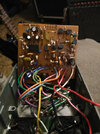
OK Fellas, I took some pics of my TS9 guts and then pulled the works out of the case.

I will try taking even more now that it is all out.

I may have seen something now that it is out. I will try to capture and display it ASAP
 
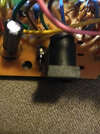
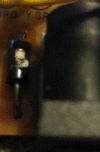
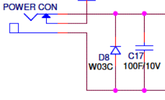
Tube Screamer Melted part.jpg Guts removed from case. Not sure, but is that little component to the left of the DC Jack, kind of weird looking like the black "case" around it, seems like it is eaten away. I am guessing the component is possibly D8 W03C as is shown in the diagram

TS9 A.jpg

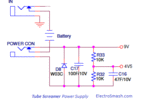
TS9 Power Schematic.GIF
 
Last edited:
I can also see where the input side Jack has a melted spot on it's black insulated holder from what appears to have been a wayward soldering iron, not that this affects the function of the pedal when switch is engaged.Tube Screamer Input Melted.jpg
 
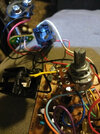
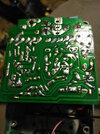
Circuit BoardTube Screamer  Circuit Solder Side1.jpg Tube Screamer Circuit Board1.jpg

While I can read the info on the board like pins 1 pin2... and the , I still have to learn what components are what they are depicted as on the schematic.

Hence when Smitty, Ivan, Flat etc mention the Jfet circuit, or Q1 Q2 ,3, 4... and even the switches as depicted in the schematic,,,,,,,,,,,,,I still have to ask which little "bits" are what and where they are on the board etc.
 
Last edited:
There's a possibility that is cheap to fix, but is a little more deep-seated.

The momentary switch SW has no audio running through it. It triggers a flip-flop circuit. Look at the JFET bypass circuit in Ivan's post above. Transistors Q6 and Q5 and their surrounding circuitry compose the flip-flop circuit. Pressing switch SW toggles those transistors either into full conduction or cutoff. When Q6 is on, Q5 is off, and vice-versa, but audio doesn't go through Q6 or Q5, either. Transistors Q6 and Q5, in turn, control JFETs Q2 and Q4, respectively. The audio does pass through these.

JFET Q2 is for the effect branch; Q4 is the bypass branch. So, since your signal is passing through the bypass branch, it seems Q4 and the associated control work. However, it may be that Q2 is not conducting. If this is the case, Q2 is being held in a state of cutoff, or it is bad.

One thing that would be interesting to try is to set the pedal so it is on and jumper around Q2 to see if you get the effect audio.

So, Smitty I need to go to college to understand this, but it should be a matter of time till I actually understand where these Q's are and the Jfet, etc circuits are on this board.

As a side note, back to my possible issue I think I see as a problem I did a little jumper wire test across the 2 solder joints on that part next to the DC Jack. The pedal was plugged in to guitar and amp, the battery in, with the pedal switch off ( guitar makes noise in amp) Then I put jumper wire across and the sound goes out, just like I hit the switch. Then I would disconnect the jumper wire and hit the switch to make the sound go off. I repeated this a number of times and it seems to simulate switch operation. In other words, I have switch OFF and get sound in amp, I jumper across the contacts and get the loss of sound much like I hit the switch. As a side note, I went to disconnect everything and found the battery had gotten hot.
This is the first time the battery has done so ( first time I have done this jumpering)
Also, I let the battery cool down and then took voltages again but didn't jumper the contacts on that component. The battery did not heat up this time.


The component in question has a number 0736 on it and I believe I found the missing black piece that covered that opening on the back as well.

Tube Screamer Melted 2.GIF


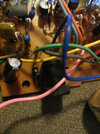
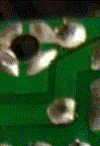
Tube Screamer Melted Solder side.GIF

The 2 ends of the soldered connections are where I jumpered across.
 
Last edited:
Here are the IC & Q1 (input buffer) & Q2 (output buffer) voltages;
IC
Pin 1; 4.5V
Pin 2; 4.5V
Pin 3; 4.5V
Pin 4; 0V
Pin 5; 4.5V
Pin 6; 4.5V
Pin 7; 4.5V
Pin 8; 9V

Q1
Collector; 9V
Base; 3V
Emitter; 2.5V

Q2
Collector; 9V
Base; 3V
Emitter; 2.5V

These may vary a little but should be close on all. I don't have the switching circuit voltages at hand & my TS(9) clone uses true bypass switching so I cant take these voltages off it. But, the entire circuit is powered up "all of the time", only the audio input & output is switched. On Chilli's, even without an audio signal presented to the circuit the DC voltages are pulled down when the effect is switched in. I would think the fault would most likely be in the switching circuit, though I may be wrong. Cheers

OK Ivan, I am getting this.

Pin1 0
2 2.185
3 8.0
4 6.72
5 8.92
6 8.92
7 8.82
8 8.88

9 8.88
10 8.88
11 0
12 9.54
13 6.78
 
that broken piece in post #27 next to the 9v DC input looks like a failed diode.
Maybe someone tried to use the wrong power adapter with it.

I did that with a pedal and a -9v dc non regulated supply from a cordless house telephone or something.
I lost some factory smoke but it survived, might have been my TS-5.
 
HAHA JT, Believe it or not, I considered that I might have done what you said. My one DC PS is fine as it is for my Danelectro Dan Echo pedal and reads 9.6 v and 200 mA, I may have plugged in one that says 9v and 1000 mA. Could the 1000mA been bad for the diode? Or like he said, someone else might have plugged a bad one in before I bought the pedal.

Now according to what JT said and my analysis of the schematic, I think need one of these and of course will buy extras in case something makes the replacement go caplooey.

1 Diode W03C/1N4001 (D8) As Per ElectroSmash's parts list for True Bypass parts needed
 
Last edited:
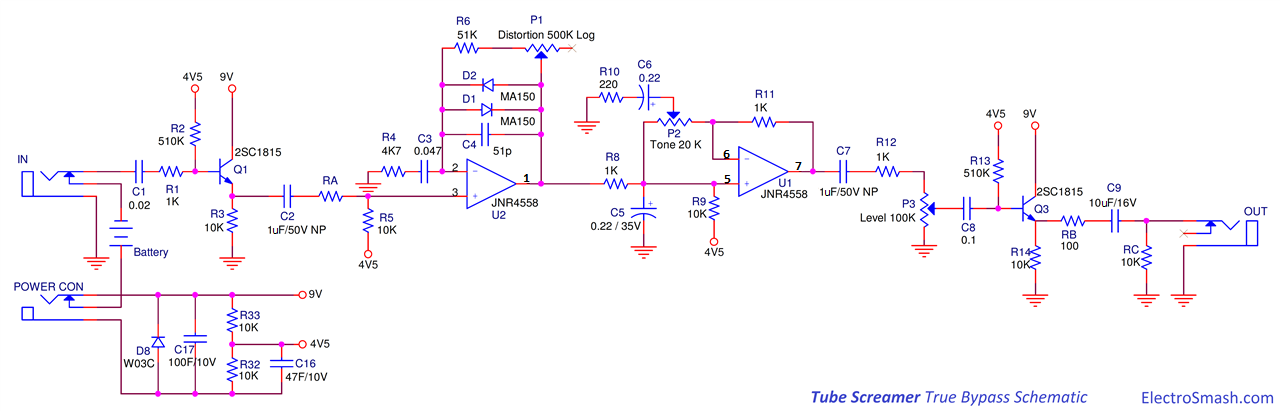
The Tube Screamer schematic can be drastically simplified using the 3PDT switch alternative. In terms of mass production true bypass switches themselves are expensive and labor-intensive, as the wiring has to be done by hand It is not cost efficient to do this in an assembly line. This is why Ibanez avoids the true bypass for the benefit of the complex toggle bypass.
tube-screamer-true-bypass-schematic.png


Tube Screamer True Bypass Part List / Bill of Materials:

2 Diode MA150/1N4148/1N914 (D1, D2)
1 Diode W03C/1N4001 (D8)
2 Transistors 2SC1815/2N5089/MPSA18 (Q1, Q3)
1 IC JRC4558/RC4559/RC4558

1 Capacitor 100uF 10V (C17)
1 Capacitor 47uF 10V (C16)
1 Capacitor 10uF 16V (C9)
2 Capacitors 1uF NP/50V (C2, C7)
2 Capacitors 0.22uF (C5, C6)
1 Capacitor 0.1uF (C8)
1 Capacitor 0.047uF (C3)
1 Capacitor 0.02uF (C1)
1 Capacitor 51pF (C4)

2 Resistors 510K (R2, R13)
1 Resistor 51K (R6)
7 Resistors 10K (R3, R5, R9, R14, RC, R32, R33)
1 Resistor 4K7 (R4)
4 Resistors 1K (R1, R8, R11, R12)
1 Resistor 220 (R10)
1 Resistor 100 (RB)

1 Potentiometer 500K/470K Log (P1)
1 Potentiometer 20K/22K Lin (P2)
1 Potentiometer 100K Lin (P3)

1 Jack 6mm Chassis Stereo
1 Jack 6mm Chassis Mono
1 Jack chassis power supply
1 footswitch 3PDT
1 9V battery clip

Note: RA 0Ω
RB 100
RC 10K


1.2 Power Supply.
 
1.2 Power Supply.
The Power Supply Stage provides the electrical power and bias voltage to all the circuit:
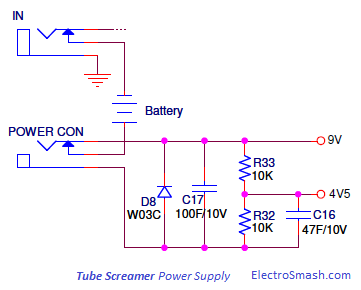
tube-screamer-power-supply.png


The 9V supply is common to all circuit components, with a simple resistor divider (R32, R33) 4.5 voltage is generated to be used as a bias voltage in some stages.

The main supply (+9V) and the resistors junction (+4.5V) are decoupled to ground with a large value electrolytic capacitors C16 (47uF) and C17 (100uF) to remove all ripple from supply voltage. The diode D8 protects the pedal against reverse polarity connections.
The stereo in jack is used as on-off switch, switching the battery (-) terminal to ground when the guitar jack is connected.
 
I hope it's as simple as replacing that funky looking diode. With my extremely limited knowledge of electrical circuits, I too would start with that diode. You should be able to check that diode and with a DVM for proper operation while it's still in the circuit. Hell... just replace it anyways.

Radio Shack probably would not have carried the proper diode anyways.

And to Smitty and Ivan....
You MoFo's make my head hurt... :BH:
 
I believe it is a little older model, not sure exact manufacture date though.
I looked at a few places and it is likely a resissue,,,, it definitely doesn't have that 4558D jrc chip

Its not a TS808
 
Last edited:
Back
Top