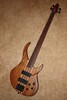
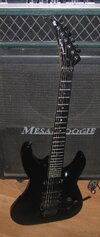
The Seagull shape was uncomfortable for some to play due to the sharp upper point and the sharp lower point that dug into the leg sitting down. It was redesigned several times including a smoother lower point, a Junior version with simpler electronics and a pointless version which is quite rare. Finally it morphed into the Eagle shape with no sharp points.
[2]
Serial numbers began as a stamped 6 digit number starting with the year and ending with the number of production (500037 would be the 37th guitar built in 1975).
[3] Most references to BCR serialization miss this point. Beginning in 1976, the numbers started with the year then the number of production (YYXXX). Since more than 1000 guitars were produced many years, the numbers became increasingly inaccurate through the 1980s, ending up about 4 years behind (i.e. a 88xxx serial number guitar would have been built in 1984).
[4] After the company was purchased by Class Axe in 1989 production of the hand-made, neck-through models was halted for several years, although GMW (Neal Moser) supplied some stock made from rejected then repaired bodies handbuilt through the years. After Class Axe took over there were a number of different serial schemes designated for the American, Asian and Bolt-on guitars.
Eagle
This model was made popular by
Brad Whitford of
Aerosmith and Neil Giraldo (guitarist and also husband of
Pat Benatar) also played his Eagle on some of her early albums and videos.
Mockingbird
The
B.C. Rich Mockingbird was designed by Johnny "Go-Go" Kessel. It was made popular by
Joe Perry of Aerosmith. The Mockingbird model experienced a resurgence in the early 1990s through
Guns N' Roses lead guitarist
Slash after he played one on the
Use Your Illusion world tour.
The Bich
The most popular of the BC Rich line is the BC Rich "Bich" 10 string model. The Bich 10 string guitar was the brain-child of Neal Moser. During the late 1960s, Moser worked with musicians including
Jimi Hendrix, and
Stephen Stills of Crosby, Stills and Nash. Neal worked as a sub-contractor for Bernie Rico (BC Rich) from 1974 to 1985. During his time with BC Rich, he conceived, designed, and built the first Bich 10 string prototype guitar. The Bich guitar was never owned by Bernie Rico/BC Rich. The design was licensed to BC Rich under contract with Neal Moser. A lawsuit filed by Neal Moser against Hanser Holdings Int'l/BC Rich resulted in Moser Custom Guitars and HHI/BC Rich both having the right to produce their own version of the Rich Bich style guitar. Neal Moser retains ownership of the original body templates. The Moser Custom Shop "Moser 10" and the BC Rich Bich "PMS" models are the closest representations of the original pre-1985 BC Rich Rich Bich body design. The "Moser 10" models have an "M" inlay on the
headstock, compared to the HHI/BC Rich "R" headstock inlay. The "Bich" can also be categorized as a guitar that "brings out" Heavy Metal and such genres.
BC Rich Bich "PMS" 10 String Prototype
To celebrate the 25th anniversary release of the
Rich Bich 10 string guitar, HHI/BC Rich contracted the original BC Rich luthiers Neal Moser and Sal Gonzales to produce 25 true hand-built reproductions of the original prototype to the Bich 10 string model. These hand-carved wonders were built off of Neal Moser's original 1978 body templates, using the same exotic woods (black African walnut, maple and Brazilian rosewood) as the original prototype model. Due to contract issues between Neal Moser and Hanser Holdings Int'l, only 16 of the PMS models were produced. These have become highly prized by BC Rich collectors due to the limited production number. These limited edition models are considered to represent the last of the true BC Rich guitars. The original prototype is currently owned by Dan Lawrence.
Warlock
The introduction of the
B.C. Rich Warlock model in the early 1980s helped push B.C. Rich into the
heavy metal music genre. Notable early players included
Mick Mars and
Nikki Sixx of
Mötley Crüe,
Lita Ford,
Paul Stanley of
KISS (featuring a broken mirror top),
Craig Goldy of
Dio and
Giuffria, and a young pre-
Les Paul playing
Slash. Its popularity continues with players such as
Slayer guitarist
Kerry King.The variation on this one, The B.C. Rich Revenge Warlock, Has a Maple neck, rosewood fretboard, and a mahogany body, with chrome hardware. Also, it has the authentic widow headstock.
Ironbird
Designed by Joey Rico in 1983, the Ironbird gained some popularity amongst heavy metal guitarists, including
Trey Azagthoth of
Morbid Angel. The original model had a pointed reverse headstock, whereas the 21st Century version has a regular pointed headstock.
Acrylic Series
These guitars are made completely of
acrylic and their bodies are transparent, making the electronics inside viewable. The original run of the acrylic models featured a standard bolt-on maple neck with wood headstock, but later models featured an acrylic headstock, matching the same color as the body and making the overall appearance of the guitar more attractive.
Acrylic is more
dense than most woods ( specific gravity of acrylic is 1.18 g/cm3 while that of
lignum vitae, probably the heaviest of woods,is approximately 1.23g/cm3
[5]) which makes the guitar heavier. In 2006 B.C. Rich introduced the IT (Invisibolt Technology) series. In this series the neck is bolted inside the body to look like a
neck-through, but neck joint is still visible. This combines the elements of both bolt-on and neck-through designs.
Like
Rickenbacker and
Jackson, B.C. Rich used a
neck-through body design in many of their instruments. BC Rich also pioneered the heel-less joint. In addition, they used custom battery-powered
active electronics — pickups and tone controls inside the guitar. These electronics were originally thought out and designed by
Neal Moser[
citation needed]Neal Moser helped with bone crafted parts and many set ups in the custom shop. He added the feet on winged guitars like the Rich Bich, which was one of his designs. Their guitars come in a variety of shapes, ranging from styles which are similar to electric guitar types (e.g., the
Telecaster-styled Blaster) to unusual styles such as the Fat Bob, which has a body in the shape of a
Harley-Davidson gas tank.