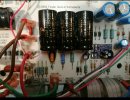
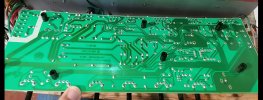
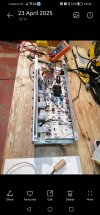
OP

STRefugee
Well-Known Member

Were following along.
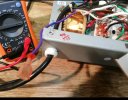
My makeshift workbench where I have been spending most of my days over a week now...
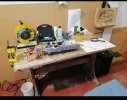
This thing's overyaking my life!

Were following along.


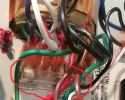
OK now looking at the back of the switch: switch onYes, there's power.
measured between those 2 top terminals with the 2 black wires attached.
View attachment 106112
You can talk about the smoke and flames, for years to come.Were following along.


OK now looking at the back of the switch: switch on
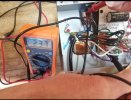
Keep one probe on the top left terminal,
Use the other probe to test both sides of the fuse.
Is there voltage on both sides of that fuse?
View attachment 106114
You can talk about the smoke and flames, for years to come.
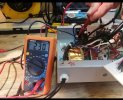
hold on I'm wrong it's wired 240V
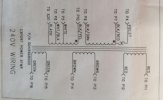
That was part of the problem. They sell those BJr here set for the EU with the 230V setting. But in the UK it needs to be the 240V set-up. That is swapping the WHT/BLK stripe from the switch with the BLK no stripe to P6. As per the attached screenshot.Looks like the power transformer wires are mixed up.
Don't power it up yet.
230V wiring
P4 Violet
P5 white no stripe
P6 Black no stripe
P7 Black red stripe
P8 No connection
P9 Black green stripe
P10 Black yellow stripe
White black stripe to switch
You see how each wire is a blade / socket connection?
Make sure each blade is centered into each socket. Sometimes the blade can miss the socket when it's plugged in.
Let me think about that for a minute...That was part of the problem. They sell those BJr here set for the EU with the 230V setting. But in the UK it needs to be the 240V set-up. That is swapping the WHT/BLK stripe from the switch with the BLK no stripe to P6. As per the attached screenshot.
View attachment 106118
I tried both 230V & 240V set-ups and get to the same dead end.
But what I have not tried yet is to plug the BLK/RED to P4 as it were before I made any changes, with the Violet left dangling, and both P8 and P7 unconnected.
And that is the mistery. Why on earth was it set-up and running that way?..
From the schematic, can we understand the intended wiring and identify the function of each wire?
Is it possible to perform some testings on the tranformer to confirm it is delivering as expected?
I will test each lug in turn for AC voltage starting with P4. I would expect it to show around 230v to 240v as well since looking at the tracing on the pcb it seems to be the first port of call after the fuse. But here I'm guessiing of course.Let me think about that for a minute...
Interesting
We measured voltage and it seemed roughly correct.
Go ahead and wire it back to what it was when you started.
I think what happened is that some primary tap in the transformer are actually bad.
Yes, I think we nailed it. We now know what the cause for that unconventional wiring is.I think what happened is that some primary tap in the transformer are actually bad.
Somebody rewired the primary to bypass the bad tap.
We checked the voltage and it was working before you started.
The amp will work, but you can get a new power transformer and swap it out in the future..
I think it will still go even though the transformer is apparently not 100% good.
I don't know how much the transformer is in England, but here it's not expensive. It's $51 here.
I don't see any reason why the amp will still not work.Yes, I think we nailed it. We now know what the cause for that unconventional wiring is.
The Violet wire must be the primary thermal circuit breaker. ( For the audience : this is a circuit board protection. When an over current occurs, heat is generated as the current flows through the reed causing the reed to deflect and snap open.)
And here, the design does not allow for a reset contrary to your typical domestic circuit breaker.
So that is why that wire was left dangling to bypass the thermal circuit breaker.
Had I started from there, would I still have cracked over £100 in caps, resistors, etc...?
When back home, I might tinker some more and update.
Cheers!
I don't see any reason why the amp will still not work.
It should work, we saw the voltages working before you started replacing parts.
I did not know there was a thermal breaker in your amp.
I don't think I ever saw a BJ with a thermal breaker.
But thermal breaker resets itself when the temperature cools down.
When I modify amplifiers:
I do install a thermal breaker, which is a safety regulation, which I follow.
But that is a requirement for custom modified appliances, not all production amplifiers.
Some amplifiers like Peavey: you will see thermal breakers installed by the factory.
There may be a thermal breaker required in some countries.I 'm likely wrong then. Saw a replacement product by a (Tube Amp doctors) including in the description:
Connection with Board labeled 2001, 2002, 2003, 2010 (Blues Junior III)
Primary:
Purple wire (Thermo) to P4 (formerly Vio) etc..
But that may be an upgrade on the original then, based on what you are saying. The price tag is to cry too at around £140.
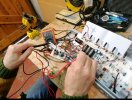
You did a great job.And here a pic of my soldering work just because...
View attachment 106126
Check and adjust the bias voltage on the grid pin 2 of the output tube EL84 socket.Yes, can take the voltages now.
Tell me where to start please.