Fender BJr repair

Turn the meter to ohms 200.
Touch the red and black probes together.
Should read zero or close to it.
Does it still read OL?
OL means open load, the ohms isn't working maybe.
Hi @Amp Mad Scientist ,
Meter set to ohms 200 and red and black probes touching gives a reading that settles on 00.3
I then repeated the ohms test on pin3 of the two power tube sockets .
Placed the red probe on the soldering blob instead of the pin hole and the reading kept fluctuating, never settling down on a value.
Placed the red probe in the hole of pin3 the reading fluctuates for some time and eventually seems to settle on a value of around 00.5 or 00.7
No idea why I could not get any reading this morning
 
Last edited:
Hi @Amp Mad Scientist ,
Meter set to ohms 200 and red and black probes touching gives a reading that settles on 00.3
I then repeated the ohms test on pin3 of the two power tube sockets .
Placed the red probe on the soldering blob instead of the pin hole and the reading kept fluctuating, never settling down on a value.
Placed the red probe in the hole of pin3 the reading fluctuates for some time and eventually seems to settle on a value of around 00.5 or 00.7
No idea why I could not get any reading this morning
try cleaning the solder where you are touching the probe with the eraser.
find a clean place on the chassis for the black probe or clean a spot with the eraser.
try digging the points down into the solder or into the metal on the chassis with a bit of hand pressure..
The point is pushing through the oxide into the bare metal to make a better contact.
should get a steady reading instead of wandering.

Or there could be something actually goofy with the ground connection.
 
try cleaning the solder where you are touching the probe with the eraser.
find a clean place on the chassis for the black probe or clean a spot with the eraser.
try digging the points down into the solder or into the metal on the chassis with a bit of hand pressure..
The point is pushing through the oxide into the bare metal to make a better contact.
should get a steady reading instead of wandering.

Or there could be something actually goofy with the ground connection.
Ok, done that now and yes!
You were right. After rubbing with the eraser I get a reading of 00.9 on both sockets.
Thank you!
 
Don't order yet Mouser UK

1X Mouser Part No
594-2222-118-36101
100uF 25V 4,000 hr 2.54 2.54

1X Mouser Part No
594-MAL211838109E3 2.32 2.32
470uF 50V 4,000 hr

2X Mouser Part No
594-2222-118-36221
220uF 25V 4,000hr 2.88 5.76

2X Mouser Part No
594-5083NW2K200JA100 .308 .616
2.2K 2W Metal Film (1 spare)
Power supply

1 X Mouser Part No
5878-80-3-5 5.05 5.05
5ft 2mm Rosin Flux solder wick

1X Mouser Part No
71-RL20S-G-33K/R
33K 1/2W .54 .54
bias Resistor metal film

1X contact lubricant
Spray aerosol w/ wand
TBD
Hi @Amp Mad Scientist
The part numbers seem to be different for UK.

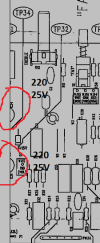
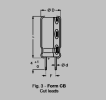
For the 100uF 25V 4,000 hr should the leads be at the base like in that pic, Screenshot_20250316_162201.jpg
or on both end?
Where is this one going?
Thank you
 
Hi @Amp Mad Scientist
The part numbers seem to be different for UK.

For the 100uF 25V 4,000 hr should the leads be at the base like in that pic, View attachment 105448
or on both end?
Where is this one going?
Thank you
You're right I picked out axial caps and the board needs radial caps.
Measure the lead spacing on the board, measure the diameter.
Make sure you are buying the parts that fit the lead space of the board.
Buy Vishay but don't buy Illinois capacitors.
 
You're right I picked out axial caps and the board needs radial caps.
Measure the lead spacing on the board, measure the diameter.
Make sure you are buying the parts that fit the lead space of the board.
Buy Vishay but don't buy Illinois capacitors.
Hi @Amp Mad Scientist ,
This capacitor you included in the list:
100uF 25V 4,000 hr
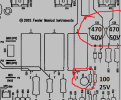
Can you please tell me where it s on the circuit board? Is it C33?
I measured the diameter is around 6.5mm and length of cylinder about 12mm. the closest match I could select on Mouser seems to be this one.
1742236925138.png

Will that work?
Thank you
 
Last edited:
Hi @Amp Mad Scientist ,
This capacitor you included in the list:
100uF 25V 4,000 hr
Can you please tell me where it s on the circuit board? Is it C33?
I measured the diameter is around 6.5mm and length of cylinder about 12mm. the closest match I could select on Mouser seems to be this one.
View attachment 105470

Will that work?
Thank you
Take the capacitor off the board.
Measure the lead spacing on the bottom of the capacitor.

Measure the lead spacing for the holes of the circuit board.
Do this for the 5 capacitors.
Then check the lead space on the mouser website.
Screenshot 2025-03-17 at 14-18-48 142rhs.pdf.png

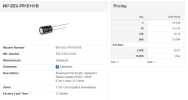
Lead Spacing is dimension "F." this matches the holes on the board.
The diameter can be any that doesn't interfere with parts on the board.
The length can be any that fits inside the chassis.
 
Last edited:
Take the capacitor off the board.
Measure the lead spacing on the bottom of the capacitor.

Measure the lead spacing for the holes of the circuit board.
Do this for the 5 capacitors.
Then check the lead space on the mouser website.
View attachment 105475

Lead Spacing is dimension "F." this matches the holes on the board.
The diameter can be any that doesn't interfere with parts on the board.
The length can be any that fits inside the chassis.
Thank you for clarifying.

How do you check which lead is + and which is -? Are they clearly indicated on the new caps, where do you look for?

Some are flagged DC and some sre flagged VDC. They are both the same aren't they? Direct Current or Volt Direct Current.

I notice the estimated life time such as 5000 hrs for instance, roughly 1/2 a year. That's not long! But they do last longer don't they?

When replacing the toasted R47 (with 2.2K 2W), pls tell me I don't need to worry which end is + and which is -

**And would you know why I don'have any emojis here?

Thank you!
 
Last edited:
Thank you for clarifying.

How do you check which lead is + and which is -? Are they clearly indicated on the new caps, where do you look for?

Some are flagged DC and some sre flagged VDC. They are both the same aren't they? Direct Current or Volt Direct Current.

I notice the estimated life time such as 5000 hrs for instance, roughly 1/2 a year. That's not long! But they do last longer don't they?

When replacing the toasted R47 (with 2.2K 2W), pls tell me I don't need to worry which end is + and which is -

**And would you know why I don'have any emojis here?

Thank you!
There's some stuff I need to explain.

1. The + is marked on the board, and on the schematic.
The cap old or new has (-) marked on it. Yes they are clearly marked, so you won't mix it up.

2. DC and VDC are the same thing.

3. 4000 hours cap: is 4000 hours when used at the full rated temperature (85C), when used at a lower temperature, the life span increases.
That's 4000 hours of "powered on at 85C temperature." The hours don't count when it's powered off.
The voltage 50 volts: when used at a lower voltage, the life span increases.
All considered: In the average guitar amp, the life will probably be 10 years or possibly longer..
The original caps that came with this amp were 2000 hour. The replacements are rated 2X longer life than the originals.
The F&T caps are rated 5000 hour at 85C.

Sometimes we do order 10,000 hour caps. Only when these are available. And they cost more.
Sometimes we do order 105C temperature caps. Same deal, they cost a lot more.
We put these type caps in amps, where cost is no object. For full time professionals who use the amp 8 hours or more every day........and the caps are supposed to last almost forever.

And so: you can order 10,000 hour if you want, you can order 105C if you want. But it will cost more.
And you will find: that high rated caps are not always available. It takes some searching.
You may wind up ordering from multiple sources, and pay multiple shipping charges.
You can go, where cost is no object....if you are so inclined.
millionaires, movie stars, international Rock Stars, who don't care right here in TTR forum. They play Dumble amplifiers in the garage.

4. Resistors have no polarity. Doesn't matter which way you install them.

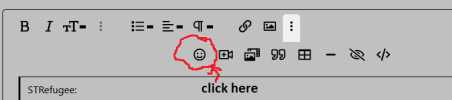
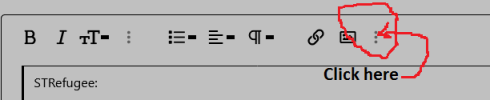
5. Emojis: Look at the top of the space that you are typing in right now.
See the three dots? ("more options") click on the 3 dots.
Now click on the smile face.
more options.png

emojis.png
 
Last edited:
@Amp Mad Scientist
Awesome!!
Thank you so much for taking the time to write back to me, explaining all this stuff. Fascinating stuff! (at least to me).
4000hrs will suffice me and most likely outlive me. :) ah! finally found the emojis too! Thank you!! :thanx:
Awesome collection!

I had never looked at capacitors etc... in that way before, and now, thanks to you! I discover a whole new world I had no idea about.
I wish I had gone into this field of studies and had built amazing amps and stuff now!..
How did it happen to you?! How did you get into it and at what point in time did you decide "this is my thing!"?
So many questions...
Playing 100K usd amps sounds criminal me but hey!? There's worse happning out there I guess..
Thank you so much!
 
@Amp Mad Scientist
Awesome!!
Thank you so much for taking the time to write back to me, explaining all this stuff. Fascinating stuff! (at least to me).
4000hrs will suffice me and most likely outlive me. :) ah! finally found the emojis too! Thank you!! :thanx:
Awesome collection!

I had never looked at capacitors etc... in that way before, and now, thanks to you! I discover a whole new world I had no idea about.
I wish I had gone into this field of studies and had built amazing amps and stuff now!..
How did it happen to you?! How did you get into it and at what point in time did you decide "this is my thing!"?
So many questions...
Playing 100K usd amps sounds criminal me but hey!? There's worse happning out there I guess..
Thank you so much!
I started working on amps when I was in high school.
Because we took our amps to repair shops, and nobody ever fixed them the right way.
Now I want to abandon my current life, and go on the road / world tour / mix sound with Gypsy Kings.
 
Last edited:
Brill!!
Love some Gypsi Kings now and then. Love "Moorea" and a few more like that.
Going on the road with those guys must be Phenomenal!!
 
Because we took our amps to repair shops, and nobody ever fixed them the right way.
Some things never change it seems..
That's what brought me here. To get a good repair job done, I'd have to take my broken amp on travel. Otherwise, only cowboys round here pretending to know more than I do.
But it's great! It's not a high spec piece of kit so perfect for me to give it a go.
And I enjoy the experience so far thanks to you!
 
Back
Top