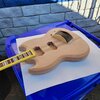
My Neck-Through-Body SG Finish Thread:

Inspector #20

Ambassador of Tone
Fallen Star
Country flag
I wanna keep this simple and use common refinishing supplies as opposed to trick Stewie-Mac stuff.

Im considering using Red Mahogany Varathane oil based wood stain with Zinnser Amber Shellac over the top.

Thoughts???
 
Is the shellac for warming up the colors and as a sealer? How would you apply the shellac?

Yes, the amber shellac looks really warm. According to my research, it will work over an oil stain.

I would imagine the shellac could be apied over the oil stain once dry???
 
This one doesn't have my typical "monster" neck.

Frets are .112 x.055" which is an oddball Fender fretwire...from work...an old roll they threw away. Fished out of the dumpster with supervisor's blessing.

The neck is 1.650" wide at the nut.

The neck is 1.785" thick at the first fret with a flatter "Jackson style" profile i discovered on an old USA Jackson i worked on for a musical friend at Fender.

20220801_103404.jpg
 
Last edited:
How far are you planning on going on the grit?

I've had poor results when going much past 400.
I tend to stop around #400 grit.

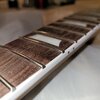
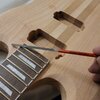
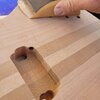
In general, I tend to use #180 to #220 for leveling with a block. This keeps all the hand-carved bevels sharp. On this guitar, there were sections where the multi-ply laminate neck planks were lower than the body, so I had to actually reduce the thickness of the body to bring everything level.

Today, I have set some time aside to start smoothing everything out with #320 and then #400 in preparation for the penetrating oil stain.

I have helped my Dad with gunstock and some furniture refinishing, so I am going to use some of those old methodologies on this project.

I don't like applying any kind of water-based product to wood. This will be penetrating oil stain, followed by amber shellac, hand-sanded between coats and top coated with nitrocellulose, 'vintage amber' lacquer

The stain will be applied, allowed to penetrate and then be wiped away with a cloth. This will be repeated until the desired color is achieved. Coats will be sanded lightly for smoothness in between applications.

Amber shellac will then be applied, most likely with a brush, and then allowed to dry. The shellac will be sanded smooth with #400 and then re-coated to achieve depth.

The final topcoat will be amber-tinted NC lacquer.
 
I see you’re going for the chisel-tip horns. That’ll give it a cool, ’70s aesthetic.

I really wanted it to look mean....

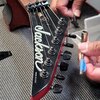
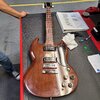
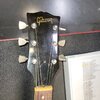
When we did the headstock repair on this one, we took some measurements and drawings, upon which we basedthe scratch build on....

20220601_103623.jpg

20220601_103556.jpg

We also made the body thicker, in an effort to add more weight to the body, even though i hand-selected all the wood for the lightest planks we could find.
 
Last edited:
I really wanted it to look mean....

When we did the headstock repair on this one, we took some measurements and drawings, upon which we basedthe scratch build on....

View attachment 86959

View attachment 86960

We also made the body thicker, in an effort to add more weight to the body, even though i hand-selected all the wood for the lightest planks we could find.

Kewl.

It even has the harmonica bridge and mini-humbuckers.
 
Last edited:
I’ve contemplated an SG build, as well.

I really like your multi-ply, neck-thru design with the tongue-in-groove construction. That is a really good concept.

But, if I did one, I’d make a few changes to the typical Gibson design. I’d move the output jack to the side and make some changes to the control layout. I may even build it as an HSS guitar. I may also move the pickup switch to the upper bout, similar to how I did to my Jackson.

Maybe I should get an SG husk and make some mods?

Or…maybe I should just keep practicing!
 
Back
Top